
Johnson vs Burns in 1908 Was the Boxing Day Fight in Sydney That Made the First Black Heavyweight Champion
On 26 December 1908 at Rushcutters Bay, Jack Johnson outclassed Tommy Burns until police stopped the fight in the 14th round. Johnson became the first Black world heavyweight champion, and Jack London's call for Jeffries started the 'Great White Hope' era.

On the morning of 26 December 1908, in a fresh-built open-air arena at Rushcutters Bay in Sydney, Jack Johnson spent thirteen rounds and part of a fourteenth taking Tommy Burns apart until police climbed into the ring. Johnson left as the first Black heavyweight champion of the world. The reaction, led in print by the novelist Jack London, began the search for a "Great White Hope" and shaped heavyweight boxing for the next seven years.
A Champion Who Took the Title Abroad
Tommy Burns was born Noah Brusso on 17 June 1881 in Normanby Township, near Hanover, Ontario, the child of a poor German-Canadian family. He had his first professional fights in Detroit in 1902, boxing as a welterweight. At roughly 5 feet 7 inches he remains the shortest man ever to hold the heavyweight championship. He won it on 23 February 1906 in Los Angeles, outpointing Marvin Hart over twenty rounds after going in as a 2-to-1 underdog.
No heavyweight champion before him had defended the title outside North America. Burns did it in England, Ireland and France, and then in Australia, and he made a long run of defences, eleven or thirteen depending on whether exhibitions are counted. What he did not do was fight the best-qualified challenger. He kept matching himself with white opponents while Jack Johnson, born in Galveston, Texas, on 31 March 1878, followed him from country to country.
Two Years on the Champion's Trail
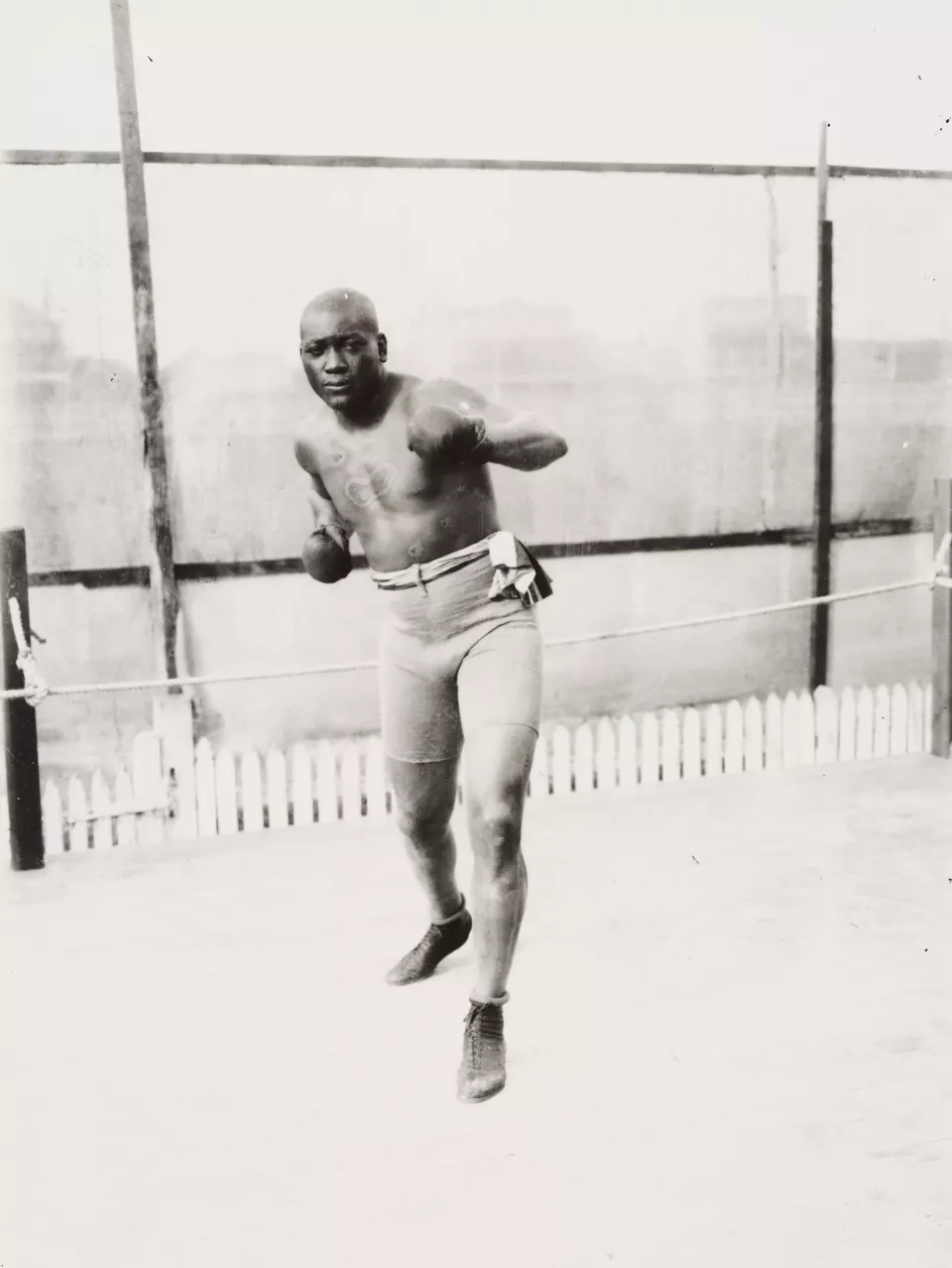
Johnson's pursuit of Burns lasted about two years, according to his Wikipedia biography. He used the newspapers to goad the champion and, as Andscape has recounted, bought ringside seats at Burns's fights so he could heckle him from close range. Burns finally gave in when money large enough to override his reluctance came from Australia.
That money came from Hugh D. McIntosh, a Sydney entrepreneur. In 1908 McIntosh had put up a temporary open-air stadium on a former Chinese market garden at Rushcutters Bay, and on 24 August Burns defended his title there against Bill Squires. For a fight with Johnson, Burns asked for a guarantee of $30,000, a figure given in his Wikipedia biography and in the Andscape and EBSCO accounts. McIntosh agreed to it. Johnson's share was $5,000. The contest was set for twenty rounds on Boxing Day, with McIntosh himself acting as referee.
Boxing Day Morning at Rushcutters Bay
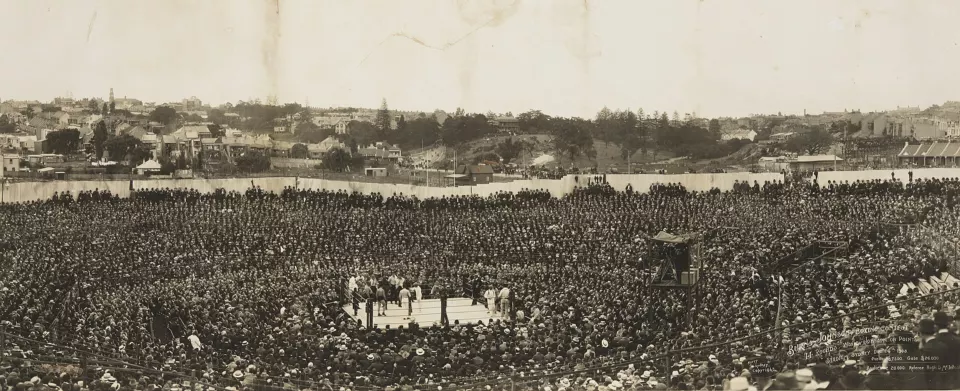
The fight was billed for eleven in the morning, and EBSCO's account puts the opening bell at 11:07 a.m. Accounts of the crowd differ. Wikipedia and the film notes from Australian Screen both give about 20,000 inside the stadium, and EBSCO adds that tens of thousands more waited outside. Andscape gives a figure of around 50,000.
The atmosphere was hostile to the challenger. EBSCO notes that the Australian press coverage before the fight was full of racial slurs against Johnson, and that he stayed calm through the abuse that met him on his way to the ring. The size difference was plain to see. Wikipedia gives Johnson's weight as 192 pounds and has Burns 24 pounds lighter, and Andscape adds that Burns stood about seven inches shorter.
Fourteen Rounds of One-Way Traffic
Burns went straight at Johnson at the opening bell and was knocked down almost at once. EBSCO describes Johnson's right uppercut, his signature punch, putting the champion down for a count of eight in the first round. By the second round Burns's right eye was swelling and his mouth was bleeding.
From there Johnson took his time. Andscape describes him turning his back on Burns in the second, third and fourth rounds to play to the crowd, and inviting the champion to hit him as hard as he could, then barely reacting when he did. The surviving film shows the same manner. Australian Screen's curators note that Johnson was theatrical on camera and often flashed a smile or struck a pose for the spectators. Burns kept coming forward and kept getting hit. Johnson appeared to be in no hurry to end it.
Police in the Ring
The finish came in the fourteenth round with Burns, in the words of the Wikipedia account, practically out on his feet. The sources tell the ending slightly differently. Wikipedia says police jumped through the ropes and stopped the fight in the fourteenth. EBSCO says officers had already come into the ring in the thirteenth, Burns protested against being stopped, and the bout was waved off in the next round because he could no longer defend himself. Burns's Wikipedia biography adds a motive: the police wanted to spare the crowd the sight of a white champion being knocked out by a Black challenger. McIntosh gave the decision and the championship to Johnson.
The bout was filmed. Australian Screen credits the pioneer director Raymond Longford with the documentary The Burns-Johnson Fight, shot by cinematographer Ernest Higgins from a raised platform set diagonally to the ring on Burns's side. Its notes say the police also stopped the cameras before the finish, so the last moments were never filmed. McIntosh is reported to have toured the film through Europe and America afterwards.
Jack London and the Call for a "White Hope"
Jack London was at ringside as a correspondent. The Public Domain Review cites his report in The San Francisco Call, while Andscape attributes the dispatch to the New York Herald. London left no doubt about who had won. "There was no fraction of a second in all fourteen rounds that could be called for Burns," he wrote, according to The Public Domain Review. He made much of Johnson's gold-toothed smile and closed with a call for the retired, unbeaten former champion James J. Jeffries to leave his alfalfa farm and wipe that smile away.
That appeal gave a name to the movement that followed. A "Great White Hope" became the description for any white heavyweight promoted as the man to take the title back. The Public Domain Review also notes that a longer version of the piece, printed in The Australian Star, shows London admitting that his own sympathies had been with Burns while still conceding that Johnson had been the better man.
Reno, Havana and the Long Aftermath
Jeffries did come back. On 4 July 1910, in Reno, Nevada, before about 20,000 people, Johnson beat him so completely that Jeffries's corner stopped it in the fifteenth round. Wikipedia records race riots in more than 25 states and 50 cities that night, with at least twenty people killed and hundreds injured. Johnson kept the championship until 5 April 1915, when Jess Willard knocked him out in the twenty-sixth round of a fight scheduled for 45 rounds at Oriental Park in Havana.
Burns fought on and in later life ran hotels, a health farm and a speakeasy. He was ordained as a minister in 1948 and died in Vancouver on 10 May 1955, aged 73. He was inducted into the International Boxing Hall of Fame in 1996. The stadium at Rushcutters Bay was later rebuilt as a permanent roofed venue and stood until 1970, when it was demolished for the Eastern Suburbs Railway. The film of Boxing Day 1908 still survives, without its final moments.
Sources
- Jack Johnson (boxer), Wikipedia, accessed October 2026
- Tommy Burns (Canadian boxer), Wikipedia, accessed October 2026
- Sydney Stadium, Wikipedia, accessed October 2026
- Boxing 1908: Johnson vs Burns, curator's notes, Australian Screen (National Film and Sound Archive of Australia), accessed October 2026
- The day Jack Johnson became the first black world heavyweight champion, Andscape, accessed October 2026
- First Black Heavyweight Boxing Champion, EBSCO Research Starters, accessed October 2026
- Jack London, Jack Johnson, and the Fight of the Century, The Public Domain Review, accessed October 2026


