
Jack Johnson Was Galveston's Defiant Son and Boxing's First Black Heavyweight Champion
From a beach fight in Galveston to the title in Sydney, the Reno riots, a racially charged conviction, exile and a 2018 pardon, the life of Jack Johnson told in full.

Jack Johnson came out of the Galveston waterfront, took the heavyweight championship from Tommy Burns in Sydney in 1908, and became the first Black man to hold boxing's biggest title. For seven years he beat whatever the sport sent at him, and a hostile country went after him outside the ring. His pardon came 72 years after he died.
A Laundress's Son on the Galveston Waterfront
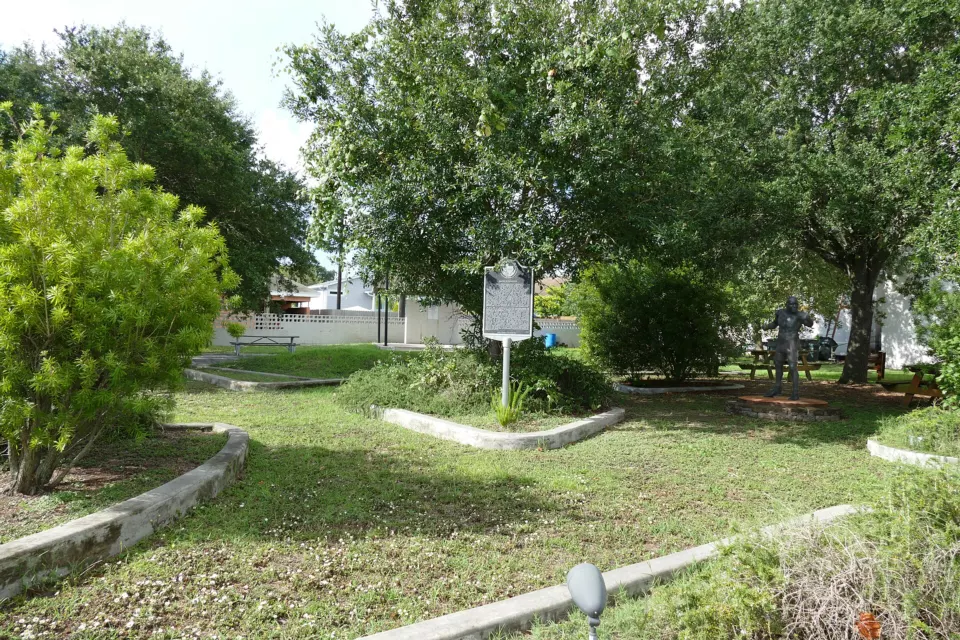
John Arthur Johnson was born in Galveston, Texas, on March 31, 1878. His parents, Henry and Tina Johnson, had both been born into slavery. Henry, a disabled Union Army veteran, worked as a janitor, and Tina took in laundry. The neighborhood the boy grew up in was racially mixed, and in later years Johnson remembered white children as his early playmates.
Wikipedia's account of his life puts his first notable fight in the summer of 1895, on a Galveston beach against a man named John Lee, with a purse of a dollar and a half. His recognized professional career began on November 1, 1898, when he knocked out Charley Brooks in the second round.
Twenty-Three Days in a Cell With Joe Choynski
On February 25, 1901, Johnson met the experienced Joe Choynski at Harmony Hall in Galveston and was knocked out in the third round. Prizefighting was illegal in Texas at the time, so both men were arrested and held for 23 days. They spent the time teaching. Choynski taught the younger man the defensive habits that became central to his style.
The lessons worked. On February 5, 1903, Johnson outpointed Denver Ed Martin over 20 rounds at Hazard's Pavilion in Los Angeles to win the so-called World Colored Heavyweight Championship. The real heavyweight title stayed out of reach, kept behind boxing's color line.
Boxing Day 1908: Burns Falls at Sydney Stadium
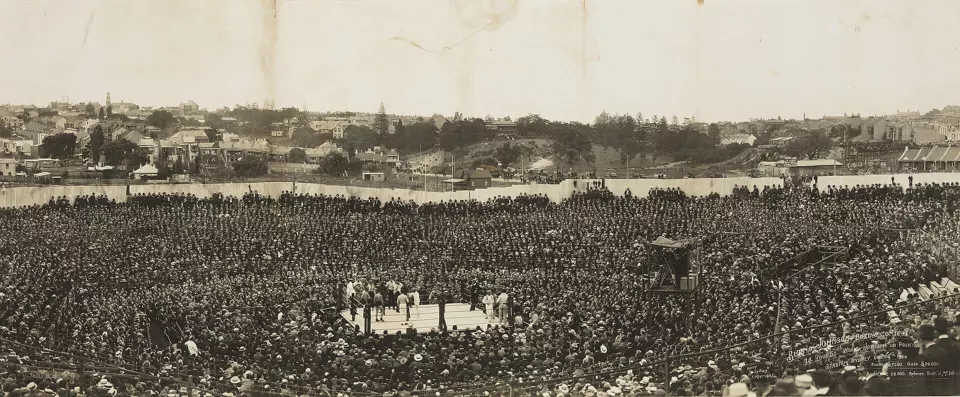
Johnson pressed the champion, Tommy Burns, for a title shot. The match finally came off on December 26, 1908, at Sydney Stadium in Rushcutters Bay, Australia. Burns had been guaranteed $30,000, a huge sum for the time, and more than 20,000 people came to watch. Johnson weighed about 192 pounds, Burns about 24 pounds less.
For 13 rounds Johnson punished Burns. In the 14th the police stopped the fight, and Johnson, winner by technical knockout, became the first Black heavyweight champion of the world.
The Search for a "Great White Hope"
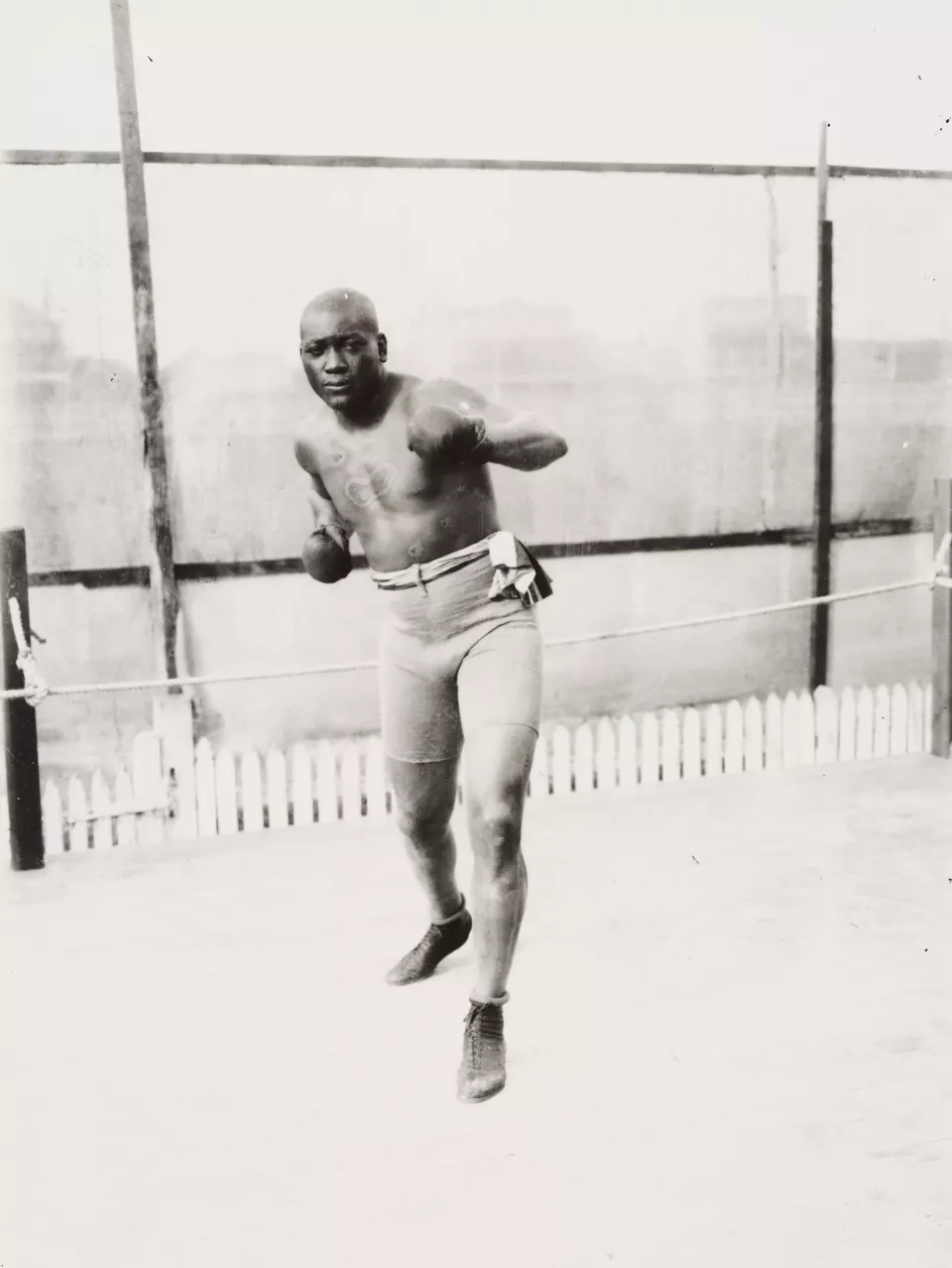
The result set off a hunt for a white challenger. One of them was the middleweight champion Stanley Ketchel, who fought Johnson on October 16, 1909, in Colma, California. Ketchel gave away about 35 pounds and was knocked out in the 12th round; several of his teeth were reportedly found embedded in Johnson's glove.
The challenger white America really wanted was James J. Jeffries, the former champion who had retired unbeaten. Jeffries agreed to come back, and promoter Tex Rickard set the fight for San Francisco. When California's governor cancelled it at the last minute, Rickard moved it to Reno, Nevada.
Reno, July 4, 1910: The Fight of the Century
Workers put up a wooden arena on East Fourth Street in downtown Reno, and special trains brought fans from both coasts. According to Nevada public radio station KUNR, the crowd of more than 20,000 was larger than the town's population of about 10,000.
Johnson controlled it from the start. In the 15th round Johnson knocked him down more than once, and Jeffries's corner ended the fight. Johnson's share of the purse was $65,000. A Reno man named John Cahlan later described the scene to KUNR in one line: "Johnson had won. He was the champion."
A Nation Erupts: The Riots of July 1910
As word of the result spread that night, Black communities celebrated, and white mobs attacked them. Violence broke out in cities including New York, Atlanta, Houston, St. Louis, Cincinnati, Baltimore, Chicago, Los Angeles, Philadelphia and Washington, D.C., and in many smaller towns. Sources give different death tolls. Wikipedia's article on the riots cites estimates of 11 to 26 dead, KUNR says at least 20, and both agree that hundreds were hurt and that most of the dead were Black.
The authorities responded by targeting the film of the fight. States and cities banned screenings, and in 1912 Congress outlawed the interstate transport of boxing films. That ban was not lifted until 1940. The footage itself was added to the U.S. National Film Registry in 2005.
Love, Scandal and the Mann Act
Johnson ignored the social rules of his time and openly married white women. His first wife, Etta Duryea, whom he married in January 1911, suffered from depression under heavy public hostility and took her own life in September 1912. Within months he married Lucille Cameron, an 18-year-old he had met at his Chicago nightclub, the Café de Champion.
Federal prosecutors went after him under the Mann Act, a 1910 law that banned transporting women across state lines for "immoral" purposes. The first case, built on his relationship with Cameron, collapsed when she refused to cooperate. A second case used testimony from a former companion, Belle Schreiber. In June 1913 an all-white jury in Chicago convicted him, and Judge Kenesaw Mountain Landis sentenced him to a year and a day in prison. Some of the conduct cited in the case had taken place before the Mann Act was passed.
Seven Years in Exile and the Havana Heat
Johnson did not report to prison. In late June 1913 he left the country by way of Montreal and went to France, and for the next seven years he lived in Europe, South America and Mexico.

His last defense came on April 5, 1915, at Oriental Park Racetrack in Havana, against Jess Willard, who stood about six feet six and a half inches and weighed around 245 pounds. The fight was scheduled for 45 rounds under the Cuban sun. Johnson was 37. He began to slow after the 20th round as Willard kept working the body, and in the 26th round he was knocked out. Johnson later said he had lost on purpose, then took the claim back, and the fight film and his comments to his corner both suggest the defeat was real.
Leavenworth, the Long Road, and a Crash in North Carolina
On July 20, 1920, Johnson surrendered to federal agents at the Mexican border. He served his sentence at the United States Penitentiary in Leavenworth, Kansas, and was released on July 9, 1921. The Associated Press, reporting on the 2018 pardon, put his time in prison at ten months. He married a third time, to Irene Pineau, in 1925, and they stayed together for the rest of his life. He fought on until 1938 and gave exhibitions as late as 1945. Sources disagree on his career record, from 94 recorded bouts to as many as 114.
On June 10, 1946, Johnson was driving on U.S. Highway 1 in North Carolina after a diner refused to serve him. His car hit a telegraph pole near Franklinton, and he died that evening at St. Agnes Hospital in Raleigh at the age of 68. He was buried in Chicago's Graceland Cemetery beside Etta Duryea. The Ring magazine named him to its Hall of Fame in its first class in 1954, and the International Boxing Hall of Fame inducted him in 1990.
The Pardon, 105 Years Later
For years Senator John McCain of Arizona and Nevada's Harry Reid pushed for a posthumous pardon, and Johnson's great-great-niece, Linda E. Haywood, took the request to two presidents. On May 24, 2018, President Donald Trump signed the pardon in the Oval Office, with former heavyweight champion Lennox Lewis and actor Sylvester Stallone present. The Associated Press quoted Trump describing the pardon as a move "to correct a wrong in our history." It came 105 years after the conviction and 72 years after Johnson's death.
Sources
- Jack Johnson (boxer), Wikipedia, accessed October 2026
- Johnson–Jeffries riots, Wikipedia, accessed October 2026
- Jess Willard, Wikipedia, accessed October 2026
- Jack Johnson and the Fight of the Century, KUNR Public Radio
- President Trump pardons late boxer and Galveston-native Jack Johnson, ABC13 Houston / Associated Press, May 24, 2018


