
Jess Willard, the Pottawatomie Giant, Beat Jack Johnson and Fell to Jack Dempsey
A Kansas cowboy who started boxing in his late twenties, Jess Willard survived a ring death and a criminal charge, won the heavyweight title from Jack Johnson in Havana in 1915 and lost it to Jack Dempsey in Toledo in 1919.

Jess Willard came to boxing almost by accident, a Kansas horseman who had never watched a professional fight when he walked into a gym in his late twenties. Within four years he was heavyweight champion of the world, having outlasted Jack Johnson under the Cuban sun. Four years after that, Jack Dempsey took the title from him in one of the most lopsided championship beatings ever recorded. Between those landmarks lay a death in the ring, a murder charge, a lucrative life in show business and a man who never seemed fully at ease with the sport that made him famous.
A Fatherless Boy in Pottawatomie County
Jess Myron Willard was born on December 29, 1881, in Pottawatomie County, Kansas, with sources placing his birthplace at St. Clere. According to Thomas Hauser's 2017 review of Arly Allen's biography of the fighter, his father died before Jess was born, leaving his mother to raise him alongside three older brothers. He quit school at about twelve and went to work herding cattle and breaking wild horses, and he spent his teens and twenties as a cowboy and farm hand. The county gave him the nickname that followed him through his career: the Pottawatomie Giant. The Kansas Historical Society's encyclopedia also records him being called the Kansas Giant, and contemporary newspapers liked to call him simply the Kansas cowboy.
The "giant" part was no exaggeration. Willard stood around six feet six inches, though sources differ by a fraction of an inch, and he fought at well over 230 pounds. In an era of smaller heavyweights, he was described as the largest man yet to climb through the ropes.
A Late Start, Inspired by Reno
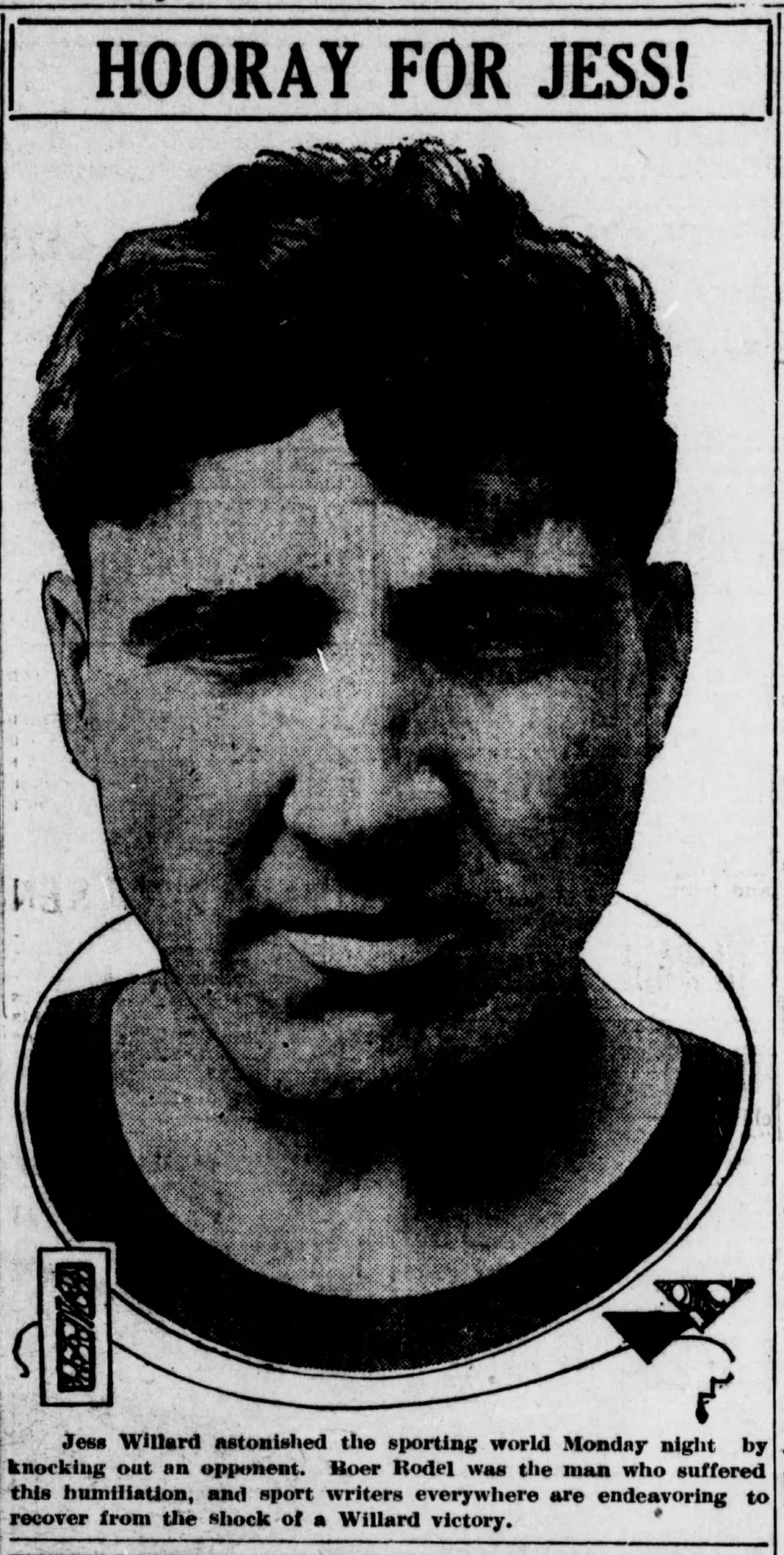
What pushed a working cowboy toward prizefighting was the racial politics of the heavyweight division. Jack Johnson, a Black champion, had beaten James J. Jeffries in Reno, and the hunt for a white challenger, the so-called Great White Hope, was on. Hauser's review quotes Willard explaining that the idea of boxing never crossed his mind until that fight. He reasoned, as Wikipedia summarizes it, that his schooling was thin but his size and strength might earn him a decent living.
The sources do not agree on exactly how old he was when he began: Wikipedia says 27, Hauser's review says 28, and Sherdog's 2016 profile says 29. What is fixed is the date of his professional debut. On February 15, 1911, at Sapulpa, Oklahoma, he lost to Lewis Fink by disqualification in the tenth round, reportedly for throwing his opponent. The Kansas Historical Society notes that he beat the same man about six weeks later.
His temperament was an odd fit for the trade. Arly Allen, as quoted by Hauser, wrote that Willard did not enjoy fighting and saw no point in hurting an opponent who was not hurting him. That reluctance would shape his career and, after August 1913, harden into something closer to dread.
The Death of Bull Young in Vernon
On August 22, 1913, Willard met John "Bull" Young, also listed in some records as William Young, in a scheduled 20-round bout at the Pacific Athletic Club in Vernon, California, just outside Los Angeles. In the eleventh round Willard dropped Young, who did not recover. He died the following day.
The sources describe the legal aftermath differently. Hauser's review says Willard was charged with manslaughter, while Wikipedia records a second-degree murder charge. He was defended by the well-known Los Angeles trial lawyer Earl Rogers and was cleared. The episode had consequences beyond Willard himself: according to Wikipedia, it helped push California in 1914 to ban public boxing matches longer than four rounds.
Twenty-Six Rounds in Havana

By 1915 Johnson was living in exile from the United States, and the title fight with Willard was staged abroad. It went instead to Oriental Park Racetrack in Havana, Cuba, on April 5, 1915, scheduled for 45 rounds. The Kansas Historical Society puts the crowd at about 25,000.
Hauser's review gives the weights as 238 pounds for Willard, then 33, and 225 for Johnson, who was 37. Johnson was the far more polished boxer and controlled the early going, but the challenger's size and patient counterpunching took a toll. Willard finally knocked him out in the twenty-sixth round.
The result quickly became contested. Johnson later claimed he had thrown the fight, an assertion that film of the bout does little to support. Wikipedia notes that he eventually retracted the story and conceded that Willard had simply been too much for him. Under federal law then banning the interstate transport of fight films, the footage could not initially be shown in the United States.
A Champion Who Rarely Fought
Willard's reign lasted more than four years, but he spent little of it in the ring. His only significant defense came on March 25, 1916, against Frank Moran at Madison Square Garden, a ten-round no-decision bout under New York rules. The money was elsewhere. According to Hauser's review, he could make about $6,000 a week touring with vaudeville and Wild West shows, and Wikipedia lists appearances with Buffalo Bill's Wild West show as well as a starring role in the 1919 film "The Challenge of Chance." Allen, again via Hauser, describes a man who never learned to handle fame and felt uncomfortable in crowds.
Seven Knockdowns in Toledo
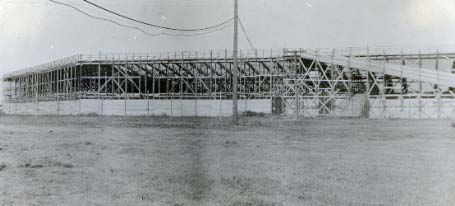
When Willard finally defended the title again, on July 4, 1919, at a purpose-built arena at Bay View Park in Toledo, Ohio, he was 37 and had barely fought in years. His challenger, Jack Dempsey, was thirteen years younger. Hauser gives Willard's weight as 243 pounds, some 56 more than Dempsey, and reports a temperature of 110 degrees on the day.
The size advantage meant nothing. Dempsey dropped Willard seven times in the first round, beginning with a left hook. Willard later recalled, in a line quoted by Hauser, that the first hook left him unsure whether he was in a ring or a cornfield. He lasted through the second and third rounds but did not come out for the fourth.
The extent of his injuries became part of the fight's legend, and the sources conflict. Later retellings commonly list a broken jaw, broken cheekbone, broken ribs and lost teeth. Yet Wikipedia cites an Associated Press report from July 5, 1919, in which Willard said his only injuries were a deep cut over the eye and a badly cut mouth, and denied losing teeth or breaking his jaw. Willard himself later fed a darker version: in a 1960s BBC interview with Harry Carpenter, he produced a metal bolt and claimed Dempsey had used it in his glove. Film of Dempsey's gloves being put on shows nothing of the kind.
A Comeback at Forty-One and a Quiet Exit
Willard returned in 1923. On May 12 at Yankee Stadium, aged 41, he stopped Floyd Johnson in the eleventh round in front of a crowd Wikipedia puts at 63,000. Two months later, on July 12, 1923, at Boyle's Thirty Acres in Jersey City, he was knocked out in the eighth round by Argentina's Luis Ángel Firpo. Attendance estimates for that night range from more than 75,000 to 100,000 depending on the source. He did not fight again.
His final record is reported differently across sources, from 22 wins with 20 knockouts in Hauser's review to 25-7-2 on Wikipedia and 26-6-1 on Sherdog, reflecting how differently early-century bouts and newspaper decisions are counted. The Kansas Historical Society describes his later years as spent peacefully away from the ring, much of it in California. He died of congestive heart failure in Los Angeles on December 15, 1968, at 86, and is buried at Forest Lawn Hollywood Hills. The International Boxing Hall of Fame inducted him in 2003.
Sources
- Jess Willard, Wikipedia, accessed October 2026
- Jess Willard, Kansapedia, Kansas Historical Society, accessed October 2026
- "Jess Willard": A Book Review by Thomas Hauser, The Sweet Science, September 27, 2017
- Boxing's Greats of the States | Kansas: Jess Willard, Mike Sloan, Sherdog, May 6, 2016


