
Luis Ángel Firpo, the Wild Bull of the Pampas, Knocked Dempsey Out of the Ring
From a shoemaker's son in Junín to the man who sent Jack Dempsey through the ropes, Luis Ángel Firpo became Argentina's first great heavyweight and later a wealthy rancher.

Luis Ángel Firpo came out of a provincial town on the Argentine plains, fought his way through South America and then crossed to the United States, where in 1923 he knocked out a former world champion and knocked the reigning one clean out of the ring. He lost that night, but he went home a national hero, and Argentina still marks the date of his defeat as the day of its boxers.
A Shoemaker's Son from Junín
Firpo was born in Junín, in the province of Buenos Aires, in October 1894. Most English-language references give the date as October 11; an Argentine account republished by the Buenos Aires Herald and a profile on British Vintage Boxing give October 1. His father, Agustín, was an Italian-born shoemaker, and his mother, Ángela Larroza, kept the home, according to the Spanish-language Wikipedia biography.
Hearing trouble shaped his childhood. The family moved to the capital around 1906 so the boy could be treated, and the same condition later kept him out of compulsory military service. Before anyone thought of him as an athlete, Firpo drifted through ordinary jobs: a restaurant, a telephone company, a pharmacy. The work that changed his life was at a factory producing refractory bricks. Accounts differ on the exact moment, but the version carried by the Buenos Aires Herald holds that he fought off three would-be robbers on his own, and that the owner, impressed by the young man's strength, pushed him toward the ring.
Learning the Trade in South America
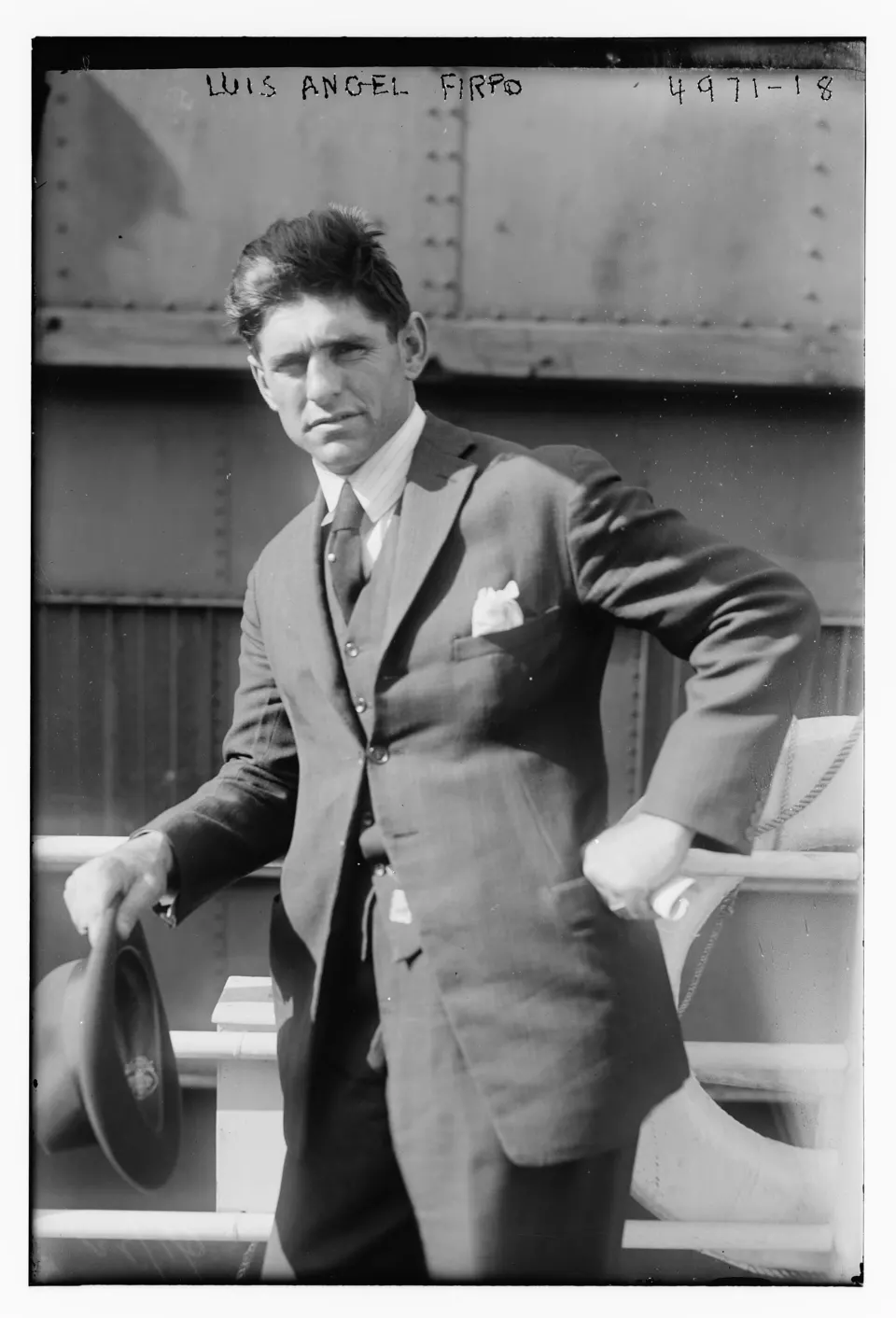
The start of his professional career is itself a small puzzle. Spanish-language sources place his debut in December 1917 against Frank Hagney in Buenos Aires; the English Wikipedia record lists January 1918, a loss to Angel Rodriguez, as his first recorded bout. What is not in doubt is that he learned on the job, far from the gyms of New York, and that he grew into a big man, listed at about six feet two and a half inches.
Boxing in the city of Buenos Aires was officially banned at the time, so Firpo's early years were a tour of South American venues. On April 30, 1920, he beat Dave Mills to claim the South American heavyweight title. By 1922 he had decided the continent was too small, and he headed north.
The Wild Bull Arrives in America
The big Argentine became known as: El Toro Salvaje de las Pampas, the Wild Bull of the Pampas. He backed it up with a run of knockouts. The most telling came on March 12, 1923, at Madison Square Garden, where he stopped the durable Bill Brennan in the twelfth round. Brennan had gone twelve rounds with Jack Dempsey before being stopped in a title fight, and he left the Garden that night with a concussion.
Willard at Boyle's Thirty Acres
The fight that made Firpo a title contender came on July 12, 1923, at Boyle's Thirty Acres in Jersey City, New Jersey. His opponent was Jess Willard, the giant Kansan who had taken the championship from Jack Johnson in 1915 and lost it to Dempsey in 1919. Willard, in his forties, had returned that spring and surprised many by stopping Floyd Johnson at Yankee Stadium in May.
Against Firpo the comeback ended. The Argentine knocked him out in the eighth round of a scheduled twelve, and Willard never fought again. Crowd figures for the night vary widely between sources: the Wikipedia article on Willard gives more than 75,000, while Firpo's own Wikipedia entry cites roughly 100,000 inside with another 25,000 turned away, which it describes as a world attendance record for boxing at the time. Whatever the true number, Firpo had beaten a former champion in front of an enormous American audience, and a shot at Dempsey followed within weeks.
Four Minutes at the Polo Grounds
On September 14, 1923, Firpo met Dempsey for the world heavyweight title at the Polo Grounds in New York. Extra seating had been built to push capacity well beyond the ballpark's usual size, and police estimated that around 150,000 people turned up in and around the grounds. He was the first Latin American ever to challenge for the heavyweight championship.
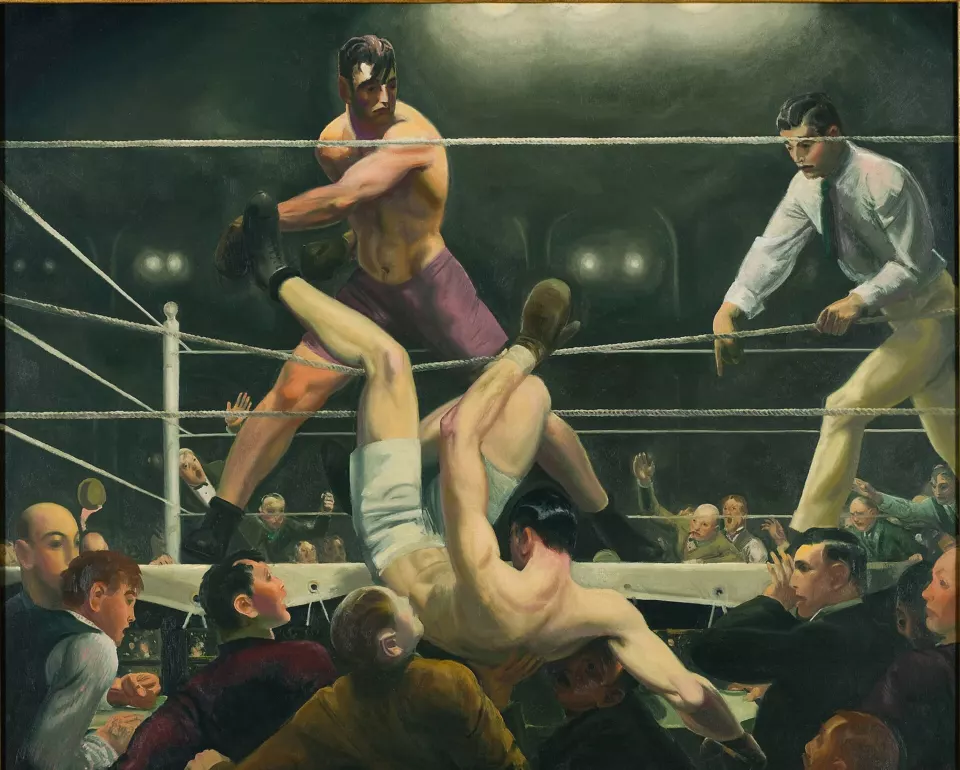
The fight lasted less than two rounds and has been argued over ever since. Dempsey dropped Firpo seven times in the opening round, but the Argentine kept getting up, and late in the round he drove the champion through the ropes and onto the press seats below. Dempsey was outside the ring well beyond a normal count; Wikipedia's account of the fight gives seventeen seconds, while other summaries put it higher. He was pushed back through the ropes by those at ringside and survived the round. In the second, he knocked Firpo out. Gene Tunney later called it the most controversial fight in boxing history and tied the result to Firpo having no manager.
Dempsey himself never pretended he had climbed back unaided. In the version recorded by Wikipedia and repeated by British Vintage Boxing, he said: "I was down, and if it wasn't for the public throwing me back in there, I would have never gotten back into the ring." The referee, Johnny Gallagher, was suspended and did not work again, and within two months New York's commission adopted the rule sending a fighter who scores a knockdown to a neutral corner. The Ring named the bout its Fight of the Year for 1923, and George Bellows turned the moment of Dempsey's fall into one of the best-known images in American sporting art.
A Nation Listening in Buenos Aires
Back home, Argentines followed the fight as best they could in 1923. According to the Herald's account, more than 2,500 people paid fifty cents each to hear the radio relay at the Luna Park stadium. Crowds who could not afford a ticket gathered outside the Palacio Barolo, where the newspaper owner Natalio Botana had arranged two lights, green for a Firpo win and red for Dempsey. A mistake with the signals briefly showed green, setting off celebrations before the truth arrived.
Defeat did not dent Firpo's standing. He came home as the father figure of Argentine boxing, and when the ban on the sport in Buenos Aires was lifted in February 1925, he was given licence number one. September 14 is now observed in Argentina as the Día del Boxeador, Boxer's Day.
Wills, Weinert and the Long Goodbye
Firpo returned to the United States in 1924. On September 11 of that year he faced Harry Wills, losing a newspaper decision before a crowd put at around 80,000. Two months later he lost another newspaper decision to Charley Weinert, a man he had stopped in two rounds the year before. His career wound down slowly after that, with his last fights coming in 1936.
His final record depends on who is counting. English Wikipedia and British Vintage Boxing list 31 wins, 26 by knockout, and four defeats. Argentine sources, including the account republished by the Buenos Aires Herald, give 33 wins, 28 by knockout, and six losses.
Cars, Cattle and Business on the Pampas
Firpo proved as stubborn with money as he was in the ring. He became a dealer for the American Stutz car company and, according to Spanish-language sources, set up a poultry farm in Florencio Varela. Land was his real business. By 1940 he was ranching on a large scale around Carlos Casares, with about 8,000 cattle, 4,000 sheep and 400 horses. British Vintage Boxing adds that his land dealings drew fraud allegations at one point, though he was never imprisoned.
He kept a foot in boxing. In July 1940 he discovered the heavyweight Abel Cestac, and he and his old opponent Dempsey agreed to manage the young fighter together.
Death and an Enduring Name
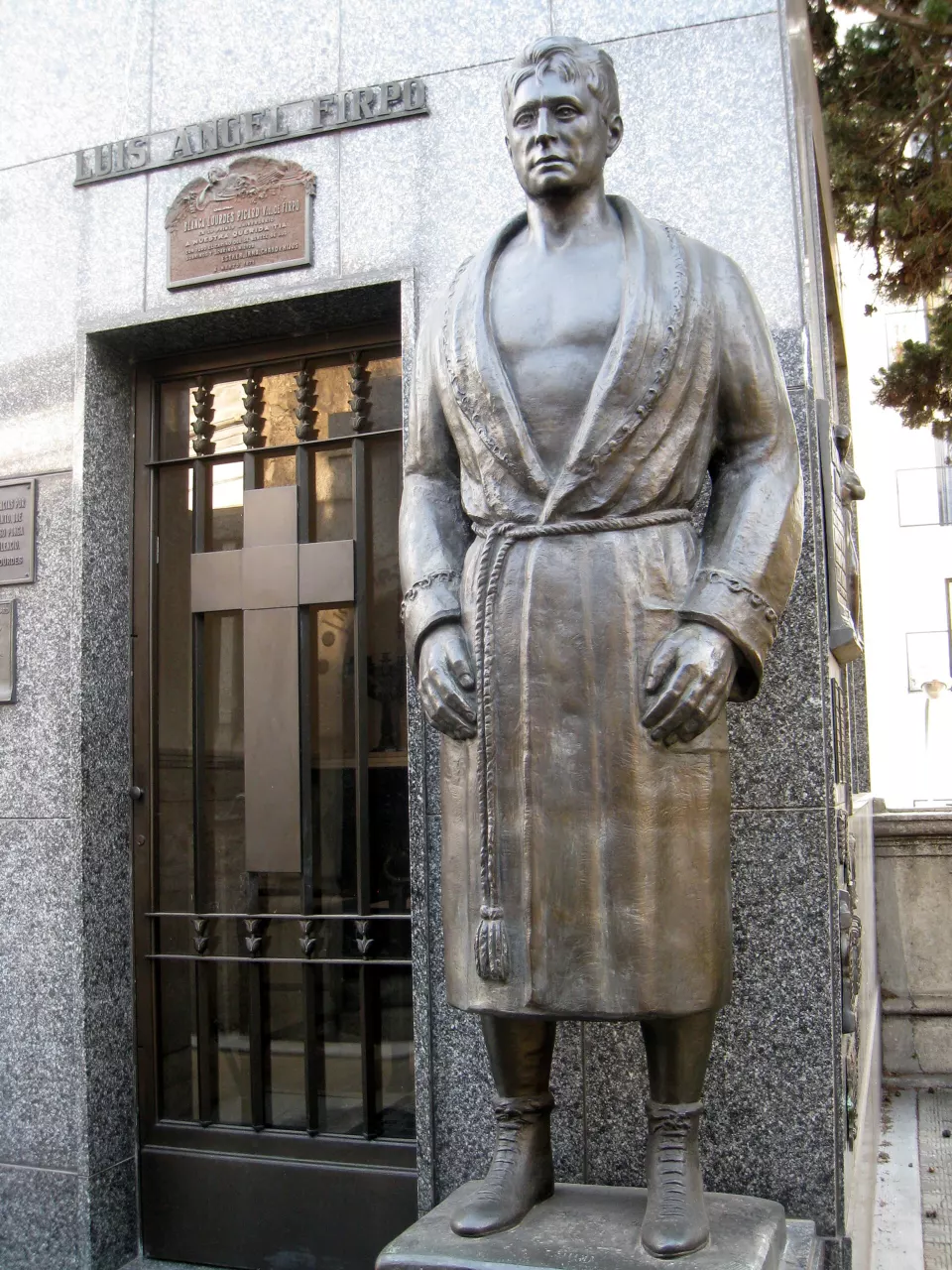
Firpo died of a cardiac arrest in Buenos Aires on August 7, 1960, at the age of 65. He was buried in La Recoleta Cemetery, where a statue of him stands at his tomb. Streets, schools and even a football club in El Salvador carry his name. In 2003 The Ring placed him among the 100 greatest punchers of all time, and in December 2023 the International Boxing Hall of Fame announced his posthumous induction in the Old-Timer category, completed at the June 2024 ceremony in Canastota, New York.
Sources
- Luis Ángel Firpo, Wikipedia (English), accessed October 2026
- Luis Ángel Firpo, Wikipedia (Spanish), accessed October 2026
- Jack Dempsey vs. Luis Ángel Firpo, Wikipedia, accessed October 2026
- Jess Willard, Wikipedia, accessed October 2026
- Firpo v. Dempsey: the fight that made September 14 Boxer's Day, Buenos Aires Herald (Walter Vargas, via Télam), September 14, 2023
- Luis Ángel Firpo – The Wild Bull of the Pampas, British Vintage Boxing, November 27, 2024
- International Boxing Hall of Fame announces 2024 inductees, WBC, December 7, 2023


