
Tommy Burns, the Shortest Heavyweight Champion, Took the Title Around the World
Born Noah Brusso near Hanover, Ontario, Tommy Burns beat Marvin Hart in 1906, defended the heavyweight title in England, Ireland, France and Australia, and lost it to Jack Johnson in Sydney before ending his life as a little-known evangelist.

At five feet seven inches, Tommy Burns is still the shortest man ever to hold the world heavyweight championship. The son of poor German immigrants from rural Ontario, he took the title from Marvin Hart in 1906, then carried it across the Atlantic and Pacific, defending it in London, Dublin, Paris, Sydney and Melbourne. He was also the champion who finally gave Jack Johnson his chance. He died in 1955 as an evangelist almost nobody remembered, and only four people were at his burial.
A Log Cabin Outside Hanover
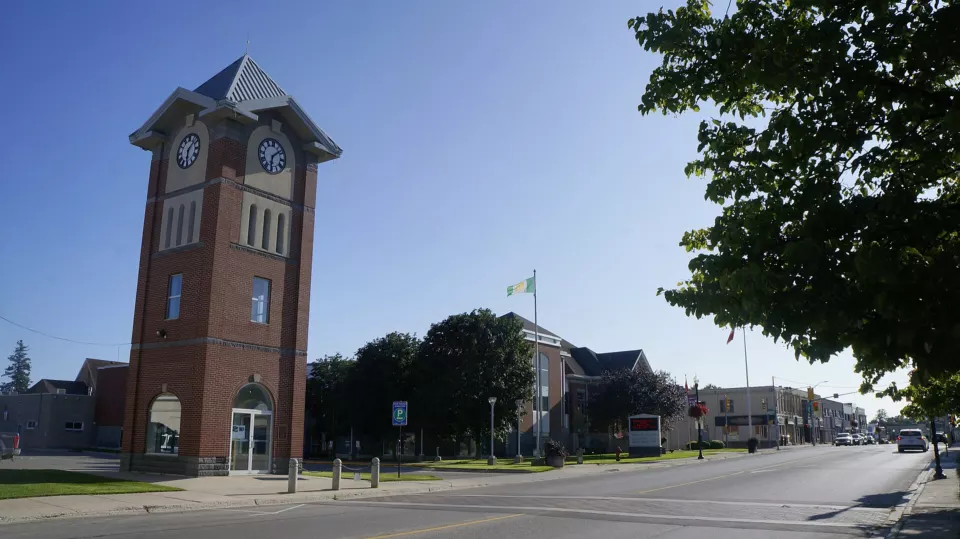
Burns was born Noah Brusso on 17 June 1881, on a farm in Normanby Township near Hanover, Ontario. His parents were German immigrants and poor. Noah was the twelfth of thirteen children, and five of his siblings died before they grew up. The family moved around Grey and Bruce counties before settling in the Galt and Preston area, where Kerry Banks, writing in Canada's History, says the boy left school at ten to work in a grocery store.
His first sport was lacrosse. He played for paid teams in Hespeler and Galt, and the Galt club won a Western Ontario intermediate title in 1898, according to the Cambridge Sports Hall of Fame. Years later Burns said outdoor lacrosse had built the strong legs that let him fight on his toes.
Noah Brusso Becomes Tommy Burns
According to Banks, Brusso was working as a baggage handler on a Lake Michigan steamer around 1900 when he walked off the boat in Detroit. He found work there as a painter and joined a boxing club. Sources give different starting dates. The Canadian Encyclopedia says he began boxing in 1900, while Wikipedia dates his first professional fight to January 1902. He soon won the Michigan middleweight title.
In January 1904 he knocked out Ben O'Grady in Detroit, and O'Grady fell into a coma. Brusso was arrested. The charges were dropped when O'Grady came round four days later. The story reached Hanover, his mother was upset, and he promised her he would stop fighting. Instead he kept boxing under a new name, Tommy Burns. Banks says he took it from a well-known Canadian jockey. Canada's Sports Hall of Fame says he chose it to sound like the Irish names that dominated boxing at the time.
That year he married and moved to Los Angeles. In 1905 he beat Dave Barry for the Pacific Coast middleweight title. Struggling to make the middleweight limit, he moved up and started fighting bigger men.
The Underdog Who Beat Marvin Hart
When James J. Jeffries retired unbeaten, Marvin Hart claimed the vacant heavyweight title by stopping Jack Root. Hart then picked Burns as his first opponent, expecting an easy payday. Banks lists Hart at six feet and 205 pounds. Canada's Sports Hall of Fame gives 190.
The fight took place on 23 February 1906 at the Pacific Athletic Club in Los Angeles. The sources disagree on the odds. Wikipedia and the Ontario Sports Hall of Fame say Burns was a 2 to 1 underdog, with bets that he would not last ten rounds. Canada's Sports Hall of Fame calls the odds ten to one. Burns went the full twenty rounds, left Hart bruised and bleeding by Banks's account, and won the decision.
Asked afterwards whether he would follow the colour line, the unwritten rule that kept Black challengers away from the heavyweight title, Burns said he would fight anyone of any race or nationality. Banks notes that Burns had already fought seven Black opponents before then.
Defending the Crown in California
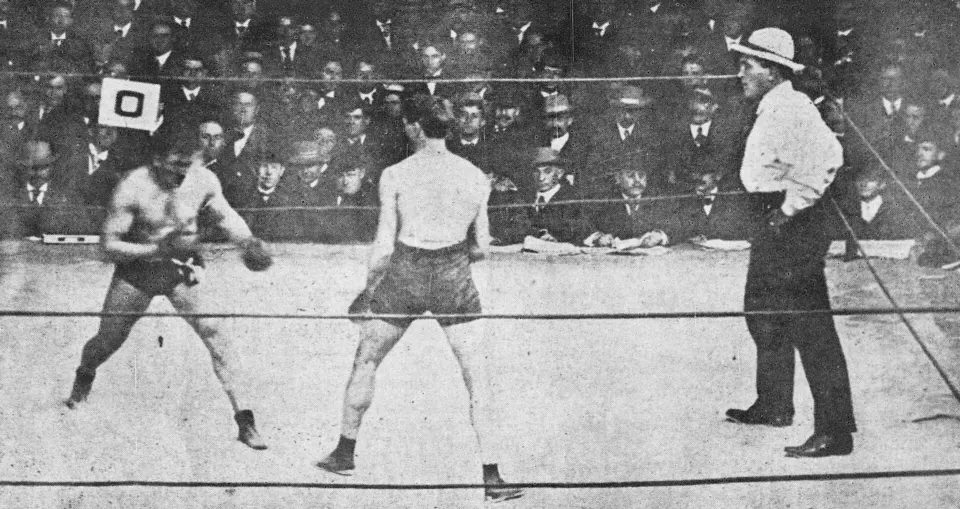
Burns stayed busy. On 28 March 1906, in San Diego, he knocked out two low-ranked opponents, Jim O'Brien and James J. Walker, in the first round on the same night. Some historians count these as exhibitions, not title defences. In October he stopped the heavy-hitting "Fireman" Jim Flynn in the fifteenth round in Los Angeles. He then fought the light heavyweight Philadelphia Jack O'Brien twice. Their November 1906 bout was a draw, and Burns won the rematch on points in May 1907. On 4 July 1907 at Colma, California, he knocked out the Australian champion Bill Squires in the first round.
A Champion Abroad: London, Dublin, Paris
No heavyweight champion before Burns had defended the title outside the United States. On 2 December 1907, at the National Sporting Club in Covent Garden, he knocked out the British champion Gunner Moir in the tenth round. Wikipedia describes it as the first world heavyweight title fight of the gloved era held outside America. In February 1908 he stopped Jack Palmer in four rounds at Wonderland in London.
On 17 March 1908, St Patrick's Day, he fought the Irish champion Jem Roche at the Theatre Royal in Dublin and knocked him out in 1 minute 28 seconds. The Canadian Encyclopedia calls it the shortest heavyweight title defence on record, and both halls of fame list the 88 seconds as a record. In Paris he knocked out Jewey Smith in April and Squires again in June, both in the fifth round, at a venue in Neuilly.
Australia and the Fight With Jack Johnson
Burns reached Australia in August 1908. He knocked out Squires for the third time in Sydney on 24 August and stopped Bill Lang in the sixth round in Melbourne on 3 September.
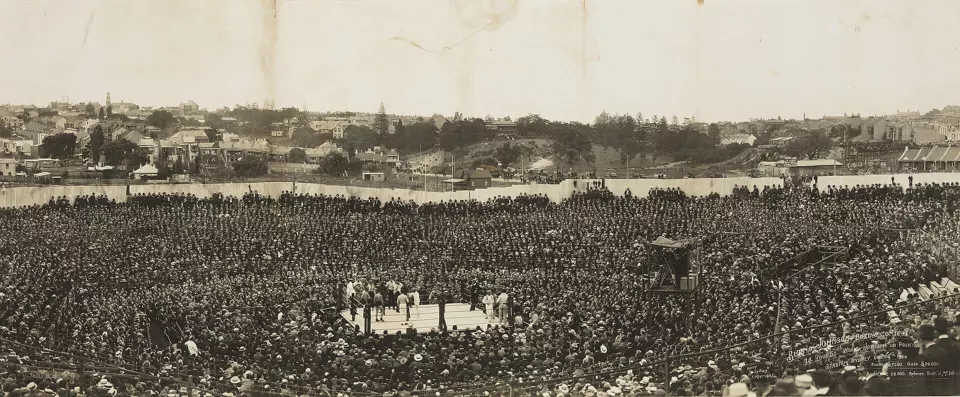
Jack Johnson had been following Burns from country to country, demanding a title shot. The promoter Hugh McIntosh offered Burns 30,000 dollars to fight him, and Johnson's share was reported as 5,000. The fight was held on 26 December 1908 at an open-air stadium at Rushcutters Bay in Sydney. The Canadian Encyclopedia gives the date as 25 December, but the other sources agree on Boxing Day. About 20,000 people were inside. Burns had reportedly been ill beforehand and weighed in light: 163 pounds according to Banks, 168 according to Wikipedia. Johnson outclassed him. In the fourteenth round police entered the ring and stopped both the fight and the filming, and McIntosh, who was also the referee, gave the decision to Johnson. Speaking in Vancouver in 1909, Johnson reportedly said of Burns, "He was beaten, but he was game" (as quoted in Canada's History).
Hotels, a Speakeasy and the Pulpit
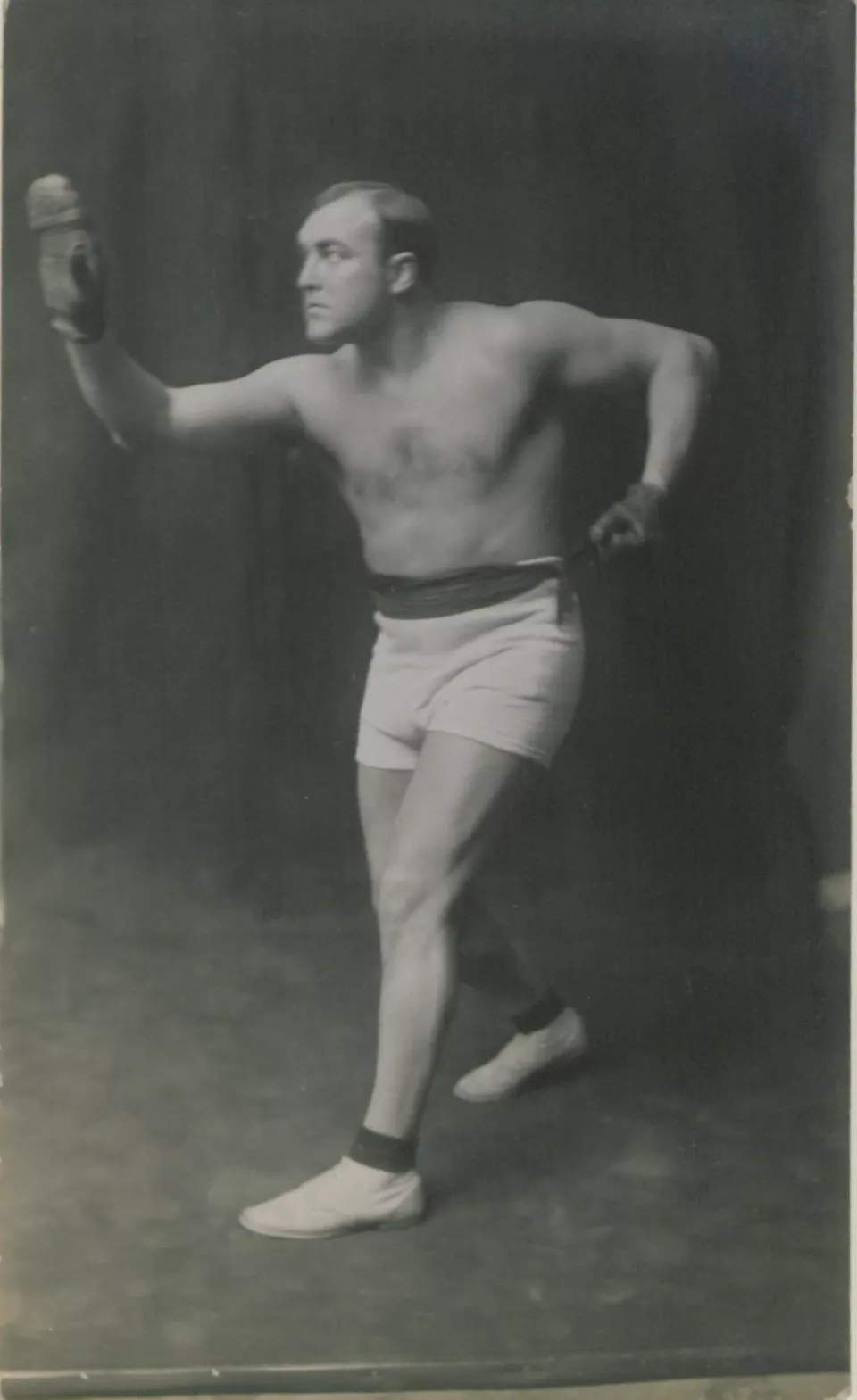
After that Burns fought only now and then. He beat Lang on points in Sydney in 1910, worked as a fitness instructor for Canadian troops during the First World War, and had his last fight in 1920 against the British champion Joe Beckett. After Burns had been knocked down twice, his corner threw in the towel in the seventh round. Sources disagree on his final record. Banks gives 47 wins, 4 losses and 8 draws. Wikipedia's table shows 47 wins, 5 losses and 9 draws.
His business ventures varied widely. Banks and Canada's Sports Hall of Fame say he ran a clothing store in Calgary, kept a pub or hotel in England and managed a speakeasy in New York. Wikipedia, citing a 1930 New York Times report, says he was arrested there by Prohibition agents. He lost most of his money after the 1929 crash and took jobs selling insurance and working as a security guard.
Wikipedia and the Ontario Sports Hall of Fame say Burns was ordained as a minister in 1948. Banks describes him in those years as a California preacher who spoke out against violence and preached a gospel of "Universal Love." Wikipedia says he was an evangelist living in Coalinga, California, when he died.
Four Mourners in Burnaby
Burns died of a heart attack on 10 May 1955 in Vancouver, aged 73, while visiting fellow believers there. Banks cites the Vancouver Sun as reporting that only four people attended his burial at Ocean View Cemetery in Burnaby: two gravediggers and two passers-by. The grave had no marker until 1961, when the sportswriter Dick Beddoes and the hockey great Fred "Cyclone" Taylor raised money for a plaque.
Recognition came slowly. Burns was inducted into Canada's Sports Hall of Fame in 1955, the International Boxing Hall of Fame in 1996 and the Ontario Sports Hall of Fame in 2012. The number of title defences credited to him depends on the source: thirteen in Wikipedia and Canada's History, eleven in the two halls of fame, and ten in the Canadian Encyclopedia. All of them agree that he remains the only Canadian-born world heavyweight champion and the first to defend the title outside the United States.
Sources
- Lonely Warrior, Kerry Banks, Canada's History, February–March 2021
- Tommy Burns (Canadian boxer), Wikipedia, accessed October 2026
- Tommy Burns, The Canadian Encyclopedia, accessed October 2026
- Canada's "little big man" of boxing, Canada's Sports Hall of Fame (Hall of Famer Weekly), 30 May 2025
- Tommy Burns, Ontario Sports Hall of Fame, accessed October 2026
- Noah Brusso "Tommy Burns", Cambridge Sports Hall of Fame, accessed October 2026
- Gunner Moir, Boxing History (boxinghistory.org.uk), accessed October 2026


