
Dempsey vs. Firpo in 1923 Lasted Under Four Minutes, Sent a Champion Through the Ropes and Changed the Rules
At the Polo Grounds on 14 September 1923, Jack Dempsey was knocked out of the ring by Luis Ángel Firpo before stopping the Argentine in the second round. The record of the knockdowns, the refereeing row and George Bellows' painting of the moment.

On the night of 14 September 1923, Jack Dempsey defended the heavyweight championship against Luis Ángel Firpo at the Polo Grounds in New York. The contest lasted less than four minutes. In that time the champion went down twice, once clean out of the ring, the challenger went down again and again, and a referee's decisions started arguments that have never fully settled.
A Champion in a Busy Summer
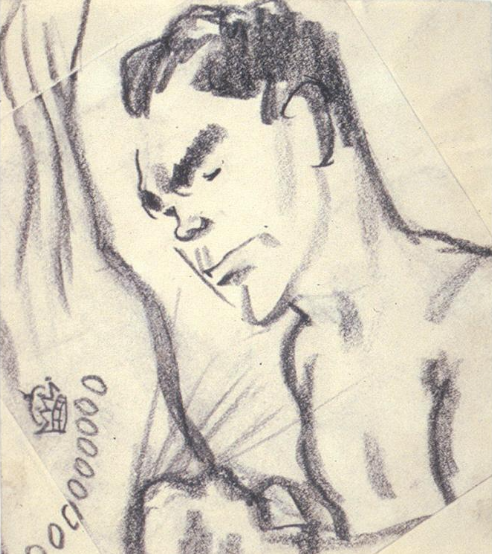
Dempsey, born in Manassa, Colorado, in 1895 and known as the Manassa Mauler, had held the title since knocking down Jess Willard seven times in the first round of their fight in Toledo, Ohio, on 4 July 1919. By 1923 he was the biggest attraction in the sport, and that summer he was busier than usual. On 4 July he went the full fifteen rounds with Tommy Gibbons in Shelby, Montana, winning on points against a slick boxer who made him work for every exchange.
Ten weeks later he was due back in the ring against a very different kind of opponent. Gibbons had tried to outthink him. Firpo intended to overpower him.
The Wild Bull From Junín
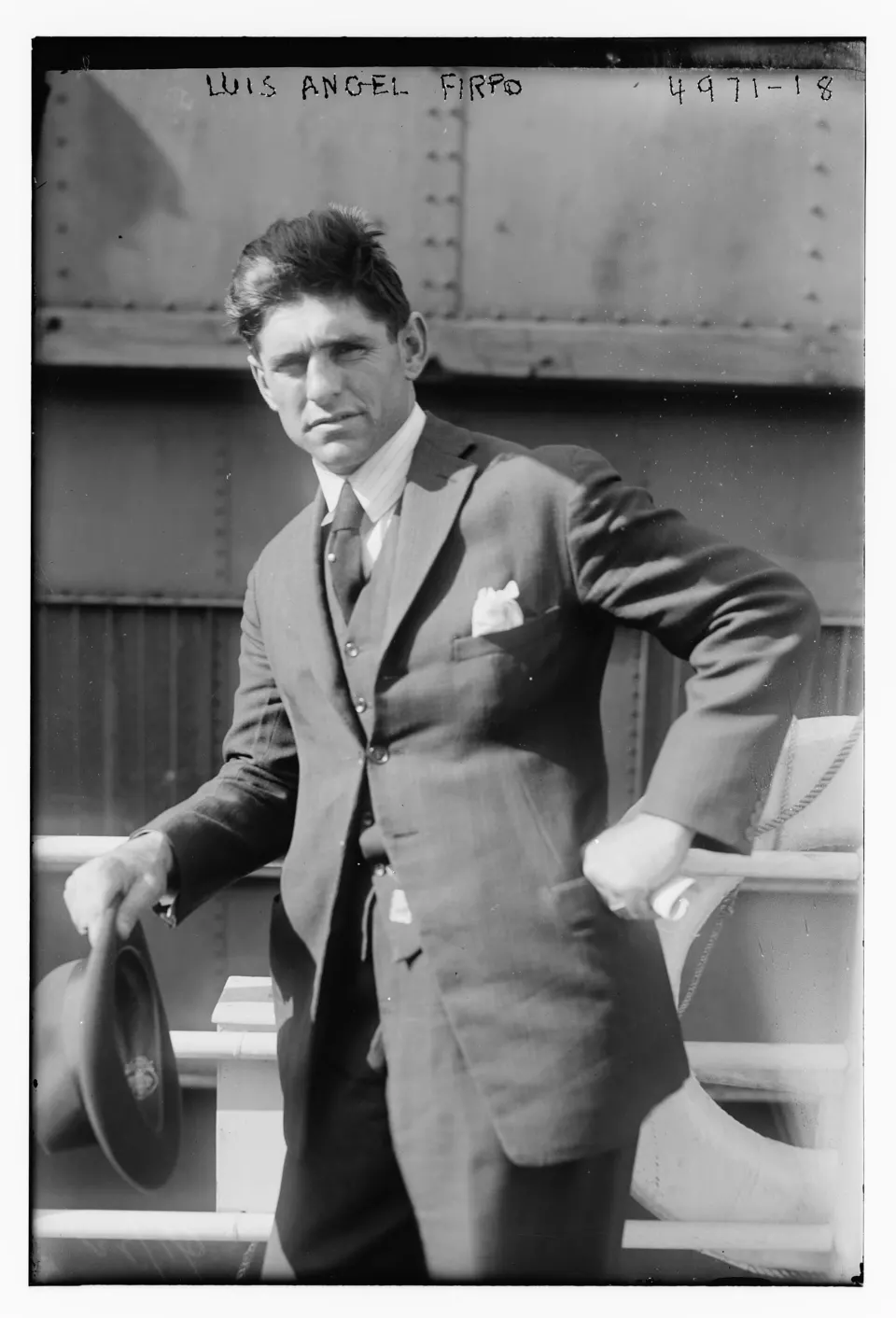
Firpo came from Junín, in Buenos Aires Province, and was born in 1894; sources give his birthday as either 1 or 11 October. The Buenos Aires Herald records that he lost much of his hearing as a child and turned to boxing after defending a brick factory against robbers, when the owner suggested he try the ring. He was a big man for his era, listed at around six feet two and a half and 216 pounds, and he fought with raw strength and a looping right hand rather than polish.
Two wins in 1923 made him a contender in the United States. In March at Madison Square Garden he stopped Bill Brennan in the twelfth round with a right hand that left Brennan in hospital with a concussion. Then on 12 July, at Boyle's Thirty Acres in Jersey City, he knocked out the 41-year-old Willard in the eighth round in front of a crowd put at about 100,000. The Herald credits the writer Damon Runyon with the nickname that followed him from then on: the Wild Bull of the Pampas.
A Crowd Beyond the Gates
The fight was staged at the Polo Grounds, the baseball home of the New York Giants. Its normal capacity of 55,000 was enlarged with temporary seating, and the figures that survive vary: Boxing News gives an official capacity crowd of 80,000, Wikipedia's account says the ground was expanded to about 83,000, and other references use 85,000. Police estimated that something like 150,000 people turned up in all, many of whom never got inside. Boxing News describes the receipts as only the second million-dollar gate the sport had seen.
The money was heavily weighted to the champion. According to the figures in Wikipedia's account of the bout, Dempsey received $468,750 and Firpo $156,250. The fight was scheduled for fifteen rounds, and the referee was Gallagher, named as Johnny in some sources and Jack in others.
Round One: Seven Knockdowns and a Flight Through the Ropes
The opening round has become one of the most retold three minutes in boxing. Dempsey went after Firpo immediately and dropped him repeatedly. Most accounts, including the WBA's history feature and the Buenos Aires Herald, count seven knockdowns of Firpo in the first round; the Boxing News retrospective gives five. Each time, Firpo got back up and kept swinging.
There were no neutral-corner rules in New York at the time, and Dempsey was allowed to hover over his man as he rose and hit him again almost as soon as he was upright. Firpo still landed. He put Dempsey down, and then, with the champion near the ropes, he caught him with a blow that Boxing News describes as half punch and half push. Dempsey went backwards through the ropes and out of the ring, landing among the working press. His own Wikipedia biography records that he came down on a reporter's typewriter.
What happened next is the heart of the controversy. Ringside writers shoved and lifted the champion back toward the apron, which was against the rules. The Buenos Aires Herald says Dempsey was out of the ring for about seventeen seconds and that Gallagher never began a proper count; Wikipedia's account says he was counted back in at nine. Either way, Dempsey was back inside before the referee waved anything off, and he survived the rest of the round despite taking a sustained barrage. Boxing News adds that he was still so unsteady at the bell that his manager, Jack Kearns, used smelling salts on him in the corner.
Round Two: Fifty-Seven Seconds
The rest was brief. Dempsey came out for the second round with his head cleared and went straight back to work. He dropped Firpo twice more, and the second time the Argentine could not beat the count. The WBA puts the end at 57 seconds of round two, giving a total fighting time of three minutes and 57 seconds.
The headline figure of eleven knockdowns in under four minutes comes from adding the seven first-round knockdowns of Firpo to the two in the second and the two suffered by Dempsey. Sources that count only five first-round knockdowns arrive at a lower total, so the number depends on which tally a reader trusts.
The Rules That Changed Afterwards
Complaints fell on Gallagher from two directions. He had let Dempsey stand over a fallen opponent and strike him as he rose, and he had allowed the champion back into the ring with help from spectators and with no clear count. Wikipedia's account reports that he was suspended and did not referee again. Within roughly two months the New York commission adopted a rule obliging a fighter who scores a knockdown to go to a neutral corner, a rule that would play its own famous part in Dempsey's 1927 rematch with Gene Tunney and the so-called Long Count.
Tunney himself later called the Firpo fight the most controversial in boxing history, and argued that a sharp manager in Firpo's corner would have climbed into the ring and claimed the title while Dempsey was outside it. Dempsey's own account, as quoted on Wikipedia, was blunt: he admitted that the crowd pushing him back was the only reason he got back into the ring at all.
Bellows at Ringside
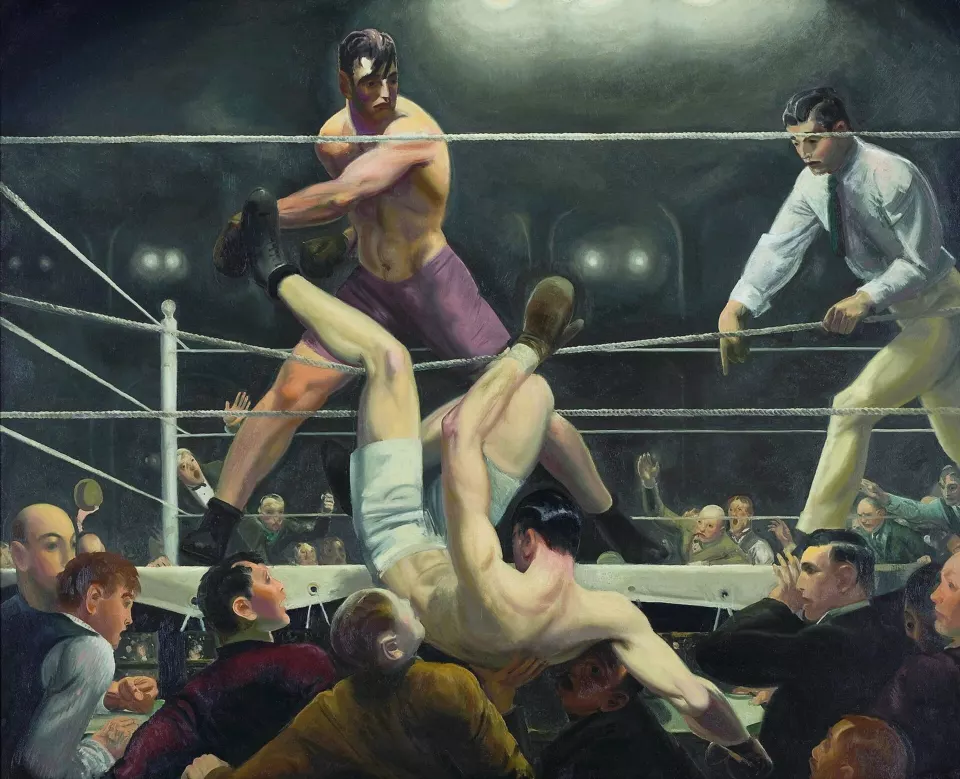
The painter George Bellows was at the fight on assignment for the New York Evening Journal, according to the Whitney Museum of American Art, which owns the oil painting he finished in 1924. He made drawings at ringside and later worked them up into a canvas of a little over five feet wide.
Bellows chose not to paint Dempsey's winning punch. He painted the moment the champion goes over the ropes, the instant after Firpo's blow sent him out of the ring and down toward the ringside seats. The Whitney notes that he put himself into the picture as a balding man at the far left, and that the low viewpoint places the viewer among the spectators shoving Dempsey back. The museum also cautions that the image dramatises the scene rather than recording it exactly. Bellows also made lithographs of the subject, and prints of it are held by the Metropolitan Museum of Art.
What It Meant in Buenos Aires
In Argentina the fight was followed live by radio. The Buenos Aires Herald reports that more than 2,500 people paid to hear the broadcast at Luna Park, while others watched signal lights on the Palacio Barolo, green for a Firpo win and red for Dempsey. 14 September is still marked in Argentina as Boxer's Day.
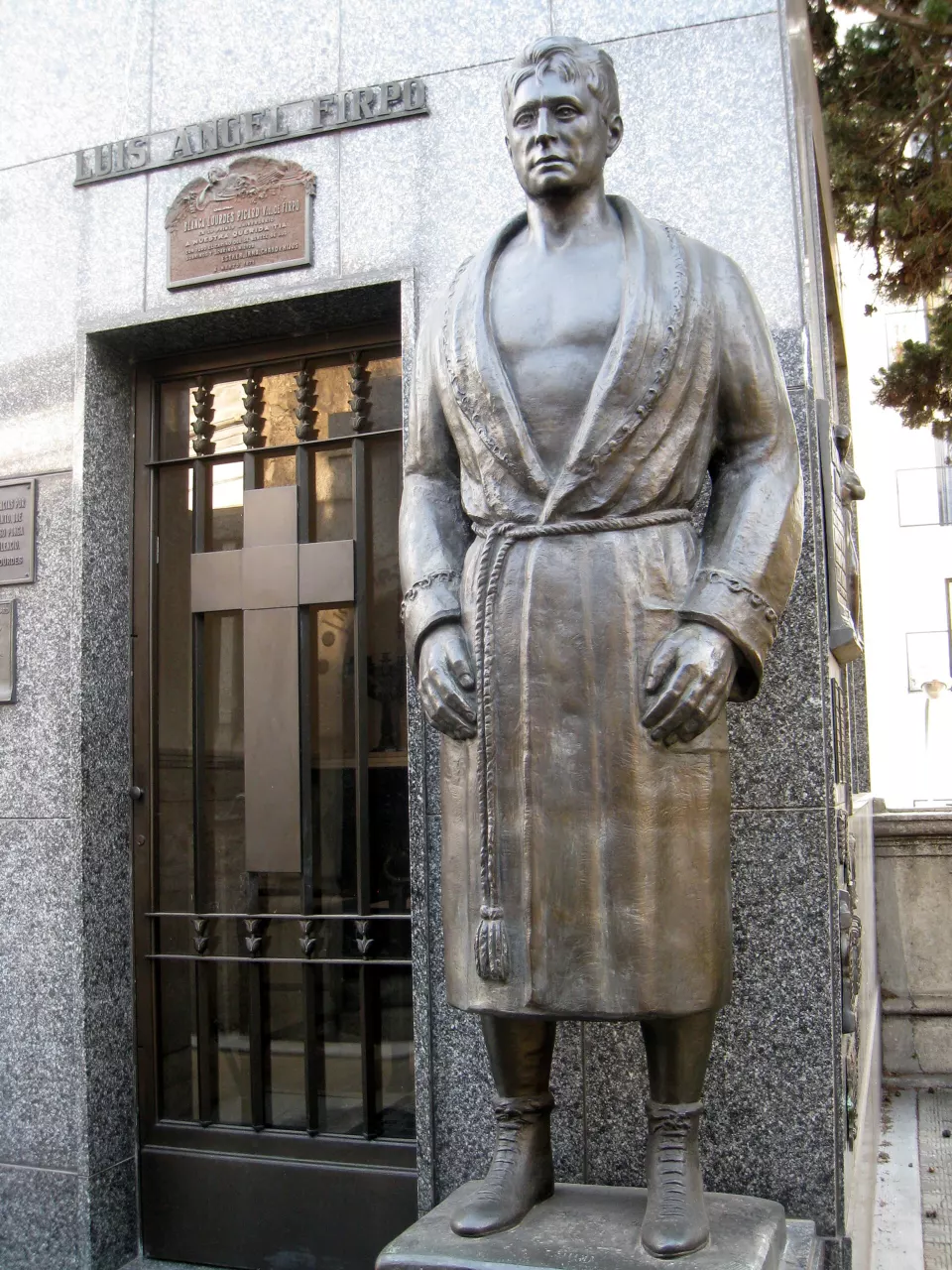
Firpo never got another title shot, but his standing at home was secure. He boxed on into the 1930s, became a car dealer and rancher, and died in 1960. He is buried in La Recoleta Cemetery in Buenos Aires. Dempsey did not defend the title again until September 1926, when he lost it to Tunney in Philadelphia.
Sources
- Jack Dempsey vs. Luis Ángel Firpo, Wikipedia, accessed October 2026
- Luis Ángel Firpo, Wikipedia, accessed October 2026
- Jack Dempsey, Wikipedia, accessed October 2026
- On this day: Jack Dempsey is knocked out of the ring in a wild brawl, Boxing News, 14 September 2019
- Today in Boxing History: Dempsey vs. Firpo, World Boxing Association, 14 September 2016
- Firpo v. Dempsey: the fight that made September 14 Boxer's Day, Buenos Aires Herald, 14 September 2023
- George Bellows, Dempsey and Firpo (1924), Whitney Museum of American Art collection
- Dempsey, William Harrison ("Jack"), Encyclopedia.com


