
Johnson vs Willard, Havana 1915, Ended in a 26th-Round Knockout, a Sold Confession and a Photograph in the Sun
Jess Willard ended Jack Johnson's seven-year heavyweight reign with a 26th-round knockout at Oriental Park in April 1915. Johnson later claimed he threw the fight and pointed to a famous photograph as proof; the record tells a different story.

On 5 April 1915, at a racetrack outside Havana, a fugitive heavyweight champion and a giant from the Kansas plains fought for twenty-five rounds under a tropical sun before Jess Willard dropped Jack Johnson in the twenty-sixth. The knockout ended a seven-year reign. What Johnson said about it afterwards, and a single photograph of him lying on the canvas, kept the result in dispute for decades.
A Champion Who Could Not Go Home
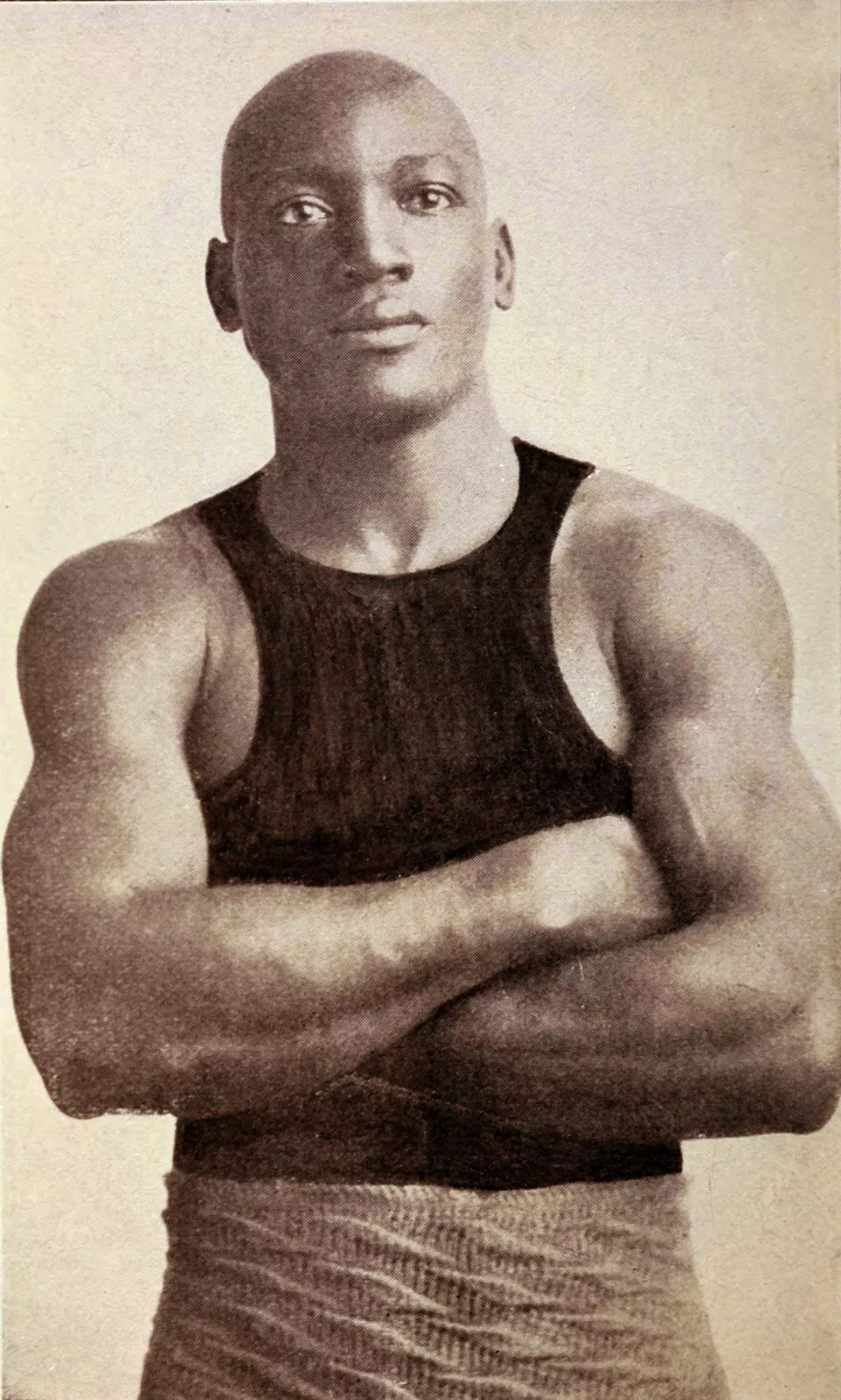
Jack Johnson had held the world heavyweight title since 1908, and by 1915 he was defending it from outside his own country. In October 1912 he was arrested under the Mann Act over his relationship with Lucille Cameron, the white woman he later married. That case fell apart when Cameron refused to testify against him, but federal prosecutors quickly built a second one around Belle Schreiber, a woman he had known in 1909 and 1910. In June 1913 an all-white jury in Chicago convicted him, even though the conduct in question predated the law itself, and Judge Kenesaw Mountain Landis sentenced him to a year and a day.
Johnson did not wait for prison. He jumped bail, crossed into Canada to meet Lucille in Montreal and sailed on to France. For the next seven years the couple lived abroad, moving between Europe, South America and Mexico. He still fought, outpointing Frank Moran over twenty rounds in Paris in June 1914, but the champion was by then in his late thirties.
The Pottawatomie Giant
Jess Willard was the man the American promoters settled on. Born in Kansas in December 1881, he stood around six feet six inches and weighed roughly 235 to 245 pounds depending on the account. He came to boxing late, at about 27, reasoning that his size could earn him more than farm work, and turned professional in 1911 in Sapulpa, Oklahoma. His debut ended in a loss on a foul; six weeks later he won the rematch. Wins in New York, Buffalo and Atlanta followed, and he was cast as yet another "White Hope" sent to take the title back from Johnson.
Why the Fight Went to Cuba
Finding a site was a problem in itself. Johnson could not enter the United States without being arrested, so the promoter, Jack Curley, looked south. Mexico was considered and dropped, according to Cigar Aficionado's account, partly over fears that Johnson could be seized and carried back across the border. Havana offered a neutral country within easy reach of American ticket buyers.
The terms were lopsided in Johnson's favour. Cigar Aficionado reports that Curley guaranteed the champion $30,000, while Willard was to receive $5,000 plus a third of the motion-picture rights. The contest was set for 45 rounds.
Oriental Park, 5 April 1915
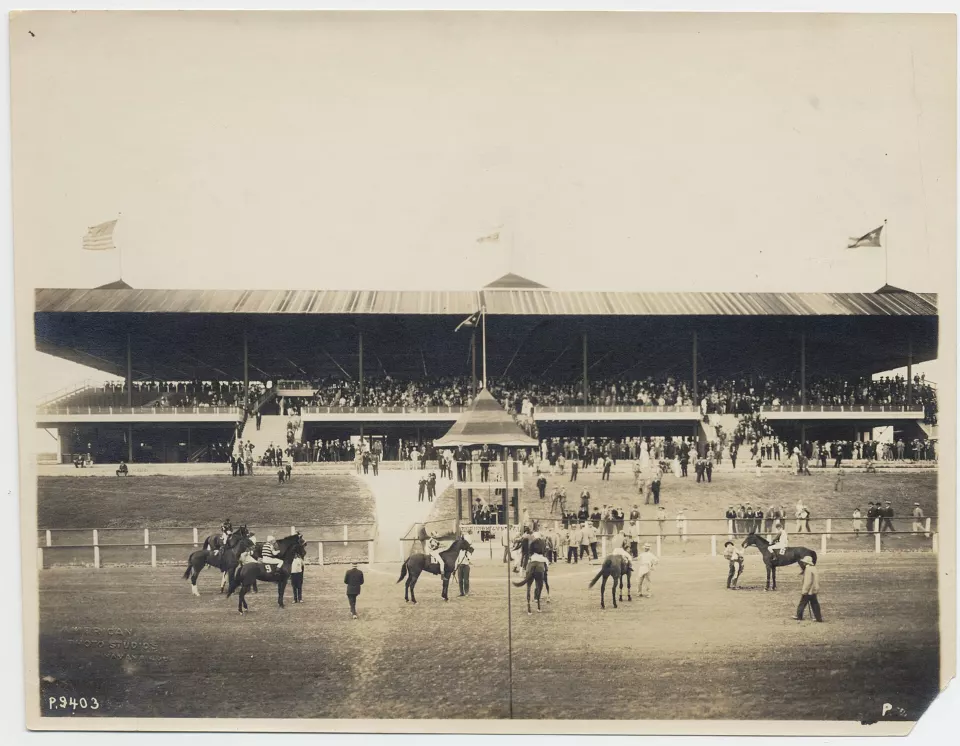
The ring was built at Oriental Park Racetrack in Marianao, a few miles outside the city. Estimates of the crowd vary considerably between sources: the Kansas Historical Society and Wikipedia put it at around 25,000, while Cigar Aficionado gives a figure of about 32,000 and notes that Cuba's president, Mario García Menocal, was among them. Century Ireland records that the crowd jeered Johnson throughout.
The heat is the one point every account stresses. Cigar Aficionado says the temperature reached 103 degrees Fahrenheit around noon, and The Fight City describes a bright, scorching day. For a champion in his late thirties who had spent his exile giving exhibitions rather than training for a marathon, those conditions mattered.
Twenty-Five Rounds of Attrition
For a long stretch the fight followed Johnson's script. He was faster, more skilled and far more experienced, and the accounts agree that he controlled the opening rounds. The Fight City notes that he taunted the challenger and made a serious attempt to finish him around the seventh round. Willard absorbed it.
Somewhere in the middle of the fight the balance shifted. Cigar Aficionado places the slowdown around the fifteenth round; The Fight City says Johnson was still in command up to about the twentieth. Either way, the champion's legs and wind began to fail before Willard's did. The referee, Jack Welch, summed it up afterwards in words The Fight City reproduces: "Johnson put up a wonderful fight to the twentieth round, but age stepped in then." Willard began to press, and in the twenty-fifth he landed a heavy right to the body.
The Twenty-Sixth Round

The end came early in the twenty-sixth. Willard threw a right hand that caught Johnson on the chin, and the champion went down on his back. He stayed there while Welch counted ten. American Heritage, reviewing the fight on its 75th anniversary, describes him lying with his knees raised and both hands held above his face against the sun as the count went on. Willard was the new heavyweight champion of the world.
The Kansas Historical Society notes that it was not a bloody fight and that Johnson left the ring under his own power; Century Ireland reports that he had to be escorted out.
A Confession Offered for Sale
In the years that followed Johnson insisted that he had lost on purpose. In the version he eventually put on paper, he said he had agreed with Curley to give up the title in return for $50,000 and an end to his legal trouble in the United States, and that he had carried on boxing until he saw his wife in the crowd give a sign that the money had been paid. Cigar Aficionado adds that he claimed the payment was delivered during the twenty-fifth round and that his statement was published by The Ring.
The provenance of that statement weakens it. The Fight City reports that Johnson did not volunteer his "confession" but sold it to Nat Fleischer of The Ring. Curley is quoted by The Fight City as saying that no one took Johnson's claims of fakery seriously.
The deal Johnson described also failed to happen. No immunity came. He stayed abroad until 20 July 1920, when he surrendered at the Mexican border; he was sent to the federal penitentiary at Leavenworth that September and released in July 1921.
Reading the Photograph
Much of the fix story's staying power rests on one image. Still photographs of the knockout, widely reproduced in 1915 and since, show Johnson flat on the canvas with his arms raised over his face.
Johnson used it as evidence. Cigar Aficionado quotes him as saying: "Shading my eyes from the sun was proof of the fix." His argument was that a man genuinely knocked senseless would not have the presence of mind to protect his eyes from the glare. Sceptics turn the same picture around: a beaten, exhausted man lying under a near-vertical tropical sun might do exactly that, whether or not he could have got up in time. The photograph shows a conscious fighter; it does not show why he stayed down.
The moving pictures are less ambiguous than the still. Wikipedia's article on Willard says the surviving footage shows him winning fairly, and its article on Johnson describes Willard as widely regarded as the outright winner. The Fight City makes a simpler point: a man planning to lose would hardly have spent the early rounds trying to knock his opponent out. Wikipedia's Willard entry also states that Johnson eventually conceded the defeat was genuine.
Willard's Answer and What Followed
Willard's own response became the most quoted line of the whole affair, though it survives in slightly different wording. Wikipedia gives it as: "If he was going to throw the fight, I wish he'd done it sooner. It was hotter than hell out there." Cigar Aficionado's version differs in a few words but carries the same point.
The new champion did little with the title. He toured on stage and defended it sparingly. On 4 July 1919 in Toledo, aged 37, he was beaten down by Jack Dempsey and could not come out after the third round. Johnson died after a car crash in North Carolina in June 1946. In May 2018, 105 years after his conviction, he received a posthumous presidential pardon. The Havana result still stands as a knockout in twenty-six rounds.
Sources
- Jack Johnson (boxer), Wikipedia, accessed October 2026
- Jess Willard, Wikipedia, accessed October 2026
- April 5, 1915: Johnson vs Willard, Robert Portis, The Fight City
- The Fight That Made Havana Famous, F. Daniel Somrack, Cigar Aficionado, May/June 2015
- 1915: Seventy-Five Years Ago, American Heritage, April 1990
- Jess Willard, Kansas Historical Society (Kansapedia)
- Jack Johnson dethroned as world boxing champion, Century Ireland (RTÉ), 6 April 1915 entry


