
Louis vs Conn II in 1946 Ended in Eight Rounds After a Five-Year Wait for a Rematch
After Billy Conn came within two seconds of the bell in 1941, a broken hand and the Second World War delayed his return with Joe Louis until June 1946. At Yankee Stadium, before a record gate and NBC's cameras, a rusty Conn was knocked out in the eighth.

Billy Conn left the Polo Grounds in June 1941 two seconds short of the bell and a few points short of the heavyweight championship. The return match that everyone wanted took five years to arrive, survived a family brawl and a world war, and when it finally happened at Yankee Stadium on 19 June 1946 it bore little resemblance to the night that created the demand for it.
Thirteen Rounds That Built a Rematch
The first meeting set the terms for everything that followed. Conn, the 23-year-old "Pittsburgh Kid" who had given up the world light heavyweight title in May 1941 to move up, outboxed Joe Louis for most of twelve rounds. When the 13th began he was in front on two of the three official cards, 7-5 and 7-4-1, with the third level at 6-6; the Associated Press had him ahead 8-4. Instead of boxing to the finish he went looking for a knockout, and Louis stopped him with two seconds left in the round. Conn's later verdict on himself, recorded by Wikipedia, was that he had lost his head and a million dollars.
The outcome left the business side of boxing with an obvious product. A smaller, faster man had shown that the champion could be outmanoeuvred, and the public wanted to see whether he could do it for fifteen rounds rather than twelve. Promoter Mike Jacobs, who controlled Louis's title fights, set about arranging a return.
A Christening, a Broken Hand and a Cancelled Date
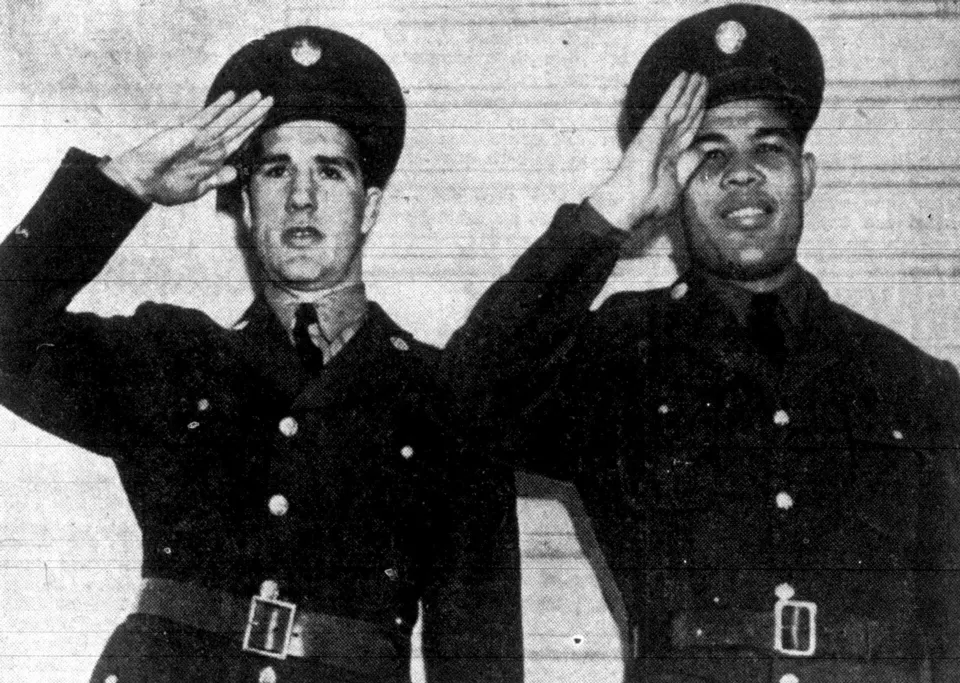
The second fight was first scheduled for 25 June 1942. It never took place on that date, and the reason had nothing to do with either man's opponent. Conn had married Mary Louise Smith in July 1941, against the wishes of her father, the former baseball player Jimmy Smith. According to Wikipedia's account of the rematch, a fight broke out at a family gathering after the christening of the couple's child on 10 May 1942, started by the father-in-law, and Conn broke his left hand in it.
The bout was pushed back, first towards September and then to 12 October 1942. By then the United States was at war and both fighters were in uniform. On 25 September Secretary of War Henry L. Stimson ordered them back to their army duties, and the date was cancelled.
Champion in Uniform
Louis spent the war years as the most visible athlete in the US Army. Before he enlisted he had fought twice for military charities: against Buddy Baer in January 1942 for the Navy Relief Society, and against Abe Simon in March for the Army Relief Fund. Ahead of the Simon fight he made the remark Wikipedia describes as widely reported, "We'll win, 'cause we're on God's side." Those two nights raised tens of thousands of dollars for the funds, yet the tax authorities later counted the proceeds as his income, a debt that would follow him for years.
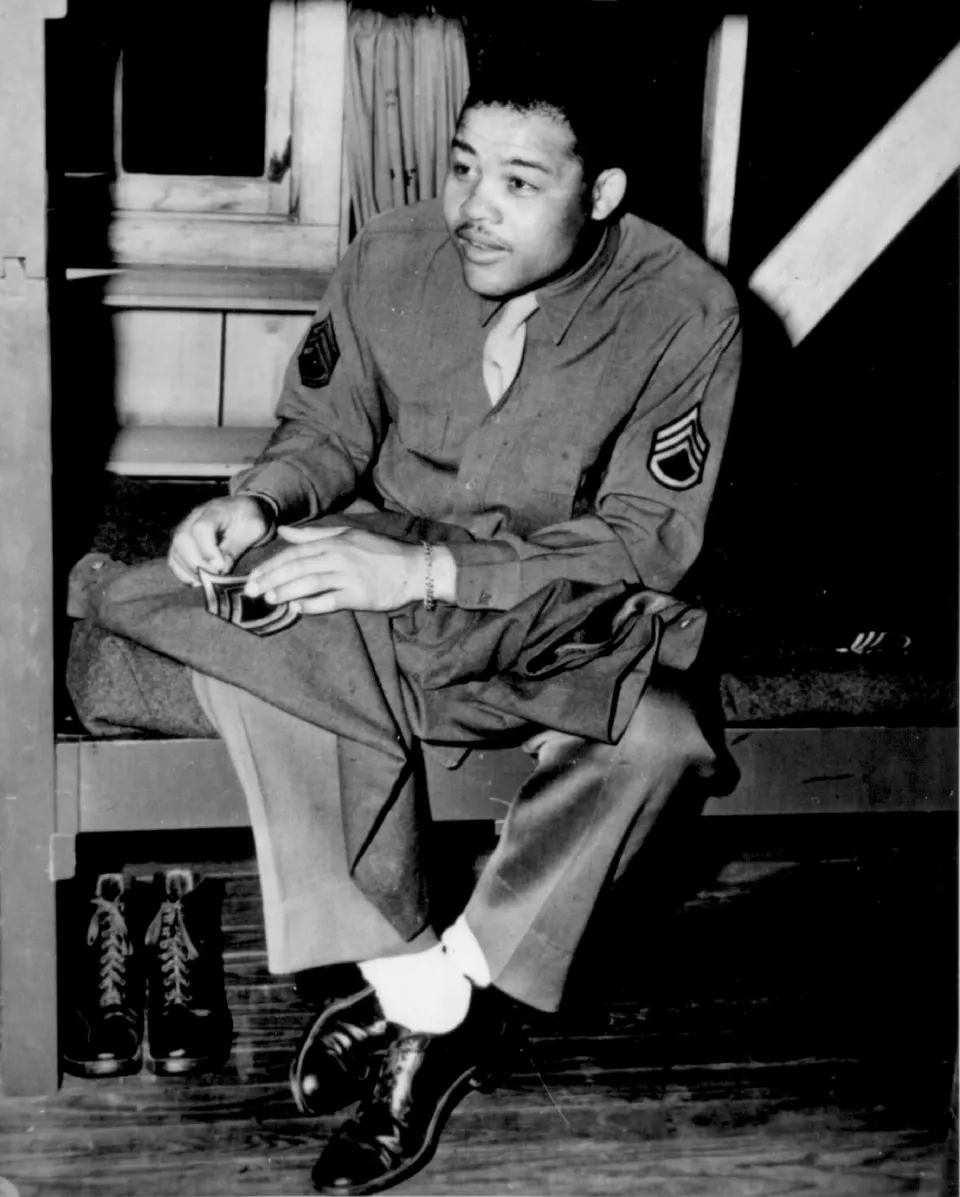
He volunteered as a private at Camp Upton on Long Island on 10 January 1942 and was assigned to a segregated cavalry unit at Fort Riley, Kansas. Rather than combat, the Army used him in Special Services, staging 96 exhibitions before some two million soldiers and travelling more than 22,000 miles. He rose to technical sergeant, received the Legion of Merit for his contribution to morale, and was discharged on 1 October 1945. Conn had left the service a week earlier, on 24 September.
Rust on Both Sides
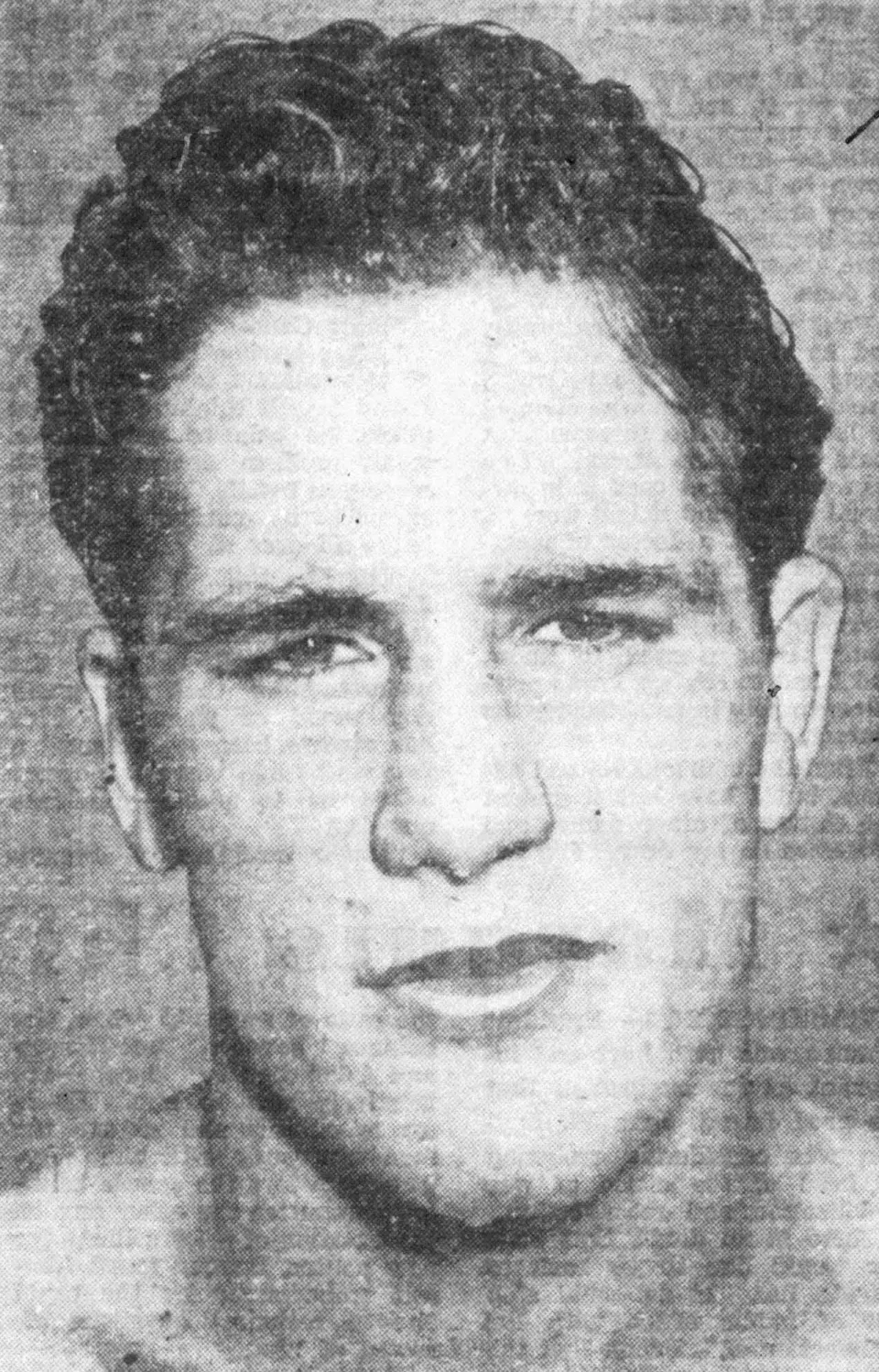
When the rematch was finally signed for Yankee Stadium on 19 June 1946, the numbers on paper hinted at what the eye would confirm. Conn had not boxed a real fight since February 1942. Louis's last title defence had come in November 1944, during his exhibition tour. Wikipedia notes that neither man was allowed a tune-up bout beforehand.
The tale of the tape recorded in Wikipedia's account had Louis at 207 pounds and Conn at 182, a gap close to the one in 1941 but with both men heavier. Louis was 32, Conn 28. The bookmakers made the champion a 7-to-2 favourite. Not everyone agreed: the former three-division champion Henry Armstrong predicted Conn would win on points, judging Louis too slow.
The pre-fight build-up also produced the line that has outlived the fight itself. Asked whether he would chase Conn if the challenger kept moving backwards, Louis answered, as recorded by both Wikipedia and the historian J.H. Graham: "He can run, but he can't hide."
The Price of a Ringside Seat
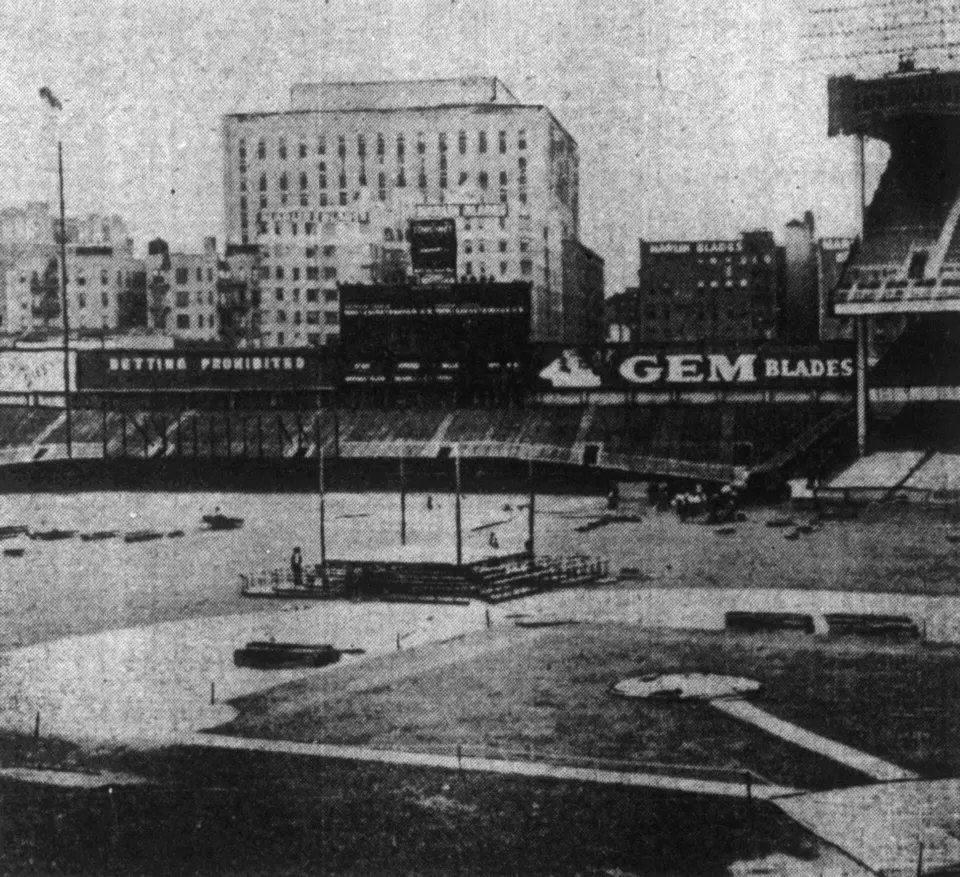
Jacobs priced the event as a once-in-a-generation attraction. TIME magazine, writing in July 1946, called it the "Louis-Conn $100-a-seat fiasco" while noting that the promoter's next show had ringside seats at $17. The gross was still enormous. Wikipedia and Andscape both give the gate as $1,925,564, the largest championship gate of Jacobs's career, and Andscape calls it the second-biggest in boxing history at the time.
Attendance fell short of the hype. Wikipedia and Andscape put the crowd at 45,266, while Wikipedia's biography of Louis gives a rounder figure of about 40,000. The purses are reported differently too. Wikipedia's fight article lists $577,700 for Louis and $289,000 for Conn; Andscape gives $625,916 and $312,958; and the Louis biography speaks of roughly $600,000 for the champion, out of which his managers and New York State took sizeable cuts.
Cameras at Yankee Stadium
The rematch also has a place in broadcasting history. NBC carried it live, and Wikipedia describes it as the first world heavyweight title bout to be televised, watched by around 146,000 people on a still tiny number of sets. Graham notes that the pictures reached only some parts of the country, that radio carried it elsewhere, and that film of the fight was showing in Los Angeles cinemas two days later.
Eight Rounds, Little Like 1941
The fight itself disappointed almost everyone who paid for it. Accounts agree that the pace was slow. Louis advanced and Conn circled, trying to stay out of range, but he no longer had the speed that had troubled the champion five years earlier, and he threw little. The crowd booed. In the fifth Louis landed a heavy right to the chin that staggered Conn, without putting him down.
The end came in the eighth. Louis opened a cut over Conn's left eye with a right, followed with both hands as the challenger wobbled, and dropped him with a left hook. Referee Eddie Joseph, who had also refereed the first fight, counted him out. Graham and Andscape give the time as 2:19 of the round. At the stoppage all three officials had Louis ahead, by margins of 5-2 and 5-1-1.
"I Just Haven't Got It"
In his dressing room Conn did not dress the result up. According to Wikipedia's account of the bout, he announced that this had been his last fight: "I'm through, I just haven't got it." Louis, for his part, conceded that his opponent had been better the first time.
Andscape reports that around 200,000 people celebrated the victory in Harlem the next day. The result did not satisfy everyone: Wikipedia records that a New York congressman, Donald L. O'Toole, wrote to the state athletic commission the following day demanding an inquiry into whether the fight had been fixed, and the commission took no action.
What the Second Fight Settled
Conn's retirement did not hold completely; he had two more fights in 1948, winning both in the ninth round, before leaving the ring for good. He died in May 1993 and was part of the first class of the International Boxing Hall of Fame in 1990. Louis was back in the ring by September, against Tami Mauriello, with the tax bill from his wartime charity fights still hanging over him.
The rematch answered the question the first fight had left open, though not in the way 1941 had suggested. The version of Billy Conn who nearly took the title in the Polo Grounds did not survive the war years. What remained from 1946 was a record gate, an early chapter in televised boxing, and a sentence about running and hiding that boxing has quoted ever since.
Sources
- Joe Louis vs. Billy Conn II, Wikipedia, accessed October 2026
- Joe Louis vs. Billy Conn, Wikipedia, accessed October 2026
- Joe Louis, Wikipedia, accessed October 2026
- Billy Conn, Wikipedia, accessed October 2026
- Mike Jacobs (boxing), Wikipedia, accessed October 2026
- The day Joe Louis defended his heavyweight title against Billy Conn, Andscape, accessed October 2026
- The Louis-Conn Rematch, J.H. Graham, 18 September 2017
- Sport: Less Money, More Fight, TIME, 8 July 1946


