
Gans vs. Nelson, Goldfield 1906, Brought Tex Rickard's Gold-Coin Gamble and a 42-Round Fight
How a Nevada mining camp bought a lightweight title fight with a purse in $20 gold pieces, how Joe Gans and Battling Nelson fought for 42 rounds until a low blow ended it, and how Nelson took his revenge twice at Colma in 1908.

On Labor Day 1906, a Nevada mining camp paid for a lightweight title fight to get the country's attention. Joe Gans and Battling Nelson fought for 42 rounds in the desert heat until Nelson was disqualified for a low blow. The fight launched Tex Rickard as a promoter. Two years later, in Colma, Nelson beat Gans twice, and by then Gans was already sick.
A Boomtown Looking for Publicity
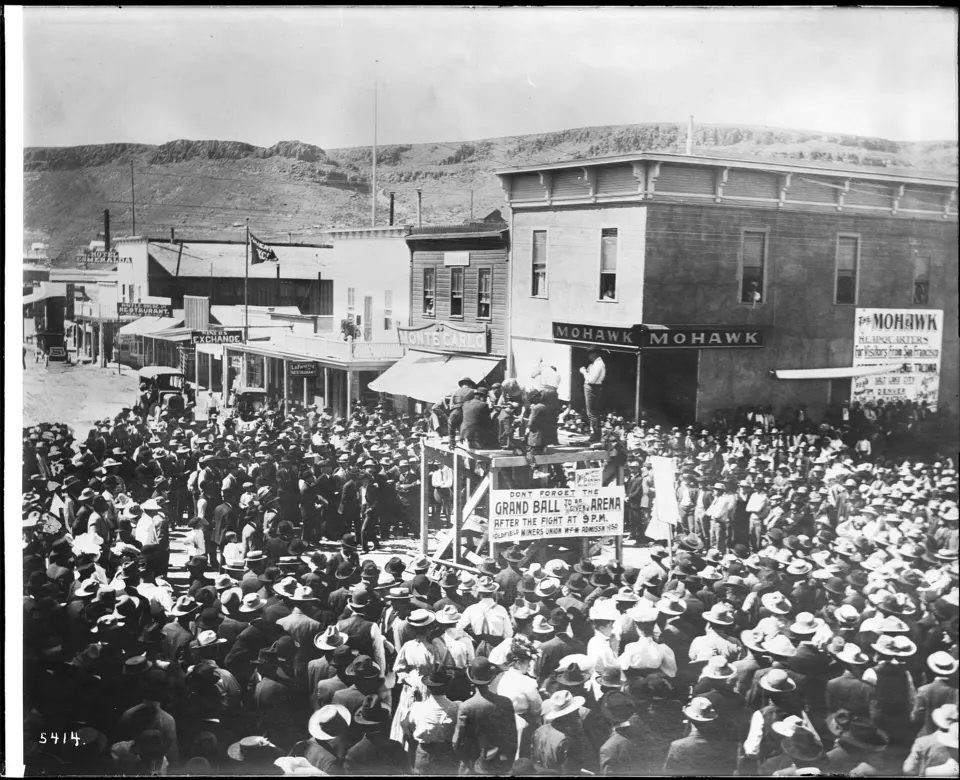
Goldfield had barely existed a few years earlier. A gold strike in 1902 turned the spot into a mining camp, and by 1906 it was Nevada's largest town. HistoryNet's account says it had about 20,000 residents at its peak. The camp's backers needed outside investors, and a national sporting event was a fast way to get Goldfield's name into newspapers.
The man who made it happen was George "Tex" Rickard. He had made and lost money in the Klondike gold rush and run a gambling saloon called the Northern in Dawson City, and now he ran a saloon of the same name in Goldfield. The Goldfield Historical Society says the first approach came from the other direction. Billy Nolan, manager of the lightweight Oscar "Battling" Nelson, wired the town asking for a fight. Writing in Wild West magazine, Don Stradley says that in August 1906 Rickard and 27 other local businessmen formed the Goldfield Athletic Club to stage it. In a 2014 column, John L. Smith adds that the mining financier George Wingfield and the stock promoter George Graham Rice were involved too, both hoping the event would bring investors to the district.
Gold Coins in a Bank Window
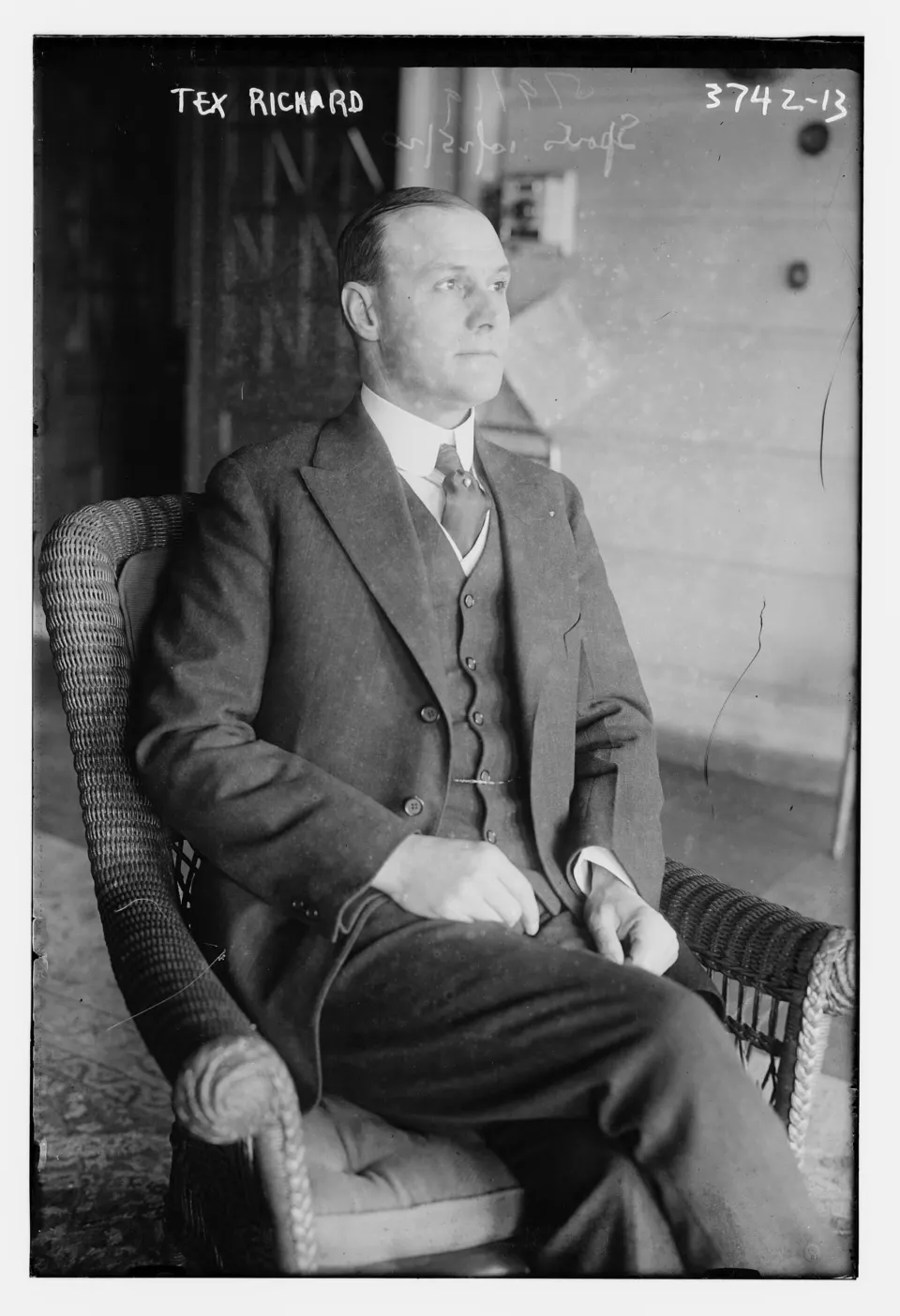
Nolan and Nelson doubted that a desert mining camp could actually pay. Rickard answered by showing them the money. The Goldfield Historical Society says he had $30,000 in $20 gold pieces stacked at the John S. Cook Bank for them to inspect. Stradley says Rickard also posed with the coins for publicity photographs, and that the purse eventually reached $32,000 in gold.
The split favored the challenger. The Historical Society and Smith both give Nelson $22,500 and the champion, Joe Gans, $11,000. Writing in The Sweet Science in 2004, Sam Gregory gives a total purse of $33,500 and says each fighter also got a $2,000 signing bonus and $500 for expenses. He also says Gans went off as a 2-to-1 favorite even though he was paid less than half as much. According to Smith, Gans accepted those terms because a recent divorce had left him nearly broke.
The weight terms were also set against him. The Goldfield Historical Society says Nolan made Gans weigh no more than 133 pounds, at ringside and in full boxing gear, and that losing the weight made him ill before the fight. Gans was 31, held the world lightweight title, and was widely known as the Old Master. Nelson was 24. He had been born in Copenhagen and was known as the Durable Dane.
Labor Day at the Edge of Town
An open-air arena was built on the edge of Goldfield. The Historical Society says it was near the cemetery, and Stradley puts its capacity at about 8,000, with tickets priced from $5 to $25. Every hotel in town was full. Kermit Roosevelt, President Theodore Roosevelt's son, was among the spectators. The sources give different figures for the gate. The Historical Society and Wikipedia both cite $69,715, a record at the time. Stradley says receipts were over $70,000, and Gregory gives $76,000. The Historical Society puts attendance at more than 8,000.
The race of the two fighters was part of how the fight was sold. Gans was Black and Nelson was white. Stradley writes that Nelson called himself the holder of the "white lightweight championship," and that Rickard promoted the fight as a battle of the century. Smith writes that the mostly white crowd started out behind Nelson but came around to Gans as the afternoon went on, impressed by how calmly he took both Nelson's punches and the racial taunts.
Sources also differ on how long the fight was scheduled to go. Wikipedia calls it a fight to the finish, while Gregory calls it a 45-round bout. Either way it was expected to be long, and George Siler was the referee.
Forty-Two Rounds in the Heat
According to Gregory, the first bell rang just after 3 p.m. and the temperature in the ring was above 100 degrees. In the eighth round Gans knocked Nelson down with a right cross and a left hook. From the ninth round on, Nelson concentrated on the body. Gregory reports that Nelson's corner shouted at him to use his head, and Stradley says Nelson both butted and kicked as the fight went on.
Wikipedia says Gans knocked Nelson down several times but could never keep him down. Smith writes that after one knockdown Gans helped Nelson back to his feet. Smith also says Gans broke his right hand in the 33rd round and fought most of the rest of the way with only his left.
The ending came after nearly three hours. Early in the 42nd round Nelson hit Gans below the belt, and Gans went down in pain. Siler ruled it a foul at once, disqualified Nelson and gave the fight to Gans. The Goldfield Historical Society calls the nearly three-hour bout a record for its length.
What Goldfield Got for Its Money
The town got the national attention it had paid for. The Historical Society says Rickard came away with about $11,000 in profit, and the fight established him as a promoter who could produce record gates. He went on to promote Jack Dempsey's heavyweight fights, was behind the development of Madison Square Garden and founded the New York Rangers. He died in 1929. The fight was also filmed. The Silent Era film database lists a five-reel Miles Brothers film of the fight, copyrighted on October 4, 1906, and notes that a print survives.
The boom did not last. Stradley says Goldfield's population fell to 4,838 by 1910. A historic marker in Goldfield now commemorates the fight.
Colma, 1908: Nelson's Two Revenges
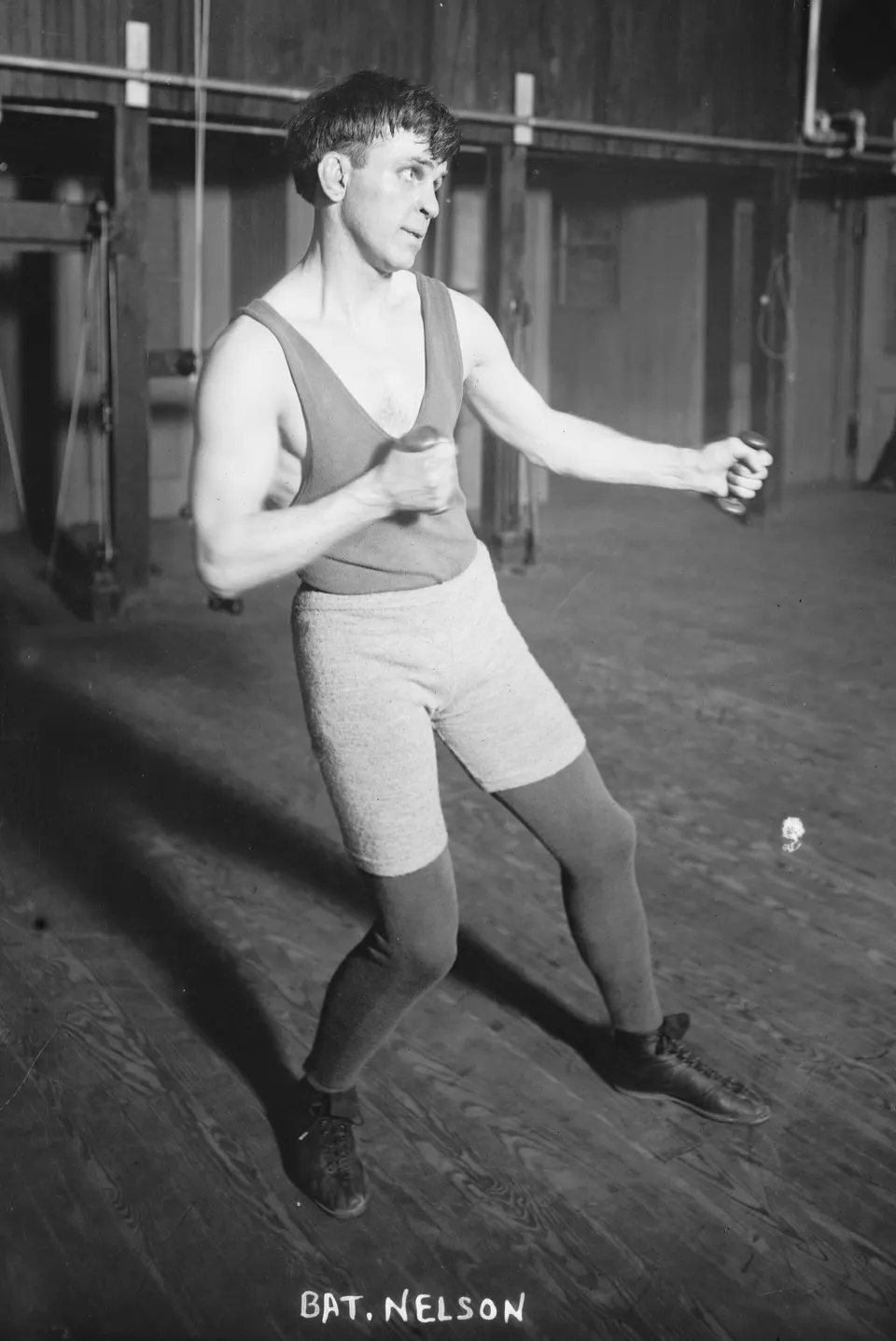
Nelson got his rematch on July 4, 1908, at the Mission Street Arena in Colma, California, just south of San Francisco. It was scheduled for 45 rounds. Wikipedia says Nelson's side again set the weight terms, and Gans had to weigh in at ringside at no more than 132 pounds, fully dressed. Nelson knocked him out in the 17th round and took the world lightweight title.
They fought a third time at the same arena on September 9, 1908, and Nelson won again, by knockout in the 21st round. The Selig Polyscope Company filmed the fight, and the Silent Era database lists a four-reel film released on September 21. Wikipedia says the film was shown in theaters across the country.
Gans was already ill by then. Wikipedia says he was dying of tuberculosis by the time of the Colma fights. The Goldfield Historical Society says he kept boxing through 1907 and 1908 while the disease advanced, so that his family would have money. He died in Baltimore on August 10, 1910, at 35. Nelson lived until February 7, 1954, when he died in Chicago. Smith notes that Nelson never fought in Nevada again. Nelson won the last two fights, but it is the 42 rounds in Goldfield that both men are remembered for.
Sources
- "Tex" Rickard, Goldfield's Great Promoter, Stewart Luce, Goldfield Historical Society, accessed October 2026
- Joe Gans (Joseph Saifus Butts) The Old Master, Colleen Aycock and Mark Scott, Goldfield Historical Society, accessed October 2026
- To Lure Investors to Goldfield, Nevada, Tex Rickard Promoted a Prizefight, Don Stradley, HistoryNet (Wild West), June 13, 2017
- Goldfield is sacred ground for boxing fans, John L. Smith, Pahrump Valley Times, September 19, 2014
- Gans versus Nelson: A Boxing Classic, Sam Gregory, The Sweet Science, October 18, 2004
- Joe Gans; Battling Nelson; Tex Rickard, Wikipedia, accessed October 2026
- Gans-Nelson Contest, Goldfield, Nevada, September 3, 1906; Nelson-Gans Fight Pictures (1908), Silent Era Progressive Silent Film List, accessed October 2026


