
Joe Gans, the Old Master, Was Baltimore's Lightweight King and Fought the 42-Round War in Goldfield
Joe Gans rose from Baltimore's battle royals to become the first American-born Black world champion in 1902, beat Battling Nelson over 42 rounds in Goldfield in 1906, and died of tuberculosis in 1910 at 35.

Joe Gans came out of the Baltimore waterfront, survived the degrading "battle royal" exhibitions staged for white crowds, and in 1902 became the first American-born Black boxer to win a world title. Four years later he outlasted Battling Nelson over 42 rounds in the Nevada desert. Tuberculosis killed him in 1910, at 35.
Joseph Gant of Baltimore
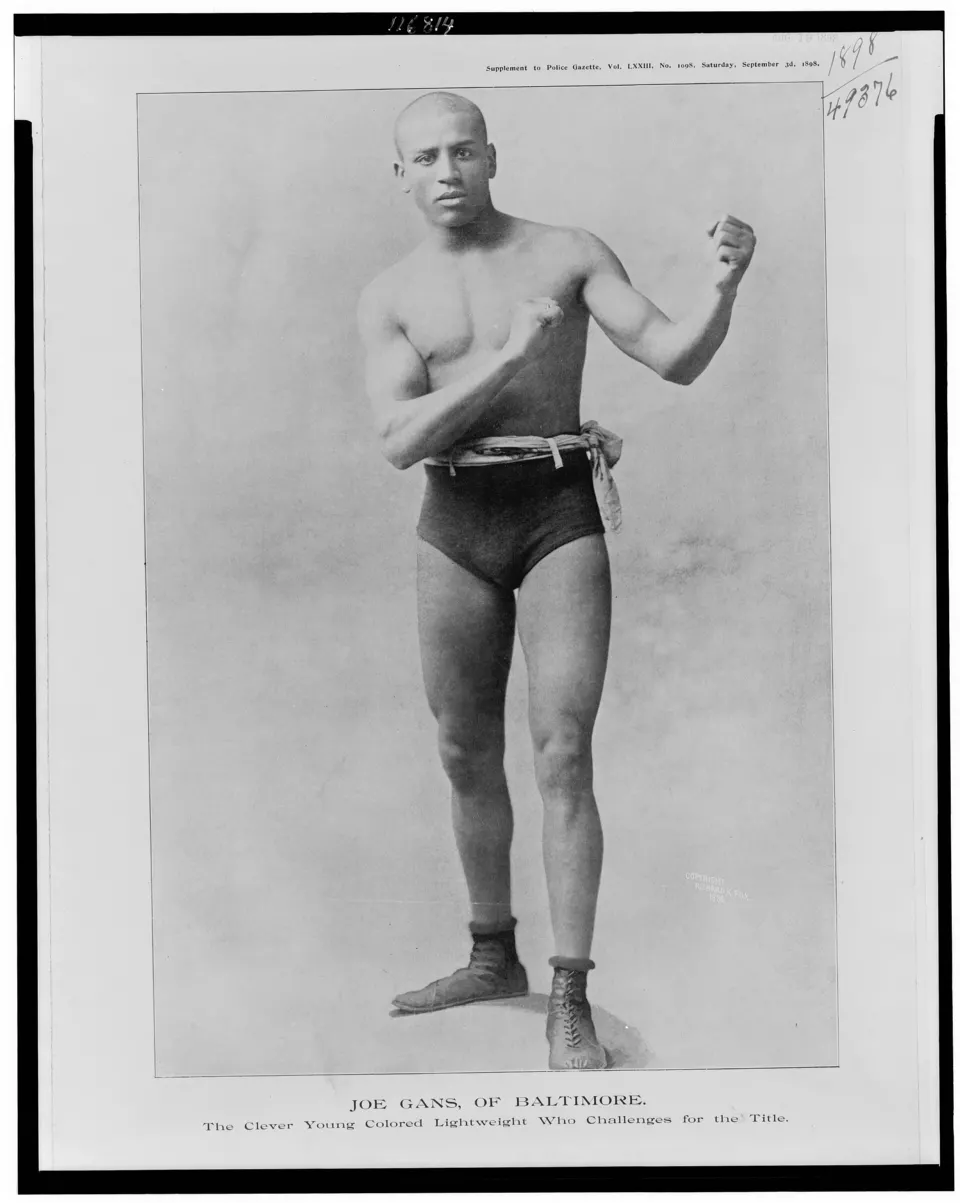
He was born in Baltimore on November 25, 1874. Wikipedia gives his birth name as Joseph Saifus Butts, and the Marin History Museum says no record of his biological parents survives. He was raised by a foster mother, Maria Gant, and grew up as Joseph Gant. The name the world knew him by came from a newspaper error. The inscription on his grave puts it in his own words: "my right name is Joseph Gant, not Gans."
As a teenager he worked at a Baltimore market, which the Marin History Museum describes as shucking oysters and NPR, drawing on William Gildea's 2012 book The Longest Fight, describes as a fish market. His supervisor there boxed as an amateur coach. According to Gildea, that man helped him buy his first gloves and taught him the basics.
His first paid fights were battle royals, spectacles in which white promoters put several young Black fighters in one ring and paid the last man standing a few dollars. Gildea told NPR that it was "virtually futile" for a young Black man to expect fame to come out of one of those brawls. Gans turned professional in Baltimore in 1891 and was later signed by the manager Al Herford.
The Making of the Old Master
Gans did not win by overwhelming people. Accounts of his career describe a methodical, defensive boxer who studied his opponents, moved his feet precisely, and worked behind a jab. Gildea says Gans usually let the other man, who was often white, throw first so he could counter. He also says Gans sometimes let fights run a few rounds longer than he needed to, so that he would not humiliate a white opponent in front of a white crowd. The nickname "the Old Master" came from that patient style.
His first title shot was a loss. On March 3, 1900, at the Broadway Athletic Club in New York, he challenged lightweight champion Frank Erne and retired in the twelfth round with an eye injury. Later that year, on December 13 in Chicago, Terry McGovern stopped him in two rounds.
One Round at Fort Erie, 1902
Gans got his rematch with Erne on May 12, 1902, at the International Athletic Club in Fort Erie, Ontario, just across the river from Buffalo. It lasted less than a round. A blow-by-blow account preserved on BoxRec says Gans bloodied Erne's nose with a left, then landed a right on the jaw, and Erne went down and was counted out.
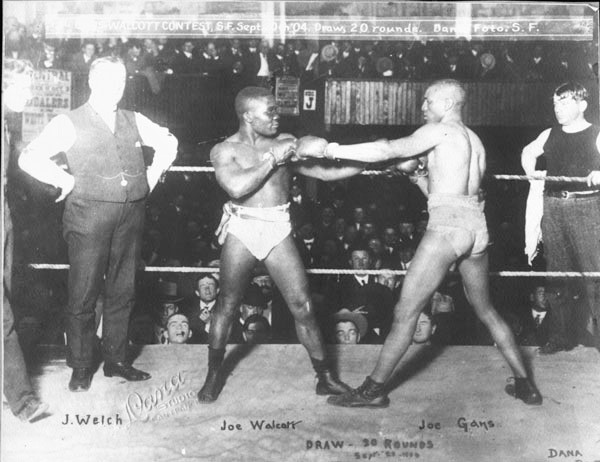
With that win Gans became world lightweight champion and the first American-born Black boxer to hold a world title. Two Black fighters had won world titles before him, but neither was born in the United States: George Dixon, a Canadian, took the bantamweight title in 1892, and Barbados Joe Walcott won at welterweight in 1901. Gans kept the lightweight title until 1908, and Wikipedia counts 15 defenses against 13 different challengers. He also fought above his weight. On September 30, 1904, he and Walcott boxed a 20-round draw in a fight announced as a non-title bout. The San Francisco Chronicle reported that Walcott's left arm was hurt early in the fight.
Forty-Two Rounds in Goldfield, 1906
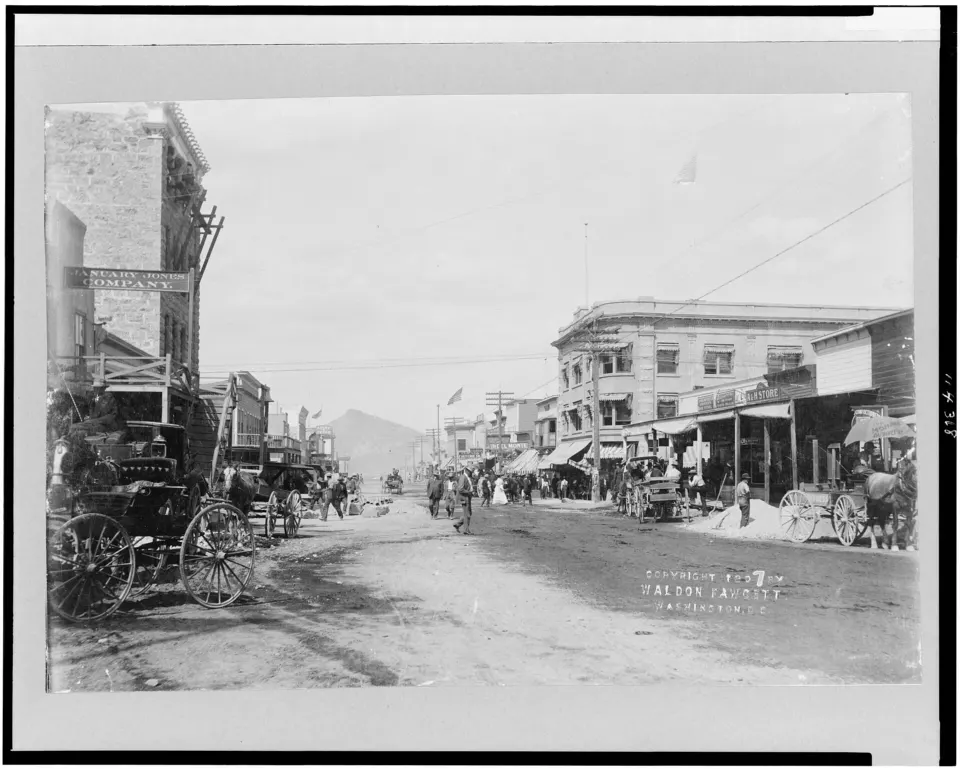
By 1906 Goldfield, Nevada, was a gold-rush boomtown with money to spend, and Tex Rickard, a gold prospector turned promoter, signed Gans to defend his title against Oscar "Battling" Nelson, the brawler known as the "Durable Dane," on Labor Day, September 3. The Goldfield Historical Society calls it the first "Fight of the Century" promoted by Rickard, who later staged Jack Dempsey's million-dollar fights. The fight was scheduled to the finish, so it would continue until one man could not go on.
The financial terms were stacked against the champion. Boxing News reports a purse of $34,000, put on display as stacks of $20 gold coins, with $22,500 going to Nelson and $11,000 to Gans. The Goldfield Historical Society puts the purse at $30,000, so the sources disagree on the total. Nelson's manager, Billy Nolan, insisted that Gans make 133 pounds and threatened to call off the fight if he came in over. According to the Goldfield Historical Society, Gans had to make that weight at ringside in full gear, which left him weakened before the first bell.
Before the fight, the ring announcer read out telegrams from well-wishers, as was the custom. The Goldfield Historical Society records one from Gans's foster mother: "Joe, the eyes of the world are upon you." It also credits her message, which asked him to bring back the bacon, and the newspaper coverage that followed with spreading that phrase into everyday English.
More than 8,000 people paid over $90,000 to watch at the Casino arena, the largest gate in boxing up to that time. Kermit Roosevelt, the president's son, was in the crowd. The fight went on for nearly three hours in heat that the Marin History Museum puts above 100 degrees. Boxing News reports that Gans broke his hand on Nelson's head in the 33rd round and kept the injury hidden. In the 42nd round Nelson landed a low blow, and Gans was awarded the fight on a foul. NPR quotes Gildea as saying no fight of that length has been staged since. Some sources date the fight to 1905, but most, including the Goldfield Historical Society, give 1906.
The Goldfield Hotel and the Colma Defeats
Gans put his Goldfield earnings into a business back home. The Goldfield Historical Society says he opened the Goldfield Hotel in Baltimore, a mixed-race "black and tan" club where the ragtime pianist Eubie Blake got his first major engagement. The same source says that during 1907 and 1908 tuberculosis was already damaging his body and that he kept fighting so his family would have money after his death.
Nelson got his rematch on July 4, 1908, at Colma, California, just south of San Francisco. Wikipedia reports that Nelson's side set the weight terms again and that Gans had to weigh in at ringside at no more than 132 pounds. Nelson knocked him out in the 17th round and took the title. They fought a third time at Colma on September 9, and Nelson won by knockout in the 21st round. A four-reel film of the second Colma fight was shown in cities across the country.
Death and Memory
Joe Gans died of tuberculosis in Baltimore on August 10, 1910, at the age of 35. He is buried at Mount Auburn Cemetery in Baltimore. Boxing News says he developed the disease after the Goldfield fight and links it to the severe weight cutting he was forced into. Other sources say only that the illness was already advanced by his final fights.
Totals for his career vary. Wikipedia, citing BoxRec, lists 145 wins (100 by knockout), 10 losses and 16 draws, plus no-contests and newspaper decisions. The Marin History Museum gives 158 wins, 12 losses and 20 draws. Fights from that era were poorly documented, so exact numbers are hard to settle.
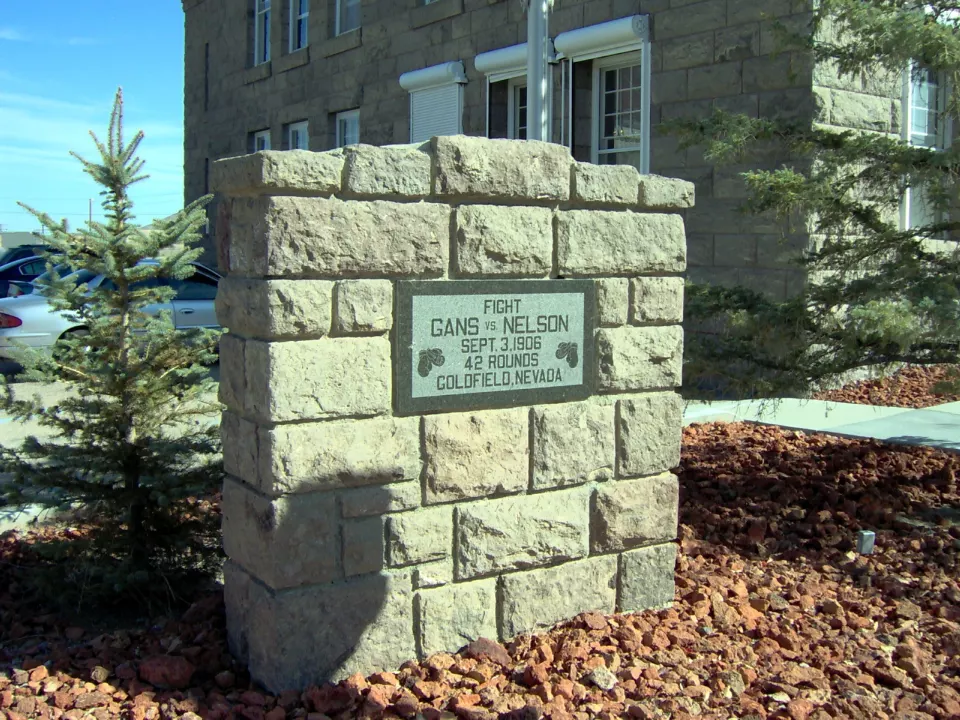
Ring Magazine founder Nat Fleischer rated Gans the greatest lightweight of all time. He was inducted into the International Boxing Hall of Fame in 1990. A bronze statue of him stands at Madison Square Garden, and a marker in Goldfield commemorates the 1906 fight. On November 25, 2024, the 150th anniversary of his birth, Maryland and Baltimore officials proclaimed Joe Gans Day. Gildea told NPR that Gans has been less remembered than Jack Johnson, partly because he was a lightweight and partly because white America's backlash against Johnson pushed the quieter Gans out of the story.
Sources
- Joe Gans, Wikipedia (citing BoxRec and the International Boxing Hall of Fame), accessed October 2026
- Rediscovering A Forgotten Boxer's 'Longest Fight', NPR, June 16, 2012
- On this day: Joe Gans defeats Battling Nelson via 42nd-round disqualification in Goldfield, Boxing News
- Joe Gans (Joseph Saifus Butts) The Old Master, Colleen Aycock and Mark Scott, Goldfield Historical Society
- Joe Gans, Marin History Museum blog


