
Dempsey vs Willard, Toledo 1919, Saw Seven Knockdowns, a Missed Whistle and the Loaded-Gloves Myth
On 4 July 1919 Jack Dempsey floored Jess Willard seven times in the first round in Toledo and took the heavyweight title when Willard's corner quit after the third. Decades later Jack Kearns claimed the gloves were loaded, a story eyewitnesses and film evidence contradict.

On Independence Day 1919, on a wooden arena by Maumee Bay in Toledo, Ohio, a 24-year-old challenger weighing 187 pounds put the 245-pound heavyweight champion of the world on the canvas seven times in a single round. Three rounds later Jess Willard's corner gave up, Jack Dempsey was champion, and a fight that lasted barely nine minutes of action began a debate that would run for decades.
A Giant Champion and a Hungry Challenger
Jess Willard had held the heavyweight title since beating Jack Johnson in Havana in 1915, and by the summer of 1919 he had defended it sparingly. He arrived in Toledo aged 37 and a half, standing six feet six and a half inches and weighing 245 pounds. Jack Dempsey was 24, about six feet one, and 187 pounds. On paper the gap in size was enormous: almost sixty pounds and more than five inches of height.
The money reflected the champion's status. Willard was guaranteed $100,000, while Dempsey's share was $27,500. The promoter was Tex Rickard, the man who held the box office, and Dempsey's manager was Jack "Doc" Kearns, a figure who would loom over the fight's reputation long after the final bell.
A Wooden Stadium on Maumee Bay
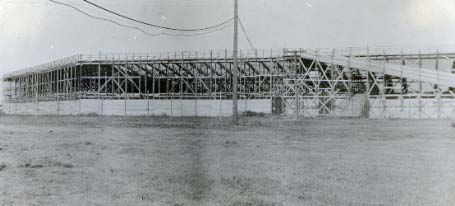
Toledo got the fight in part through Addison Q. Thacher, a local contractor and boxing enthusiast, according to Toledo historian Tedd Long. The arena was built from timber for this single event, designed by the San Francisco engineer James McLaughlin for a crowd of 80,000, on land that is now Bayview Park.
How many people actually filled it is still argued over. The official count was 19,650 paid spectators. Grantland Rice, writing for the New York Tribune the next day, put the crowd at around 50,000, and a later analysis by Steven K. Doig, cited by Long, argued for at least 50,000. Other modern retellings settle on 45,000. The reported gate was about $452,000, a figure that pointed the way toward the million-dollar promotions Rickard and Dempsey would later stage.
The weather is just as hard to pin down. Every account agrees it was brutally hot, but the numbers vary: Rice wrote of a 114-degree sun, some later histories say 110, and Long's account says only that temperatures went past 100.
Seven Times Down in Round One
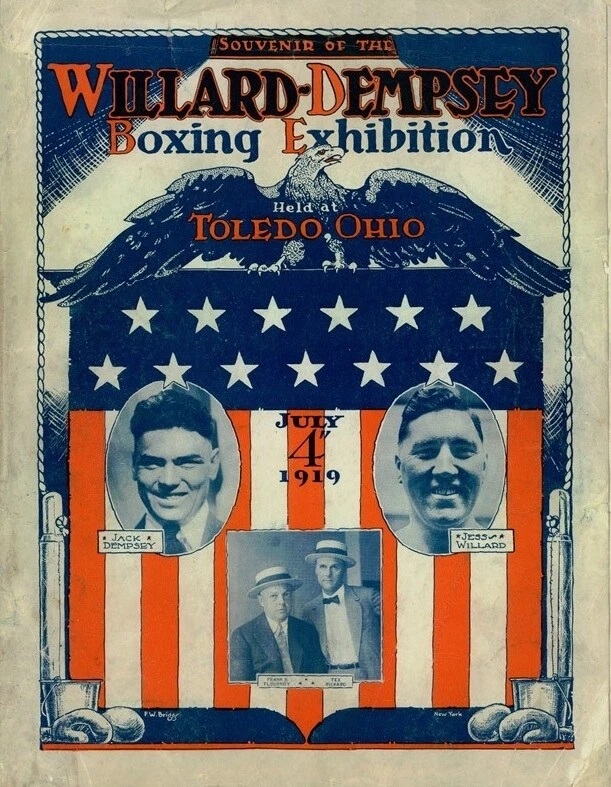
The referee was Ollie Pecord and the timekeeper W. Warren Barbour. Once the first round began, the size difference stopped mattering. Dempsey's first knockdown came from a left hook, and he went on to drop Willard six more times before the round ended. The rules of the day did not make him go to a neutral corner. He could stand close to the fallen champion and hit him again as soon as Willard's gloves came off the canvas, and he did so repeatedly.
At the end of that round came a moment that nearly undid everything. Dempsey left the ring believing Pecord had counted Willard out and the title was his. In fact Barbour had blown his whistle to end the round before the count finished, but in the crowd noise neither the referee nor the challenger heard it. Leaving the ring could have cost Dempsey the fight on a disqualification. Willard had saved money by doing without experienced professional seconds, and his corner did not press the point, so Dempsey was brought back and the bout went on.
Rounds Two and Three, and the Corner's Decision
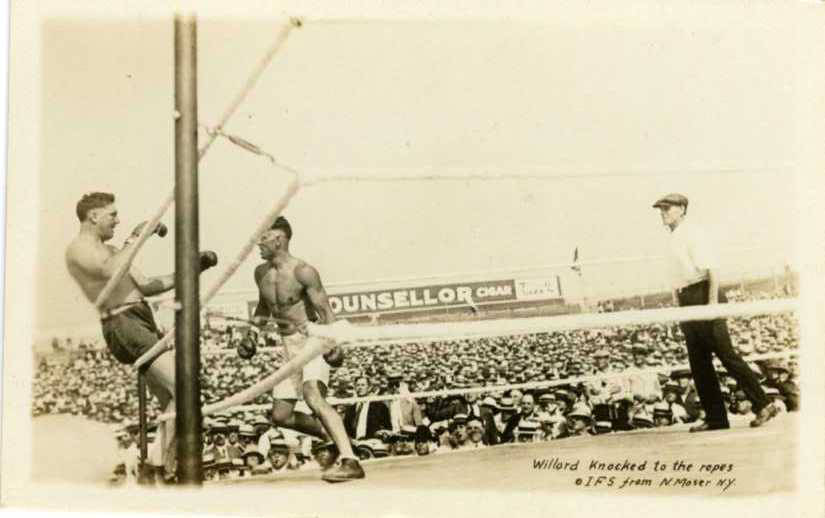
Willard survived the second and third rounds, but Dempsey kept control of both without scoring another knockdown. Rice described a champion whose right eye had closed and whose face had become badly disfigured, while noting that Dempsey himself came through it unmarked. Damon Runyon also wrote of the right side of Willard's face as a ruined mass. Before the bell for the fourth round, Willard's corner stopped the fight. Dempsey was the new heavyweight champion of the world.
What the Damage Really Was
The list of Willard's injuries grew in the retelling. Many later accounts say he suffered a broken jaw, a broken cheekbone, broken ribs and lost teeth, and some add partial hearing loss in one ear. Contemporary reporting was less dramatic. The New York Times account, as summarised in the Wikipedia history of the fight, did not mention broken bones and described swelling on one side of his face, and other reports from the time spoke of a deep cut over the eye and a badly cut mouth. The difference matters, because the more extreme version of the injuries later helped make the loaded-gloves story sound believable.
Kearns and the Loaded Gloves
Dempsey and Kearns had long since split acrimoniously when Kearns gave his own version of Toledo. In a Sports Illustrated piece dated 20 January 1964, he claimed he had put plaster of Paris on the wrappings under Dempsey's gloves, and that Dempsey never noticed. One later account dates Kearns's article to 1963; Wikipedia's history of the fight gives the January 1964 issue.
Dempsey denied it and sued Time Inc., the magazine's publisher, for $3 million. The case was settled out of court in September 1965 for an amount that was never disclosed.
The Rebuttals
The strongest denial came from Nat Fleischer, founder of The Ring, who said he had watched the hands being wrapped. "Jack Dempsey had no loaded gloves, and no plaster of Paris over his bandages," Fleischer said, adding that the only man who handled the taping was trainer Jimmy DeForest, not Kearns.
Other evidence pointed the same way. Footage from before the fight shows Dempsey's gloves being put on in the open with nothing visibly added. Fight film shows him pushing Willard with open hands and gripping the ropes with both, which would have been very difficult with hardened wraps. Boxing Illustrated later showed that plaster of Paris would crack as soon as it struck something, and Long's account adds that a fist set in plaster would break the hand rather than the opponent. A separate legend about an iron spike hidden in a glove is contradicted by the same film.
The gloves themselves never settled the question. By one account Dempsey put a pair under the cornerstone of his New York restaurant in December 1934, while a former bantamweight champion, Babe Herman, said he had been given them. They were never examined, and nobody knows for sure where they are.
What Toledo Started
Willard had taken the title from Jack Johnson and lost it to a far smaller man in three rounds. Dempsey went on to help build the era of the million-dollar gate, starting with his fight against Georges Carpentier in 1921. The wooden stadium was a one-event building. The argument over what happened in Toledo, from the crowd and the heat to Willard's injuries and Dempsey's hands, has lasted far longer than the arena did.
Sources
- Jess Willard vs. Jack Dempsey, Wikipedia, accessed October 2026
- Jack Dempsey, Wikipedia, accessed October 2026
- The Truth About Toledo's Day in the Sun, Tedd Long, Holy Toledo History, 3 July 2019 (updated 17 September 2025)
- The Dempsey-Willard Fight, Grantland Rice, New York Tribune, 5 July 1919 (reprinted by Deadline Artists)
- Where Are The Gloves From The Dempsey/Willard Fight?, Boxing Over Broadway, undated


