
Ross vs McLarnin Produced Three Welterweight Title Fights and Three Disputed Verdicts
In twelve months between 1934 and 1935, Barney Ross and Jimmy McLarnin traded the welterweight championship three times in New York. Ross won two narrow decisions and McLarnin one, and none of the three verdicts went unchallenged.

Between May 1934 and May 1935, Barney Ross and Jimmy McLarnin fought three times for the welterweight championship of the world, each time over fifteen rounds in New York, each time in front of tens of thousands of people under the open sky. The title changed hands after every fight. Ross won two of the three, McLarnin one, and not one of the verdicts was beyond argument.
Two champions on a collision course
By the spring of 1934 both men had already climbed as high as most fighters ever do. McLarnin, born in Ulster in December 1907 and raised in Vancouver after his family left the Saskatchewan prairie, had been shaped since boyhood by Charlie "Pop" Foster, a former carnival fighter who stayed his manager and friend for the rest of his career. Sources differ on his birthplace: Wikipedia gives Hillsborough in County Down, while The Canadian Encyclopedia names Belfast. His youthful looks earned him the nickname "Baby Face," and on May 29, 1933, in Los Angeles, he took the welterweight title by stopping Young Corbett III at 2:37 of the very first round.
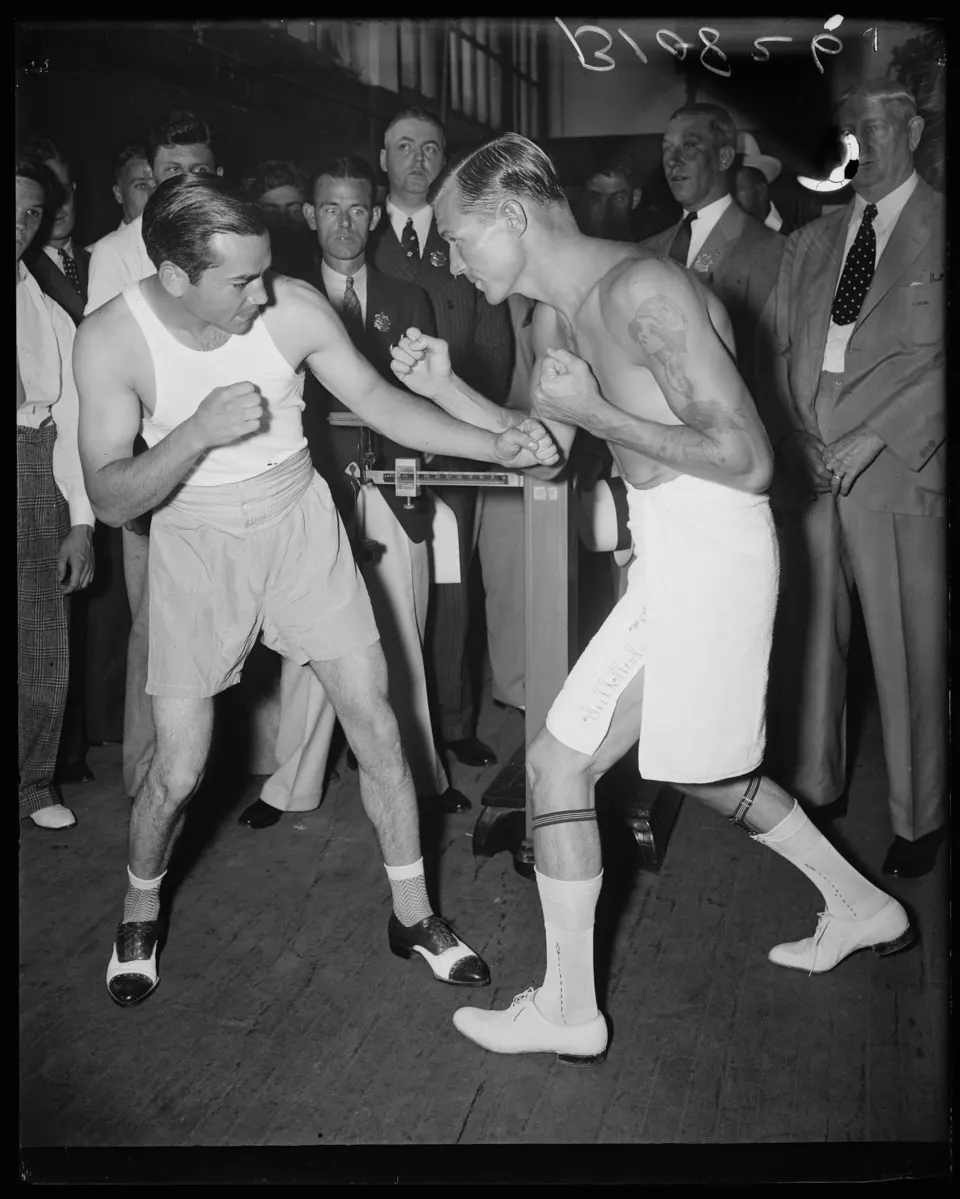
Ross, born Dov-Ber Rosofsky in New York in 1909 and raised in Chicago's Jewish ghetto, came into the fight already holding the lightweight and junior welterweight titles. Victory over McLarnin would put a third championship in his hands at the same time, something no boxer had managed before.
The matchup carried a charge beyond the belts. A Kirkus review of Douglas Century's biography of Ross describes the atmosphere at their fights as heavy with tribal rivalry: bands played McLarnin to the ring with Irish jigs, and Ross walked out to "My Yiddische Mamme."
May 28, 1934: a split verdict in the Garden Bowl
The first fight was staged at the Madison Square Garden Bowl, an outdoor arena of wooden bleachers that had opened in 1932 at 48th Street and Northern Boulevard in Long Island City, Queens. It was McLarnin's first defense of the title. Boxing News reports that officially almost 40,000 people paid close to $200,000 to get in, with unofficial estimates closer to 60,000.
The fight went the full fifteen rounds and ended in a split decision for Ross. By the account in Boxing News, the general view at ringside was that he had won clearly, even if one official disagreed. With the result, Ross became the first lightweight champion ever to add the welterweight title as well, and the first man to hold championships in three divisions at once. The Ring later listed the bout as its Fight of the Year for 1934.
September 17, 1934: McLarnin takes it back
Less than four months later the two men returned to the same arena in Queens, now with Ross as champion and McLarnin as challenger. Again they went fifteen rounds, and again the officials split, this time in McLarnin's favour. The decision returned the New York, National Boxing Association and Ring welterweight titles to the Irishman.
The verdict did not settle anything in the public mind. When the United Press reported on the third fight the following spring, its correspondent noted that both earlier meetings had left considerable disagreement and dissatisfaction among spectators. The Garden Bowl itself was gathering a reputation; Wikipedia records that it became known as the "Jinx Bowl" because so many champions lost their titles there.
May 28, 1935: the rubber match at the Polo Grounds
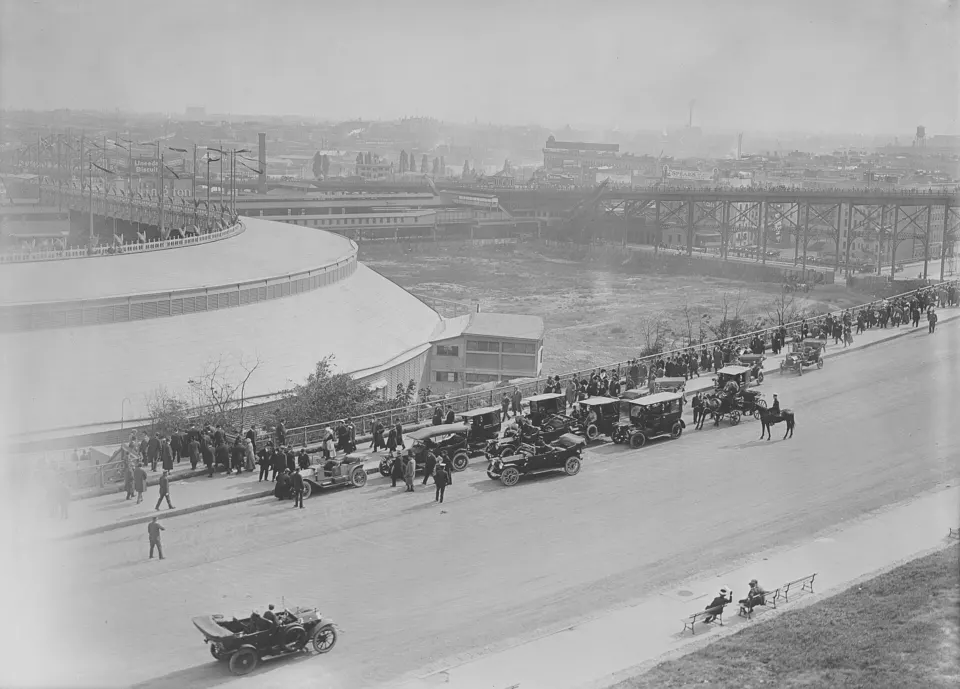
The decider was moved across the river to the Polo Grounds, the home of baseball's New York Giants, and set for the first anniversary of the original fight. The size of the crowd depends on whom you read. The Canadian Encyclopedia puts it at 40,000; the United Press dispatch filed that night said more than 43,000.
The UP account, preserved in a digitised copy of the University Daily Kansan from the next day, called this the third and most savage of their title fights. It portrayed a heavier, stronger and much improved Ross pressing forward for fifteen rounds, driving hooks with both hands to McLarnin's body and head. The same report credited McLarnin with one of the best performances of his career, which made the margin all the more narrow.
This time the decision was unanimous, but only just. An Associated Press photo caption, transcribed by a memorabilia dealer, gives the cards as 7-5-3, 8-6-1 and 9-4-2 in rounds, all for Ross. With three, one and two rounds scored even, no official had Ross ahead by more than five rounds. Wikipedia describes the outcome as a narrow decision. The UP reporter heard a strong current of booing mixed into the cheers, yet judged that most experts accepted the result.
The same AP caption pointed out that the welterweight jinx had struck again: for the twelfth consecutive time, a champion had lost the title in his first defense.
An even rivalry, by the numbers and in the memory
Across forty-five rounds, the trilogy produced one unanimous decision and two split ones, with the title changing hands each time. Contemporary and later sources agree on the outline but not on every detail. The BC Sports Hall of Fame, for example, refers to four title fights between the two men while describing only three, and attendance figures for the first and third bouts vary from source to source. Boxing News sums up the result in its own way, noting that each fighter went to his grave convinced he had won all three. At the end of their last fight, it adds, the two men embraced in the ring.
After the trilogy
McLarnin never held the title again. He retired in November 1936 and went on to a comfortable life in business. Wikipedia notes that BoxRec ranks him second on its all-time pound-for-pound list, behind only Sugar Ray Robinson. He died in Richland, Washington, in October 2004.
Ross went on to serve in the U.S. Marine Corps in the Second World War and was decorated with the Silver Star at Guadalcanal. He died in Chicago in 1967 and entered the International Boxing Hall of Fame with its first class in 1990; McLarnin is an inductee as well. Their three fights remain the reason the two names are so often mentioned together.
Sources
- Jimmy McLarnin, Wikipedia, accessed October 2026
- Barney Ross, Wikipedia, accessed October 2026
- Madison Square Garden Bowl, Wikipedia, accessed October 2026
- The Ring magazine Fight of the Year, Wikipedia, accessed October 2026
- On this day: one of the toughest fighters ever, Barney Ross, was born in 1909, Nick Bond, Boxing News, December 23, 2017
- Jimmy McLarnin, The Canadian Encyclopedia, accessed October 2026
- Jimmy McLarnin, BC Sports Hall of Fame, accessed October 2026
- United Press report from the Polo Grounds, University Daily Kansan, May 29, 1935, via University of Kansas Digital Collections
- Barney Ross by Douglas Century, book review, Kirkus Reviews, 2006
- Ross-McLarnin wire photo listings with original AP and ACME captions, JO Sports Inc., accessed October 2026


