
Jeffries vs Fitzsimmons in 1899 Ended With the Boilermaker's Eleventh-Round Knockout at Coney Island Before the 1902 Rematch
On June 9, 1899, the unbeaten James J. Jeffries knocked out Bob Fitzsimmons in the 11th round at Coney Island to win the heavyweight title; three years later he survived a beating in San Francisco to stop Fitzsimmons again in the eighth.

On June 9, 1899, at Coney Island in Brooklyn, a 24-year-old former boilermaker named James J. Jeffries walked into the ring as the underdog against Bob Fitzsimmons, the man who had taken the heavyweight title from James J. Corbett two years earlier. Eleven rounds later Fitzsimmons was on the canvas and Jeffries was champion of the world. Three years after that, in San Francisco, they did it again.
Two Years of Theatre for the Champion
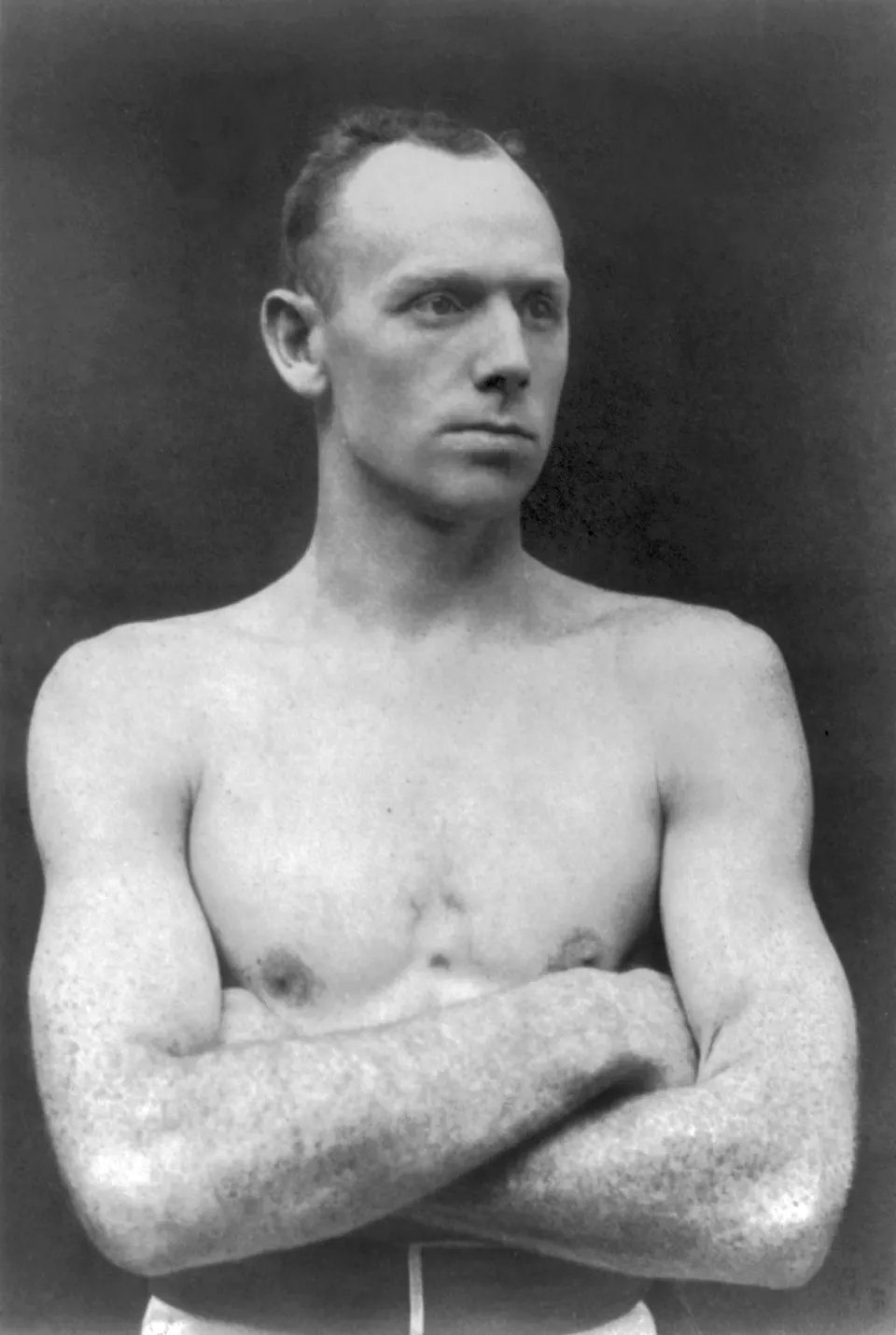
Bob Fitzsimmons was one of the strangest heavyweight champions the sport has produced. Born in Helston, Cornwall, on May 26, 1863, he moved with his family to Timaru, New Zealand, in 1873 and learned to swing a hammer in the family blacksmith's forge. The work, by Wikipedia's account, built up his upper body considerably. He won the middleweight championship from Jack (Nonpareil) Dempsey in New Orleans in January 1891, then climbed all the way to heavyweight, stopping Corbett with his famous body shot in the 14th round at Carson City, Nevada, on March 17, 1897.
Wikipedia lists him at 5 feet 11½ inches and 167 pounds when he won the heavyweight crown, which is why he is often called the lightest man ever to hold it. Having won it, he did not defend it right away. According to Wikipedia's account of his career, he spent the rest of 1897 and all of 1898 touring the stage. When he finally agreed to put the title on the line, more than two years after Carson City, the opponent was a young Californian who had never lost.
The Boilermaker From Carroll, Ohio
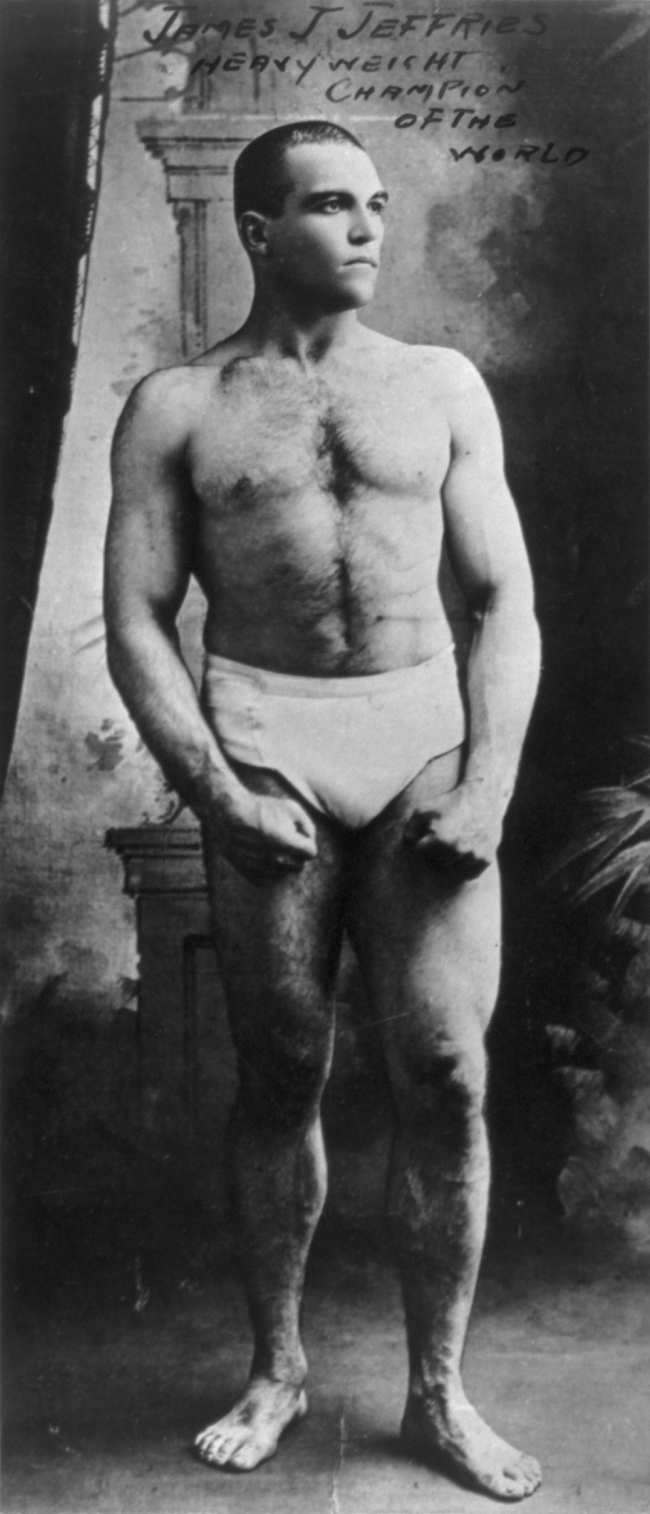
James Jackson Jeffries was born in Carroll, Ohio, on April 15, 1875, and grew up in Los Angeles, where he worked as a boilermaker. He was far bigger than Fitzsimmons and, by the standards of the day, unusually fast for his size. Part of his education came inside the champion's own story: before Corbett met Fitzsimmons in 1897, Jeffries had worked as one of Corbett's sparring partners.
His own record was short but unbeaten. Wikipedia lists a 20-round draw with Joe Choynski in San Francisco on November 30, 1897, and a 20-round decision over Tom Sharkey at Mechanics' Pavilion on May 6, 1898, a fight in which Sharkey was dropped in the 11th. The Fight City notes that the Fitzsimmons bout was only the 14th of Jeffries' professional career.
A Crouch Built for One Opponent
The physical gap between the two men was obvious, but the stylistic plan behind Jeffries is where the sources part ways. Wikipedia and the New World Encyclopedia credit his trainer, the former welterweight and middleweight champion Tommy Ryan, with teaching him to fight from a low crouch, left arm pushed out in front. The New World Encyclopedia adds that Jeffries worked up a left hook and a short straight left he could throw from that crouch, with the long-limbed Fitzsimmons specifically in mind.
Other accounts tell it differently. A 2013 profile in The Sweet Science traces the crouch to the Choynski fight, saying a punch from Choynski broke Jeffries' nose and teeth and that he changed his stance afterward. Wikipedia's article on Ryan records that Jeffries himself disputed Ryan's role and said the stance came to him instinctively after he was hit by another fighter, John Brink. The crouch is real; who deserves the credit for it is not settled.
Odds, Weights and a Brooklyn Arena
None of that seems to have moved the betting public. Wikipedia's Fitzsimmons article says most people gave Jeffries little chance, even though he was much younger and much heavier. The Sweet Science puts the weights at 206 pounds for Jeffries and 167 for Fitzsimmons and says around $100,000 was wagered on the result.
The venue is usually given as the Coney Island Athletic Club in Brooklyn, the name used by Wikipedia and by the New World Encyclopedia. The Sweet Science calls it the New Coney Island Sporting Club. Whatever the name on the door, the fight was scheduled for 20 rounds and was the first defense of the title Fitzsimmons had won at Carson City.
Eleven Rounds at Coney Island
The accounts agree on the shape of the fight more than on its details. Jeffries did not try to outbox the champion at range. The Fight City describes the bigger man forcing his way inside Fitzsimmons' guard and working the body, the same target Fitzsimmons had used to beat Corbett.
The first knockdown came early. The New World Encyclopedia records Fitzsimmons going down in the second round. He got up, and the fight went on for several more rounds without a decisive turn. In the tenth Jeffries dropped him twice, both times with left hands according to that account. By The Fight City's count there were four knockdowns in all.
The end came in the eleventh. The New World Encyclopedia describes a left hook followed by a right uppercut. The Sweet Science describes a left hook followed by a right, after which Fitzsimmons fell and rolled onto his side, and says his handlers dragged him back to his corner. Wikipedia records the result as a knockout in the 11th round of 20. The Sweet Science also reports that Corbett, the man Fitzsimmons had dethroned, told the crowd on his way out that an American now held the championship. Jeffries was 24 years old and champion of the world.
A Fight the Cameras Half Caught
The fight also belongs to the early history of film. The Silent Era database lists a picture called The Fitzsimmons-Jeffries Fight, shot on June 9, 1899, by the Vitagraph Company of America and distributed by the Edison Manufacturing Company, and records that a print exists. The Victorian Cinema database says Vitagraph filmed only part of the bout before its arc lights burned out.
The record here is not tidy. The Fight City writes that only two of Jeffries' professional fights were ever filmed and does not count this one, while the cinema databases do. What is clear is that Jeffries' first defense, the 25-round decision over Sharkey at Coney Island on November 3, 1899, was the one filmed in full under artificial light, by the American Mutoscope and Biograph Company.
San Francisco, 1902: The Rematch in Brief
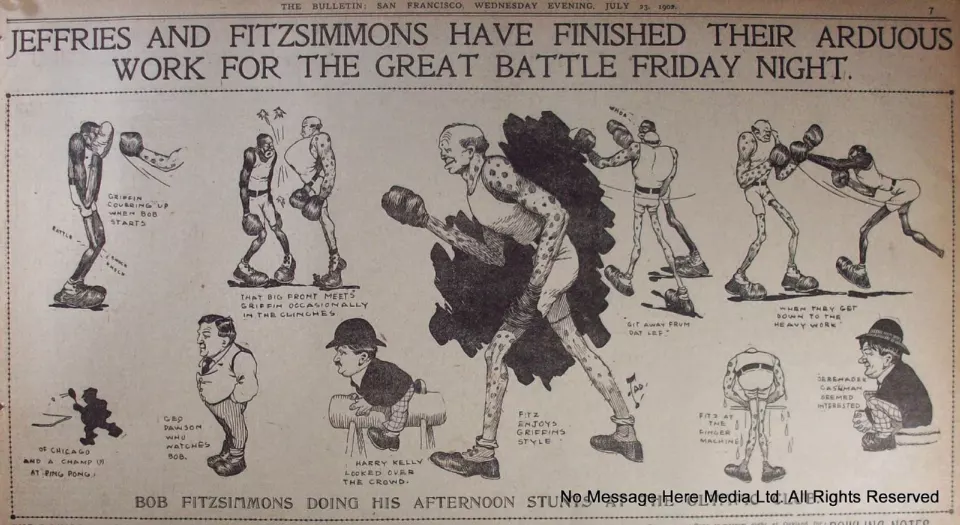
Fitzsimmons did not fade. Wikipedia lists knockouts of Gus Ruhlin and Tom Sharkey in August 1900, and The Fight City says the Sharkey win, in two rounds, built the case for a second meeting. Jeffries kept him waiting. They met again on July 25, 1902, in San Francisco; The Fight City places it at The Arena, while Wikipedia's Fitzsimmons article names the San Francisco Athletic Club. Fitzsimmons was 39, and The Fight City says Jeffries was expected to outweigh him by 30 pounds or more.
Before the fight there were rumours that Fitzsimmons would load his gloves with plaster of Paris. "Let him do it," Jeffries said, according to The Fight City. "I'll flatten him anyway." No plaster was found, though the same article says Fitzsimmons wrapped his hands with electrical tape instead of gauze and no one from Jeffries' corner objected.
For seven rounds the old champion gave the young one a beating. Wikipedia describes Jeffries' nose broken and his cheeks cut to the bone, with gashes over both eyes. Then, in the eighth, Fitzsimmons stopped and dropped his guard. The Fight City says he spoke to Jeffries, though nobody knows what he said. Jeffries answered with a right to the body and a left hook to the jaw, and Fitzsimmons was knocked out. Talk of a fix followed, and both men rejected it. "The fight was won fairly and to the best man belongs the laurels," Fitzsimmons said, as quoted by The Fight City.
Jeffries kept the title until he retired unbeaten in May 1905. Fitzsimmons was not finished either. In November 1903 he won the light heavyweight title from George Gardiner and became the first man to hold world titles in three weight classes.
Sources
- James J. Jeffries, Wikipedia, accessed October 2026
- Bob Fitzsimmons, Wikipedia, accessed October 2026
- Tommy Ryan, Wikipedia, accessed October 2026
- James J. Jeffries, New World Encyclopedia, accessed October 2026
- The Legend of James J. Jeffries, The Sweet Science, October 4, 2013
- July 25, 1902: Jeffries vs Fitzsimmons II, Robert Portis, The Fight City
- The Fitzsimmons-Jeffries Fight (1899), Silent Era Progressive Silent Film List
- James J. Jeffries, Who's Who of Victorian Cinema


