
Bob Fitzsimmons the Cornish Blacksmith Became Boxing's First Three-Division Champion
Born in Helston and raised at his father's forge in Timaru, Bob Fitzsimmons won world titles at middleweight, heavyweight and light heavyweight. His solar plexus punch took Corbett's crown at Carson City in 1897, before two defeats by James J. Jeffries.

He was bald, freckled and thin in the legs, and he often gave away a lot of weight to the men in front of him. Bob Fitzsimmons, a Cornish-born blacksmith raised in a small New Zealand port town, still became the first boxer to win world titles in three weight classes. He took the heavyweight championship from James J. Corbett in Carson City with a body punch that boxing writers have talked about ever since.
From Helston to the Forge in Timaru
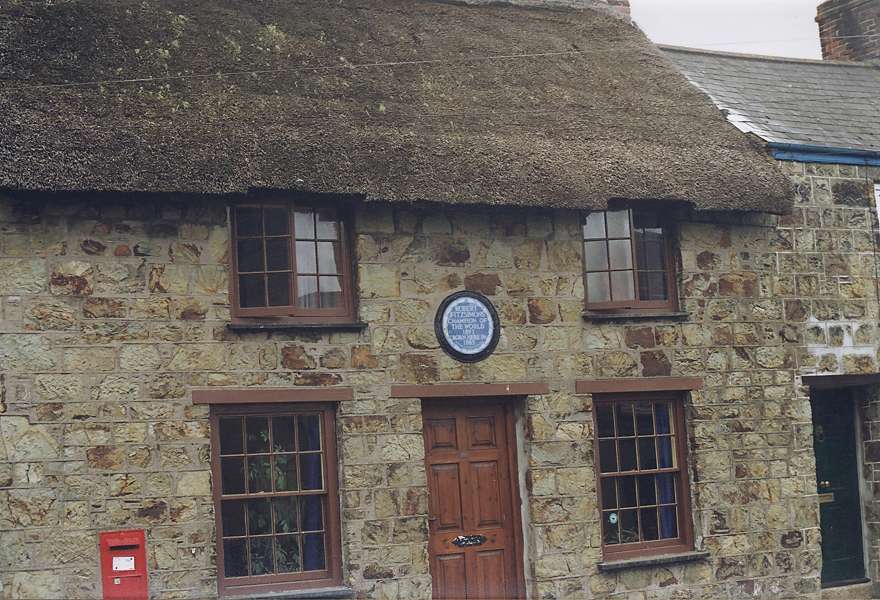
Robert James Fitzsimmons was born in Helston, Cornwall. Most references give the date as 26 May 1863, though some records put it at 4 June 1862, and the old New Zealand biographical entry simply says 1862. The Australian Dictionary of Biography describes his father, James, as a policeman and former soldier from Ireland, and his mother as Jane Strongman. Robert was the twelfth child.
In the early 1870s the family emigrated to New Zealand. The Australian Dictionary of Biography dates the move to 1872 and other accounts to 1873. They settled in Timaru, a town on the east coast of the South Island, where James Fitzsimmons opened a blacksmith's forge. Robert and an older brother learned the trade there. Years of swinging a hammer built his arms and shoulders, and his legs stayed thin. Later writers liked to point out how odd the combination looked in a boxing ring.
Jem Mace's Tournaments and the Sydney Years
His first real step into boxing came at amateur tournaments in Timaru run by the English veteran Jem Mace. According to Wikipedia's account, Fitzsimmons won the 1880 competition at lightweight with four knockouts and returned in 1881 to win the middleweight section, knocking out five opponents.
In 1883 he crossed to Sydney, hoping to train under the well-known instructor Larry Foley. Boxing did not yet pay enough to live on, so he kept working as a blacksmith. In October 1885 he married Louisa Johns, the first of his four marriages. The Australian Dictionary of Biography counts 27 bouts in his eight Sydney years and notes a strange pair of results against Jim Hall in February 1890 that suggest at least one of them may have been arranged beforehand.
America and the Middleweight Crown
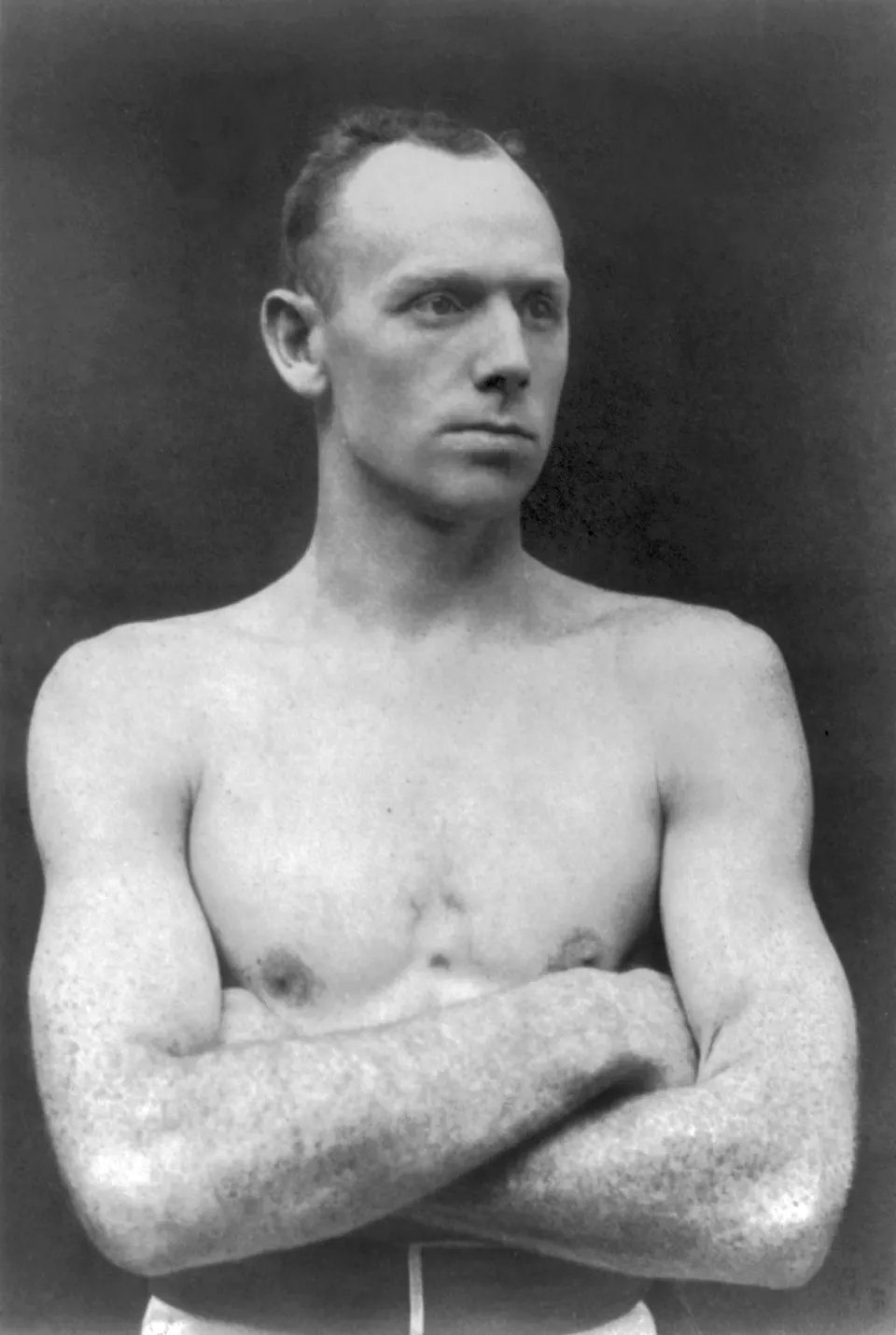
Fitzsimmons sailed for San Francisco in April 1890. Less than a year later, on 14 January 1891 in New Orleans, he fought Jack "Nonpareil" Dempsey for the world middleweight championship. Dempsey was one of the most admired fighters of the era, but he took a sustained beating that night. Wikipedia's account says Dempsey was in such poor shape that Fitzsimmons urged him to give up before the fight ended with a knockout in the 13th round.
The new champion was hard to miss. Fans called him "Ruby Robert," "The Freckled Wonder" and "The Fighting Blacksmith," and the less flattering "Freckled Freak" also stuck. He took American citizenship before winning his world titles, but Britain, New Zealand and Australia would all claim him as one of their own.
St Patrick's Day in Carson City, 1897
The heavyweight title belonged to James J. Corbett, who had dethroned John L. Sullivan in 21 rounds in New Orleans in 1892. Corbett was quick and clever, and he was also the heavier man. Fitzsimmons weighed about 167 pounds, and Guinness later listed him as the lightest man to win the heavyweight championship. The two men had no time for each other, and the fight was finally staged outdoors in Carson City, Nevada, on 17 March 1897, with George Siler refereeing.
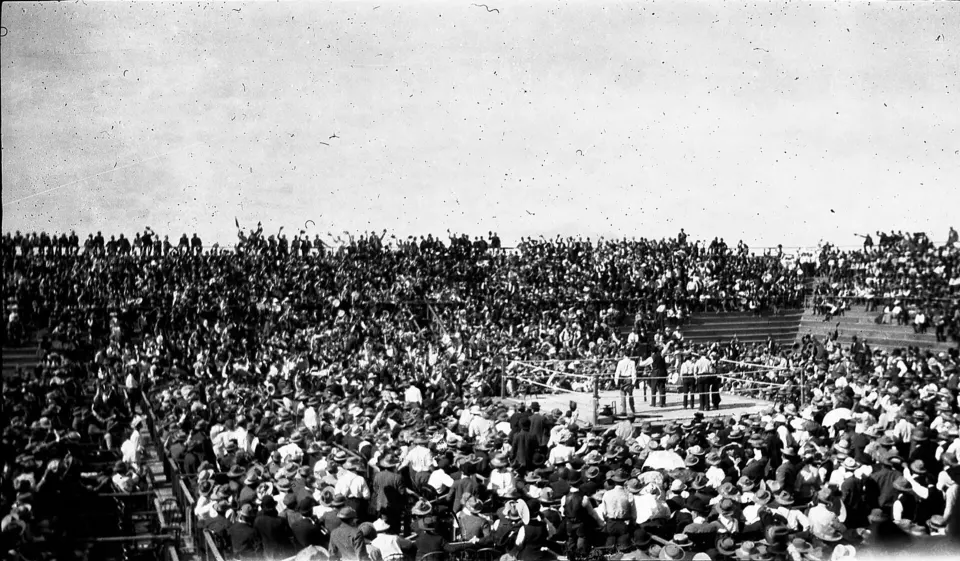
For much of the afternoon Corbett was in charge. He boxed well from range and knocked Fitzsimmons down in the sixth round. Fitzsimmons got up and began working on Corbett's body. A story repeated in Wikipedia's Corbett biography has his wife, Rose, calling from ringside, "Hit him in the slats, Bob!" In the 14th round he did exactly that. He feinted toward the head, Corbett raised his guard, and Fitzsimmons drove a short left into the pit of the stomach. Corbett went down and could not beat the count.
The punch became famous as the "solar plexus punch." Accounts disagree on the details: some sources call it a left to the solar plexus, others an uppercut under the heart, and the WBA's own retrospective calls it a liver shot. They all agree that it was a short body blow and that it won the title.
The First Fight Film to Fill a Theatre
Enoch J. Rector filmed the fight with three cameras on wide 63mm stock. The finished film, distributed by Veriscope from May 1897, included all fourteen rounds plus an introduction and an epilogue. It ran well over an hour and a half and is widely described as the first feature-length film. Nobody agrees on how much money it made. Promoter William A. Brady's claim of $750,000 profit is far above film historian Charles Musser's estimate of around $100,000. Either way, the film earned more than the live gate. In 2012 it was added to the US National Film Registry.
Corbett wanted a rematch and offered a guaranteed purse, but Fitzsimmons refused. Wikipedia's account suggests personal dislike was at least part of the reason.
Two Nights Against Jeffries
Fitzsimmons's first heavyweight defence came more than two years later. On 9 June 1899, at the Coney Island Athletic Club in Brooklyn, he faced James J. Jeffries, a former boilermaker from Ohio who was about 12 years younger. Jeffries knocked him out in the 11th round and took the title.
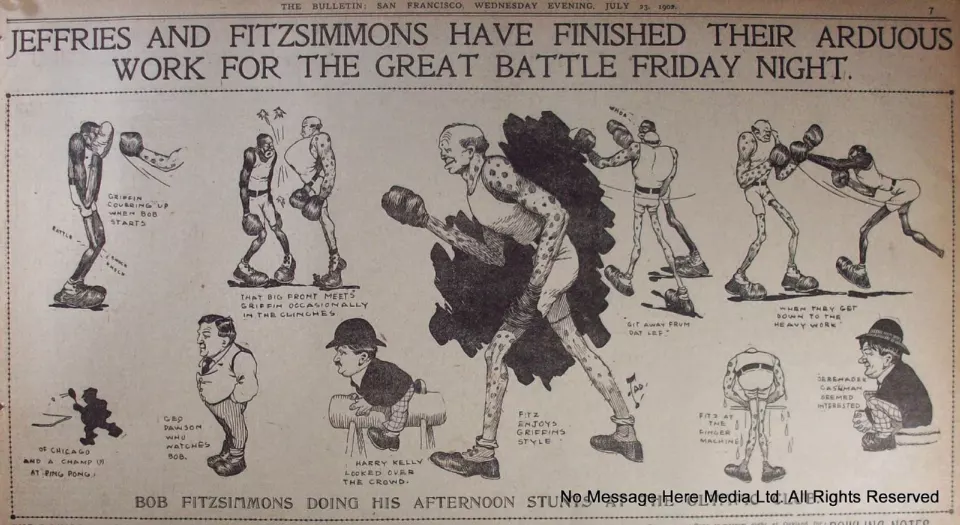
Fitzsimmons stayed active, and the New Zealand biographical entry lists wins over Tom Sharkey and Gus Ruhlin in 1900. That earned him a rematch on 25 July 1902 at the San Francisco Athletic Club. For several rounds the older man had the better of it. According to the Jeffries biography on Wikipedia, Fitzsimmons broke the champion's nose and cut his cheeks badly. Jeffries kept coming, though, and in the eighth round a right to the body followed by a left hook to the jaw knocked Fitzsimmons unconscious.
A Third Title at Forty
Most men would have retired. Instead Fitzsimmons moved to the new light-heavyweight division. On 25 November 1903, at Mechanics' Pavilion in San Francisco, he met champion George Gardner over 20 rounds. ESPN's history notes that Fitzsimmons was 40 years old and 14 years older than Gardner, and that he floored the champion four times on his way to a points decision. That made him the first boxer to win world championships at middleweight, heavyweight and light heavyweight. The WBA notes that he remained the oldest man to win a world title for decades.
He lost the light-heavyweight belt to Philadelphia Jack O'Brien on 20 December 1905, when he was retired in his corner. In 1907, at about 44, he was knocked out in two rounds by Jack Johnson. On 27 December 1909 in Sydney, Bill Lang stopped him in a fight for the Australian heavyweight title. His last bouts were two no-decision contests in Pennsylvania in 1914, when he was about 50.
Stage, Pulpit and a Disputed Record
Away from the ring, Fitzsimmons acted in stage plays and published a book, Physical Culture and Self-Defence, in 1901. The Australian Dictionary of Biography says he became an evangelist in the last months of his life. He died of pneumonia in Chicago on 22 October 1917.
His record is hard to pin down. Wikipedia lists 69 wins (57 by knockout), 12 losses, 14 draws and 6 no-contests. The Australian Dictionary of Biography's tally for 1881 to 1914 is 81 bouts: 53 wins, 11 losses, 1 draw, 12 no-decisions and 4 exhibitions. Record-keeping from his era is incomplete, and much depends on which Australian and exhibition bouts are counted. Nat Fleischer of The Ring ranked him the third-greatest heavyweight in history. Henry Armstrong was the next fighter to hold world titles in three divisions, and that was decades later.
Sources
- Bob Fitzsimmons, Wikipedia, accessed 2026
- Fitzsimmons, Robert (1863–1917), A. F. Collings, Australian Dictionary of Biography, Vol. 8, 1981
- Robert Fitzsimmons, Dictionary of New Zealand Biography (1940 entry, online edition), accessed 2026
- On this day: "Old man" Bob Fitzsimmons becomes first three-weight champion, ESPN, accessed 2026
- Bob Fitzsimmons: Three-division king before his time, World Boxing Association (wbaboxing.com), accessed 2026
- The Corbett–Fitzsimmons Fight, Wikipedia, accessed 2026
- James J. Corbett, Wikipedia, accessed 2026
- James J. Jeffries, Wikipedia, accessed 2026


