
How Roberto Durán Went From El Chorrillo to Four World Titles Across Five Decades
Roberto Durán rose from the streets of Panama City to dominate the lightweight division, beat Sugar Ray Leonard in Montreal and win world titles in four weight classes in a career that ran from 1968 to 2001.

Roberto Durán came out of the poorest streets of Panama City, turned professional at sixteen and became the most feared lightweight of his generation. Over a career stretching from 1968 to 2001 he beat Sugar Ray Leonard, quit against him five months later, and then spent two decades proving he was far from finished, winning world titles in four weight classes along the way.
A Boyhood in El Chorrillo

Durán was born on June 16, 1951. Most accounts place his birth in El Chorrillo, the crowded waterfront district of Panama City where he grew up, although Wikipedia gives Guararé, his mother's home town in the interior, as the birthplace. His mother, Clara Samaniego, raised the family largely alone; his father, Margarito Durán, was an American soldier of Mexican descent who was stationed in Panama and left soon after Roberto was born.
As a boy he earned money shining shoes and selling newspapers. By around the age of eight he had found his way to the Neco de La Guardia gym, where he began sparring. His amateur career was brief and its record is uncertain: Wikipedia notes that published figures range from 13–3 to 29–3, while a World Boxing Association profile lists only two amateur bouts. Either way, he did not stay amateur for long.
Sixteen Years Old and Already a Professional
Durán made his professional debut on February 23, 1968, at the Arena Colón in Panama City, beating Carlos Mendoza over four rounds. He then won his first 31 professional fights, most of them inside the distance.
The nickname that would follow him for the rest of his life, "Manos de Piedra" or "Hands of Stone," attached itself to him in September 1971 after he knocked out Benny Huertas in New York. That same year the veteran American trainer Ray Arcel began working with him, giving the young puncher a teacher with decades of championship experience.
Madison Square Garden, 1972: The First Title
On June 26, 1972, Durán met Scotland's Ken Buchanan for the WBA lightweight championship at Madison Square Garden. Buchanan was the established champion; Durán was 21 and largely untested at world level. The Panamanian pressed relentlessly, and the fight was stopped after the 13th round with Buchanan unable to continue. The ending remains disputed: Buchanan went down in pain after a blow delivered around the bell that he and many observers considered low, but the result stood and Durán left New York as a world champion.
Five months later, in a non-title bout, he suffered his first professional defeat, a ten-round decision against Puerto Rico's Esteban De Jesús. It would become one of the defining rivalries of his career. Durán knocked De Jesús out in the 11th round of a title defense in March 1974, and on January 21, 1978, he stopped him in the 12th round of a third meeting to add the WBC belt and unify the division.
The Lightweight Reign
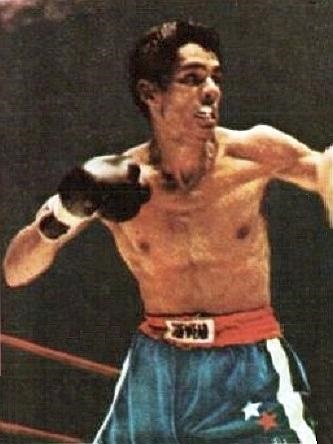
Between 1972 and 1978 Durán made 12 successful defenses of his lightweight crown, 11 of them by knockout. Wikipedia credits him with a record of 62–1 at lightweight, the single loss being that first fight with De Jesús. The Sporting News later named him its fighter of the decade for the 1970s, and the Associated Press ranked him the best lightweight of the twentieth century. In early 1979 he gave up the lightweight titles to move up in weight.
Montreal, June 1980: Beating Sugar Ray Leonard
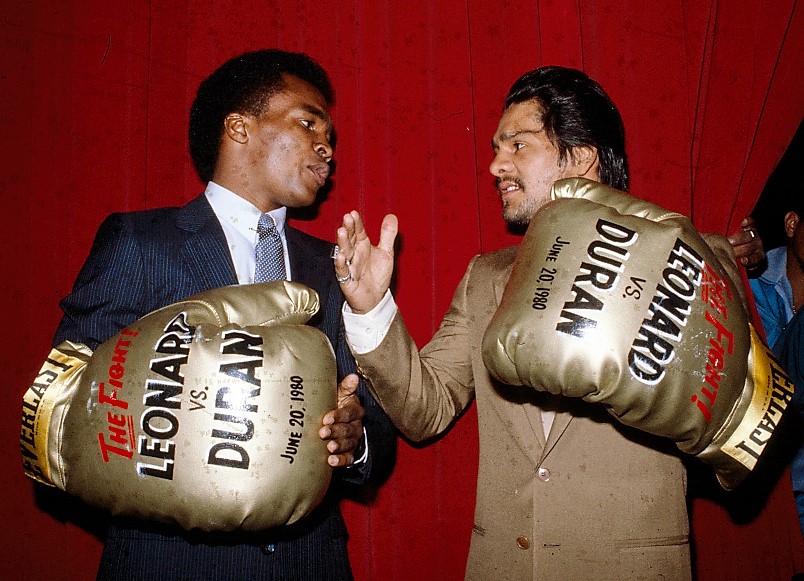
The move led to the biggest fight of his life. On June 20, 1980, at the Olympic Stadium in Montreal, Durán challenged the unbeaten Sugar Ray Leonard for the WBC welterweight title. Durán arrived with a record of 71–1 but was the betting underdog. In the ring Leonard chose to stand and trade rather than box at range, which suited the challenger. A WBC retrospective describes Durán hurting Leonard with a left hook in the second round and attacking the body throughout, before Leonard rallied late.
After 15 rounds the judges scored it 145–144, 148–147 and 146–144, a unanimous decision for Durán. He was champion in a second weight class, though Wikipedia notes he earned only a fraction of Leonard's purse for the night.
No Más in New Orleans
The rematch came quickly, on November 25, 1980, at the Louisiana Superdome. This time Leonard boxed, moved and taunted, and late in the eighth round Durán turned away and stopped fighting. The words he used remain disputed, but the phrase "no más" became attached to him for years. That night has its own RingTalk article; here what matters is that he briefly retired, then changed his mind.
Davey Moore and a Third Title
The road back was uneven. In September 1982 he lost a split decision to Britain's Kirkland Laing in Detroit, a result that seemed to confirm that his best days were gone. Early in 1983 he stopped former champion Pipino Cuevas in four rounds, and on June 16, 1983, his 32nd birthday, he faced the unbeaten WBA light middleweight champion Davey Moore at Madison Square Garden.
Moore's eye was swollen shut by the sixth round, he was put down in the seventh, and the fight was stopped in the eighth. Durán had won a world title in a third division, at the same arena where he had won his first eleven years earlier.
Hagler, Hearns and Another Retirement
Five months later he moved up again to challenge undisputed middleweight champion Marvelous Marvin Hagler in Las Vegas on November 10, 1983. Durán lost a unanimous decision, but the scores of 144–142, 144–143 and 146–145 showed how close he had pushed one of the era's great fighters. Wikipedia notes that he broke his hand during the bout.
On June 15, 1984, Thomas Hearns knocked him down three times and stopped him in the second round, the first knockout loss of his career. Durán retired a second time and stayed away until 1986. Remezcla quotes him recalling that Panamanian police detained him when he returned home after that defeat.
Atlantic City, 1989: A Fourth Title at 37
The comeback that defined his later years came on February 24, 1989, at Convention Hall in Atlantic City. Iran Barkley held the WBC middleweight title, having beaten Hearns months earlier, and carried a record of 25–4. Durán was 37 and widely expected to lose. There was a personal edge as well: Barkley had been a childhood friend of Davey Moore, who had died in an accident the previous year.
The fight was hard and close. In the 11th round Durán landed a series of right hands that dropped Barkley for the only knockdown of the night. The judges split, 116–112 and 118–112 for Durán and 113–116 for Barkley. The Ring named it the Fight of the Year, and Durán had now won world titles at lightweight, welterweight, light middleweight and middleweight. "I don't remember when I felt this good," Durán said afterward, as quoted by Remezcla.
A third fight with Leonard, for the WBC super middleweight title, followed on December 7, 1989, in Las Vegas. Leonard won a wide unanimous decision.
Fighting Into a Fifth Decade
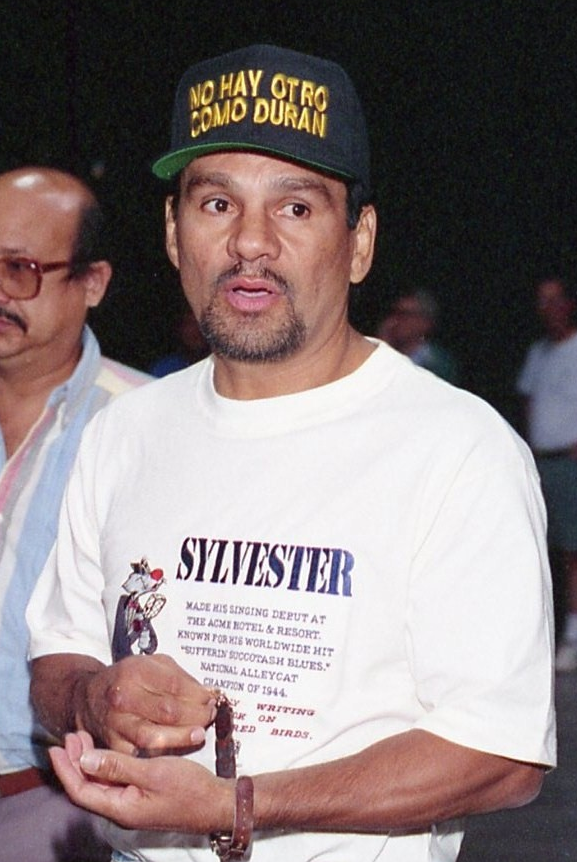
Durán kept going through the 1990s, losing twice to Vinny Pazienza in 1994 and 1995 and dropping a disputed decision to Héctor Camacho in 1996. In 1998, at 47, he was stopped in three rounds by WBA middleweight champion William Joppy. His last fight came on July 14, 2001, in Denver, a decision loss in a rematch with Camacho, shortly after his 50th birthday. Having fought in the 1960s, 70s, 80s, 90s and 2000s, he became, according to Wikipedia, only the second boxer after Jack Johnson to compete across five decades.
In October 2001 he was badly injured in a car crash in Buenos Aires, where he was promoting a salsa album, and in January 2002 he formally retired. His final record stands at 103 wins and 16 losses, with 70 wins by knockout.
Legacy
Durán was inducted into the World Boxing Hall of Fame in Riverside, California, in 2006 and the International Boxing Hall of Fame in Canastota, New York, in 2007. His story reached cinemas in 2016 in the film Hands of Stone, with Édgar Ramírez as Durán and Robert De Niro as Ray Arcel. He is widely regarded as the finest boxer Latin America has produced.
Sources
- Roberto Durán, Wikipedia, accessed October 2026
- Iran Barkley vs. Roberto Durán, Wikipedia, accessed October 2026
- Roberto Durán: a living legend, World Boxing Association (wbaboxing.com), accessed October 2026
- Roberto Durán, Biography.com, accessed October 2026
- On this day in history: Roberto Durán shook the world and defeated Sugar Ray Leonard, World Boxing Council (wbcboxing.com), accessed October 2026
- Latin Legends: A Look Back at the Night Roberto Durán Won His Fourth World Title, Remezcla, accessed October 2026


