
Muhammad Ali Went From Louisville to The Greatest
The life of Muhammad Ali, from Olympic gold and the upset of Sonny Liston to his refusal of the draft, three years in exile, three heavyweight titles and the torch in Atlanta.

He began as a skinny Louisville kid looking for a stolen bicycle and ended as one of the most recognized people on the planet. Muhammad Ali won Olympic gold, took the heavyweight title from a feared champion, gave up his prime years rather than accept induction into the Army, and then won the championship back, twice. This is the arc of that life, from the West End of Louisville to the cauldron in Atlanta.
A Stolen Bicycle in Louisville
Cassius Marcellus Clay Jr. was born in Louisville, Kentucky, in January 1942. Most references give the date as January 17; a HISTORY.com feature gives January 14. He was twelve when his bicycle was stolen and he went, angry, to a police officer named Joe E. Martin. Martin also ran a boxing program, and he told the boy that before he went looking for anybody to fight, he had better learn how.
The boy learned quickly. By the commonly cited count he went 100-8 as an amateur and won six Kentucky Golden Gloves titles. Fully grown he stood about six feet three.
Gold in Rome, Then the Professional Road
At the 1960 Olympic Games in Rome, Clay fought at light heavyweight and reached the final against Zbigniew Pietrzykowski, an experienced Polish southpaw. Clay won and came home with the gold medal. Ali later said he threw the medal into the Ohio River; whatever the full truth of that story, he received a replacement at the Georgia Dome during the 1996 Games.
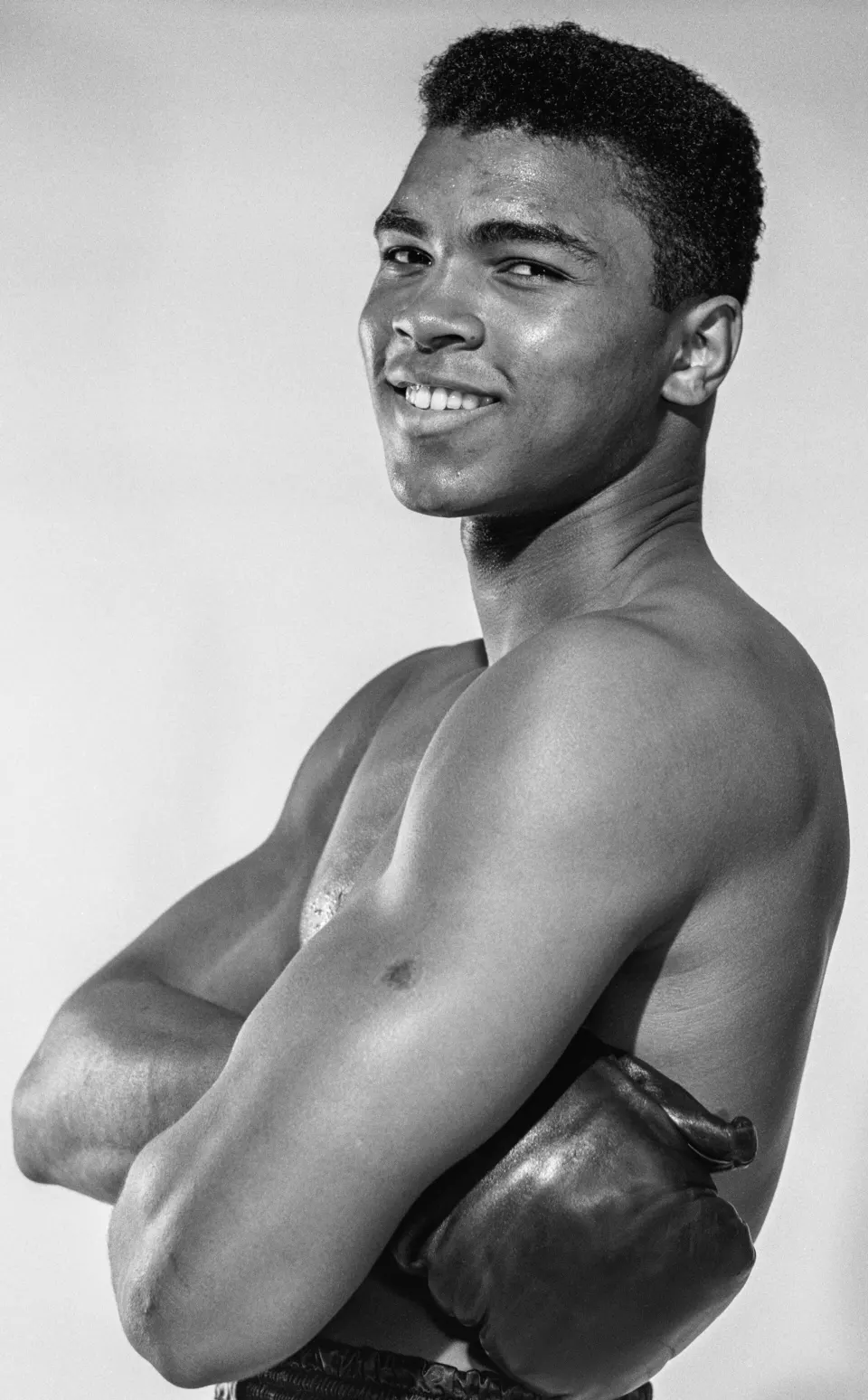
He turned professional within weeks, beating Tunney Hunsaker over six rounds on October 29, 1960. Over the next three years he kept winning and kept talking, a brash young contender unlike anyone the division had seen.
Shaking Up the World in Miami Beach
By early 1964 Clay had earned a shot at Sonny Liston, the heavyweight champion and one of the most intimidating men ever to hold the title. The bookmakers made Clay roughly an 8-to-1 underdog. On February 25, 1964, in Miami Beach, the 22-year-old challenger outboxed Liston, and when the bell rang for the seventh round Liston stayed on his stool. Clay was champion.
In the ring afterward he declared himself the greatest and said he had shaken up the world.
Cassius X Becomes Muhammad Ali
After the Liston fight the new champion aligned himself publicly with the Nation of Islam. He was briefly known as Cassius X before taking the name Muhammad Ali.
The rematch with Liston, on May 25, 1965, was staged in the small town of Lewiston, Maine. It ended in the first round, inside two minutes, when Liston went down from a punch so short that it became known as the phantom punch and has been argued about ever since. Ali then defended the title repeatedly, including against former champion Floyd Patterson in November 1965 and Ernie Terrell in February 1967.
Houston, April 1967: The Refusal
Ali had sought classification as a conscientious objector on religious grounds; his draft board did not grant it. On April 28, 1967, he reported to the induction center in Houston and refused to be inducted into the U.S. Armed Forces, citing his faith and his opposition to the war in Vietnam.
The consequences came fast. The New York State Athletic Commission suspended his boxing license and the World Boxing Association stripped him of the title. On June 20, 1967, a federal jury in Houston convicted him of draft evasion. He was sentenced to five years in prison and fined $10,000, though he remained free while the case was appealed. The U.S. Court of Appeals for the Fifth Circuit upheld the conviction.
The Exile Years
For roughly three and a half years, at an age when most heavyweights are at their best, Ali did not fight. He spent much of that time speaking on college campuses, criticizing the war and talking about Black pride and racial justice.
He was able to return before the courts finished with him. On October 26, 1970, in Atlanta, he stopped Jerry Quarry in three rounds. In December he outlasted Oscar Bonavena, finally stopping the Argentine in the fifteenth round. Then, on June 28, 1971, the U.S. Supreme Court reversed his conviction in Clay v. United States. The vote was 8-0, with Justice Thurgood Marshall not taking part; the Court held that because the appeal board had given no reason for denying his objector claim, the conviction could not stand.
Three Fights With Joe Frazier
Ali's return set up the fight boxing had been waiting for. Joe Frazier had become champion during the exile, and on March 8, 1971, the two unbeaten men met at Madison Square Garden in a bout billed as the Fight of the Century. Frazier won a unanimous decision over fifteen rounds and put Ali on the canvas in the last of them. It was Ali's first professional defeat.
They met again on January 28, 1974, at the Garden. By then Frazier had lost the title to George Foreman, so no championship was at stake, and Ali won a unanimous decision. The third fight, in Manila in 1975, is the brutal one remembered as the Thrilla in Manila, and it belongs to a story of its own.
Kinshasa and the Long Last Reign
Between the second and third Frazier fights came Kinshasa. On October 30, 1974, Ali faced Foreman in Zaire and knocked him out in the eighth round to regain the heavyweight championship, the night now known as the Rumble in the Jungle.
The later years were harder. On February 15, 1978, in Las Vegas, Ali lost the title on a split decision to Leon Spinks, who had only eight professional fights behind him. Seven months later, on September 15, 1978, at the Louisiana Superdome in New Orleans, Ali won the rematch by unanimous decision and became the first man to win the heavyweight championship three times.
Holmes, Berbick and the Last Bell
Ali retired, then returned. Before he could fight Larry Holmes in 1980, the Nevada commission required a neurological examination at the Mayo Clinic, which noted some difficulty with coordination and speech but did not bar him from boxing. On October 2, 1980, outside Las Vegas, Holmes dominated a fight Ali could not win, and trainer Angelo Dundee stopped it after the tenth round over Ali's objections. A year later, on December 11, 1981, Ali lost to Trevor Berbick and never fought again. His professional record stood at 56 wins, 37 of them by knockout, and 5 losses.
Parkinson's and the Cauldron in Atlanta
In 1984 Ali made public that he had been diagnosed with Parkinson's syndrome. The illness slowed him, but he did not disappear from public life; among other roles he served for a decade as a United Nations Messenger of Peace.
His most memorable appearance came at the opening ceremony of the 1996 Atlanta Olympics. Unannounced, Ali stepped forward with the torch and, his hand trembling, set the cauldron alight.
Death and Legacy

Sports Illustrated named him Sportsman of the Century in 1999, and the BBC named him its Sports Personality of the Century. In 2005 he received the Presidential Medal of Freedom.
Ali died on June 3, 2016, in the Phoenix area, at age 74, after being hospitalized with respiratory problems. His funeral was held in Louisville, where flags were lowered to half-staff. President Barack Obama's statement opened with a line that echoed the fighter's own boast: "Muhammad Ali was The Greatest. Period." He had been the first three-time heavyweight champion, and he had paid for a principle with the best years of his career.
Sources
- Muhammad Ali, Wikipedia, accessed October 2026
- Clay v. United States, Wikipedia, accessed October 2026
- Muhammad Ali vs. Leon Spinks, Wikipedia, accessed October 2026
- Larry Holmes vs. Muhammad Ali, Wikipedia, accessed October 2026
- Ali defeats Spinks to win world heavyweight championship, HISTORY.com, accessed October 2026
- Muhammad Ali dies at age 74 after long battle with Parkinson's disease, ABC7 News (ABC / Associated Press), June 2016
- This Day in History: June 20, 1967: Muhammad Ali convicted for refusing Vietnam War draft, Live 5 News, June 2026


