
Mayweather vs Pacquiao in 2015 Followed Five Years of Talks, a Record Night in Las Vegas and the Shoulder Nobody Mentioned
After more than five years of failed negotiations, Floyd Mayweather Jr. outpointed Manny Pacquiao at the MGM Grand on 2 May 2015 in the richest fight ever staged. Pacquiao's undisclosed shoulder injury then led to a commission inquiry and fan lawsuits that ran until 2019.

For more than five years the two best fighters of their generation circled each other through lawyers, mediators and television executives. When Floyd Mayweather Jr. and Manny Pacquiao finally met at the MGM Grand Garden Arena on 2 May 2015, the night broke every financial record in boxing, ended in a clear unanimous decision, and then spilled into a medical controversy and a string of lawsuits that took until 2019 to settle in the courts.
Blood Tests and a Defamation Suit: The Talks Collapse, 2009-2010
The first serious attempt to make the fight came at the end of 2009. In early December, ESPN reported that Pacquiao had signed for a date in March 2010, a claim his side denied almost at once. Golden Boy Promotions, then working with Mayweather, proposed an even split of the money but attached a condition: Olympic-style drug testing, including random blood draws right up to fight night.
That clause became the sticking point. Pacquiao's camp, promoted by Bob Arum's Top Rank, accepted urine testing at any time but wanted a cut-off for blood samples before the bout, first proposing 30 days and later 14 in its accounts of the talks, arguing that late blood draws could weaken a fighter. A mediation session in January 2010 before retired federal judge Daniel Weinstein failed when the two sides could not agree where the cut-off should fall; Wikipedia's summary records that a 24-day window was rejected.
The dispute did not stay in the negotiating room. On 30 December 2009, Pacquiao filed a federal suit accusing Mayweather Jr., his father, his uncle Roger and Golden Boy executives of falsely suggesting he used performance-enhancing drugs. The case ended in a confidential settlement in September 2012, with the Mayweather side stating that it had never meant to claim Pacquiao used such drugs.
Years of Near Misses, 2010-2014
Through the following years the fight resurfaced every few months and vanished again. A reported second round of talks in mid-2010, said to run through HBO and adviser Al Haymon, was denied outright by Mayweather's camp. In late 2012 Mayweather offered Pacquiao a flat 40 million dollars with no share of revenue, while Pacquiao wanted a 55-45 split. By January 2014 the public tone had soured to the point that Mayweather was trading insults with his rival in the press.
The thaw came from outside boxing's usual channels. In May 2014, according to the account collected on Wikipedia, an actor named Gabriel Salvador introduced CBS chief Les Moonves to Pacquiao's trainer Freddie Roach at a Beverly Hills restaurant, and the two men became informal go-betweens. On 27 January 2015 Mayweather and Pacquiao met face to face at an NBA game in Miami. On 20 February 2015 Mayweather announced that the fight was set for 2 May.
The Richest Fight Ever Staged
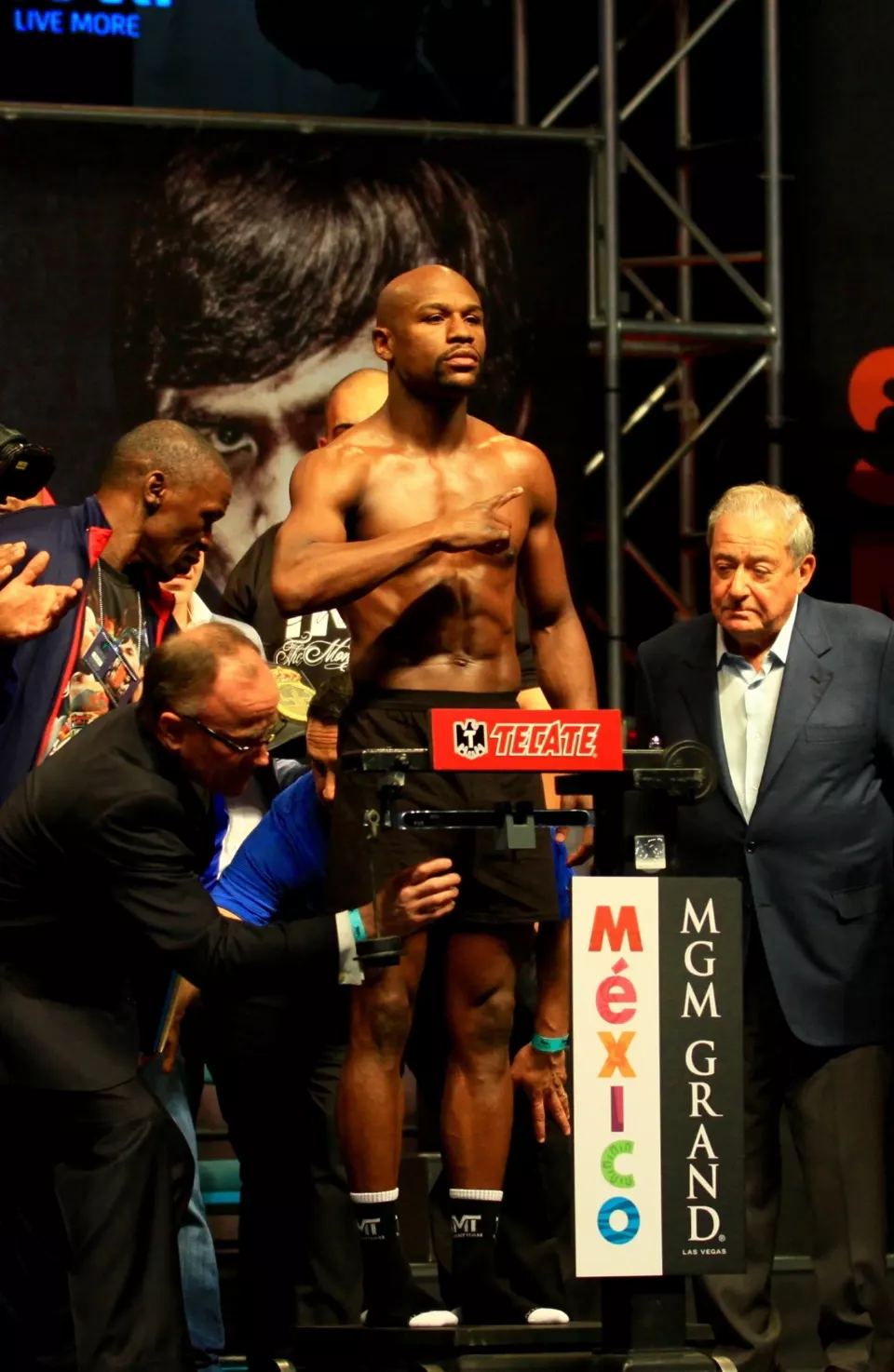
The bout was built as a joint venture between rival networks HBO and Showtime, the first such partnership since Lennox Lewis met Mike Tyson in 2002. At stake were Mayweather's WBA and WBC welterweight titles, Pacquiao's WBO belt and The Ring championship. Mayweather came in at 47-0 with 26 knockouts; Pacquiao was 57-5-2 with 38.
The money was on a scale the sport had never seen. The purse was divided roughly 60-40 in Mayweather's favour. Published figures differ: the Wikipedia account lists 180 million dollars for Mayweather and 120 million for Pacquiao, while the Associated Press, reporting the revenue totals ten days after the fight, projected that Mayweather could earn up to 250 million and Pacquiao more than 120 million once all income was counted.
The live gate, as reported by the Nevada Athletic Commission and carried by the AP, came to 72,198,500 dollars from 16,219 tickets, an average face value of about 4,451 dollars. The previous record, set by Mayweather against Canelo Álvarez in 2013, had been just over 20 million. Pay-per-view cost 89.95 dollars in standard definition and 99.95 in HD. HBO and Showtime announced more than 4.4 million US buys and over 400 million dollars in revenue, close to double the previous buy record of 2.48 million set by Mayweather and Oscar De La Hoya in 2007. The buy figure was later revised upward to 4.6 million, according to Wikipedia. Top Rank's Bob Arum admitted to the AP that his own forecast had topped out at about 3.5 million buys.
Twelve Rounds in Las Vegas
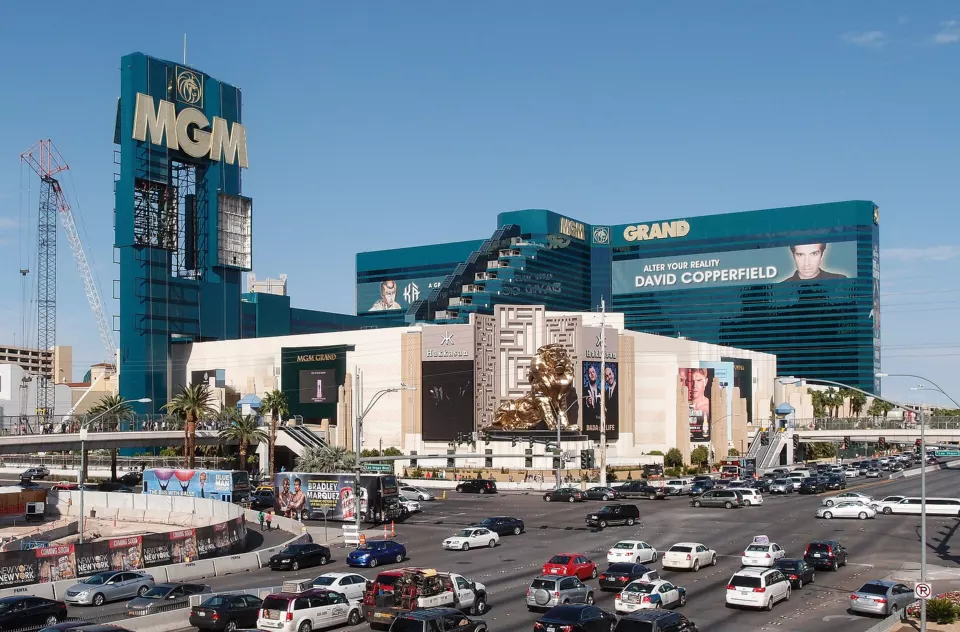
When the bell finally rang under referee Kenny Bayless, the fight followed the pattern that Mayweather's defenders had predicted. He worked behind the jab, kept Pacquiao at range and tied him up when the Filipino got close. Pacquiao's best moment came in the fourth round, when a straight left drove Mayweather back to the ropes and brought the crowd to its feet, but he could not keep the pressure on. There were no knockdowns.
The CompuBox numbers, as reported by CBS News, told the story of a technical mismatch in accuracy. Mayweather landed 148 of 435 punches, 34 percent, including 81 of 168 power shots. Pacquiao, known as a volume puncher, threw fewer punches than his opponent, 429, and landed only 81 of them, 19 percent, with just 18 of 193 jabs finding the target.
The judges agreed on the winner. Dave Moretti and Glenn Feldman scored it 116-112 and Burt Clements 118-110, all for Mayweather; the Associated Press card had it closer at 115-113. Afterwards Mayweather told reporters that Pacquiao "never figured out my jab," while Pacquiao said he believed he had landed more often than his opponent and was surprised by the cards, according to CBS News. Mayweather also said he planned to box once more, in September, before retiring.
The verdict on the spectacle itself was harsher than the verdict on the scorecards. Many critics felt the long wait had drained the contest of the drama it might have had in 2010, and the billing of "Fight of the Century" was widely mocked in the days that followed.
The Shoulder Nobody Mentioned
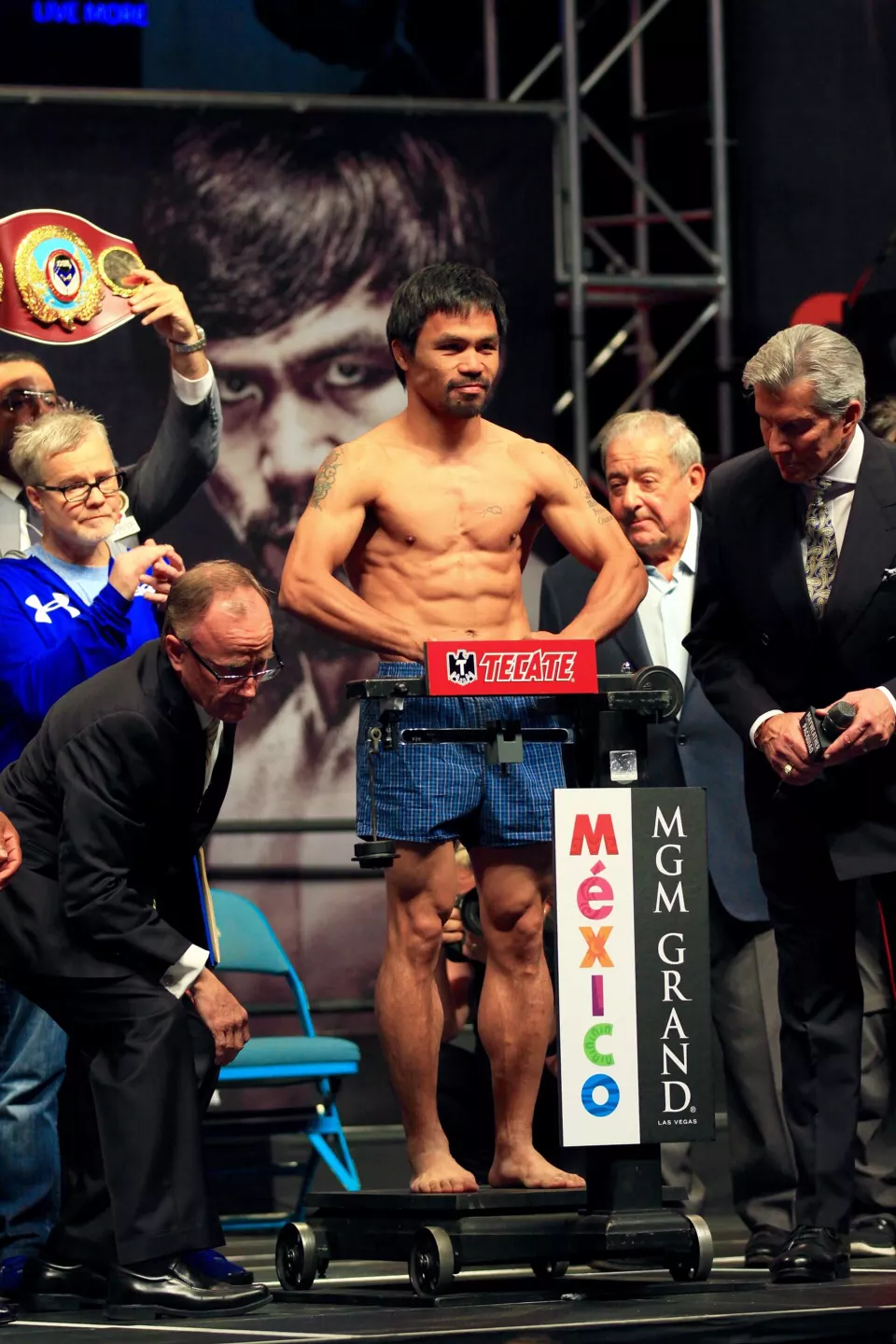
Within hours, the story changed. Pacquiao's camp revealed that he had hurt his right shoulder in training camp and aggravated it during the fourth round. On the Nevada commission's pre-fight medical questionnaire, filled in shortly before the weigh-in on the day before the fight, his side had answered "no" to the question about a shoulder injury.
About two hours before the opening bell, Pacquiao's team asked to give him an anti-inflammatory injection, reported by ESPN as Toradol, in the dressing room. Commission chairman Francisco Aguilar refused, citing the lack of prior disclosure and fairness to Mayweather. Top Rank said the injury had been reported to the US Anti-Doping Agency, which had cleared the shot, but USADA chief Travis Tygart told ESPN that it was not an anti-doping matter and that the real question was why the camp had checked "no." Aguilar said the commission would gather the facts, and a fine or suspension was discussed as a possibility.
Orthopaedic surgeon Neal ElAttrache examined Pacquiao in the days after the fight and found a significant tear in the rotator cuff that required surgery, with a recovery estimated at nine to twelve months, ESPN reported. Freddie Roach said he had believed the shoulder had improved enough during camp.
Fans in Court, 2015-2019
Ticket buyers and pay-per-view customers quickly filed class-action suits against Pacquiao, Mayweather, their promotional companies and the broadcasters, arguing they would not have paid had they known Pacquiao was hurt. The cases were consolidated as multidistrict litigation in the Central District of California.
In August 2017 US District Judge R. Gary Klausner dismissed them. He expressed sympathy for fans who felt deceived but held that they had bought the right to watch a fight between the two men and had received exactly that, with no legal claim to an exciting contest or two fully healthy boxers. The plaintiffs appealed, and on 21 November 2019 a Ninth Circuit panel upheld the dismissal. Judge Jacqueline Nguyen, writing in what was described as the circuit's first ruling on the rights of a disappointed sports spectator, noted that Pacquiao's shoulder had not stopped him from completing all twelve rounds.
Sources
- Floyd Mayweather Jr. vs. Manny Pacquiao, Wikipedia, accessed October 2026
- Mayweather-Pacquiao eclipses 4.4 million PPV buys, $72M gate, Associated Press via ABC7, 12 May 2015
- After months of hype, "Fight of the Century" goes the distance, CBS News, May 2015
- Manny Pacquiao could face disciplinary action for failing to disclose shoulder injury, ESPN, 5 May 2015
- Consumer Class Actions Over Boring Boxing Match Dismissed, Olshan Frome Wolosky Advertising Law Blog, 2017
- Greenberg Traurig Secures Victory for Undefeated World Champion Boxer Floyd Mayweather, Greenberg Traurig, 22 November 2019


