
Louis vs Schmeling in 1938 Took Two Minutes to Answer 1936
Max Schmeling's 1936 upset of Joe Louis became Nazi propaganda; two years later Louis ended their Yankee Stadium rematch in 2:04 of the first round. The rivals later became friends.

On the night of 22 June 1938, Joe Louis needed just two minutes and four seconds at Yankee Stadium to settle a debt from two years earlier. The rematch with Max Schmeling had been sold to the world as democracy against Nazism, but the story of the two men who fought it ran far deeper, and far longer, than one round.
The Upset at Yankee Stadium, 1936
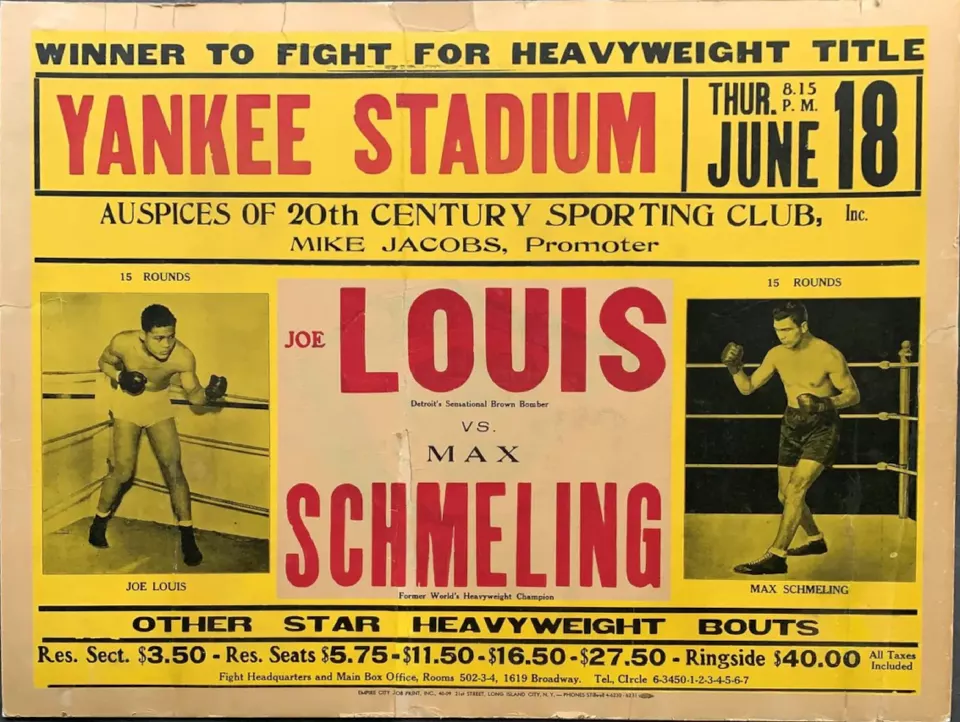
When Louis and Schmeling first met in the Bronx, the outcome looked like a formality. Louis arrived unbeaten, and the betting had the German as a heavy underdog. The figures vary with the source: Wikipedia and the WBA put Louis at 24-0 and the odds at 10-1, ESPN credits him with 27 straight wins, and the United States Holocaust Memorial Museum describes Schmeling as an eight-to-one outsider. Even the date is not uniform. Most records list 19 June 1936, while the Holocaust Museum's catalogue gives 18 June.
Schmeling, a former world champion then aged 30, had done his homework. He had studied film of Louis and noticed that the American let his left hand drift low after throwing the jab. For three rounds Louis's jab did damage and began to close the German's left eye. In the fourth, Louis began throwing hooks, and Schmeling slipped an overhand right over the top. Louis went down for the first time in his professional career.
From there Schmeling kept answering Louis's jab with the same right hand. ESPN's account counts 54 clean shots to the jaw over the evening. In the twelfth round Schmeling landed to the body and then to the head, and Louis sank near his own corner to be counted out at 2:29. Louis later conceded the point without excuses, saying in effect that the better man had beaten him that night.
Two Countries Read One Result
In Germany the knockout became state property almost overnight. Accounts differ on who sent the first congratulations: Wikipedia records flowers and a note of congratulation from Adolf Hitler to Schmeling's wife, the Czech-born actress Anny Ondra, while ESPN names propaganda minister Joseph Goebbels. Either way, the regime presented the win as evidence for its racial theories. A Nazi periodical quoted by the Holocaust Museum called the victory a matter of prestige for the race, and Schmeling himself told German reporters that his thoughts had been with the Fuehrer and his countrymen.
In the United States the defeat landed hard in Black neighbourhoods, where Louis had become a symbol during the Depression. The poet Langston Hughes described grown men weeping on Seventh Avenue in Harlem. The record on Schmeling's politics is more tangled than either side's caricature. He never joined the Nazi Party and refused to drop his Jewish American manager, Joe Jacobs, despite pressure from Berlin. Yet the Holocaust Museum also notes that, when questioned by Americans in the 1930s, he denied reports of Jewish persecution and spoke well of the new Germany.
A Champion Who Did Not Feel Like One
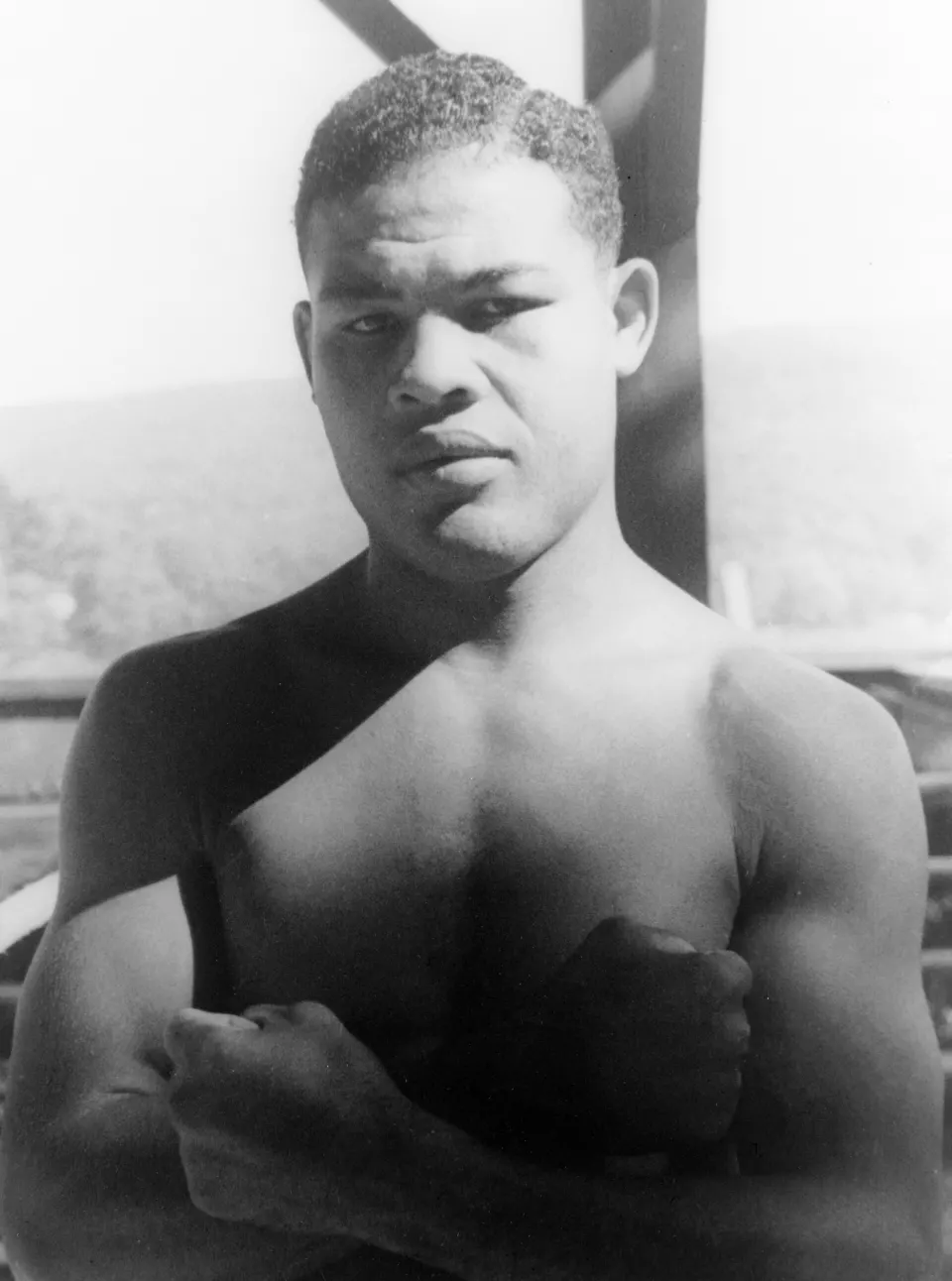
Louis rebuilt quickly. In 1937 he took the heavyweight title from James J. Braddock, but according to The Fight City he made clear the belt felt incomplete while the Schmeling loss stood. His line, as that outlet reports it, was blunt: "I want Schmeling. I ain't no champion 'till I beat Schmeling."
By the time the rematch was signed, it was being framed as a contest between democracy and fascism. Wikipedia and the WBA both report that, in the weeks before the fight, President Franklin D. Roosevelt told Louis the country needed muscles like his to beat Germany. Tickets moved at record speed; The Fight City notes that ringside seats were priced at 40 dollars, a figure promoters soon regarded as far too cheap.
Two Minutes and Four Seconds
The crowd is usually given as 70,043, the WBA's figure, though the Holocaust Museum writes of 80,000. Wikipedia lists the gate at $1,015,012 and estimates a radio audience of 70 million Americans and more than 100 million worldwide.
Louis left no room for strategy. Within about half a minute, ESPN reports, he had landed a left hook to the chin and then turned to the body. Driven into the ropes, Schmeling took a body shot that made him scream; the WBA says the blow fractured a vertebra, and Schmeling later claimed he had been hit in the kidneys. Wikipedia's count gives Louis 41 punches thrown, 31 of them landing solidly, against two from Schmeling.
How many times Schmeling went down depends on whom you read. Wikipedia and the WBA count three knockdowns, ESPN says four, and The Fight City describes two knockdowns followed by a final combination. All agree on the finish: a towel came in from Schmeling's corner, referee Arthur Donovan waved the fight off, and the clock showed 2:04 of the first round. The WBA reports that Schmeling told Louis afterwards that he was a real champion.
Cracked Vertebrae and a Quiet Homecoming
Schmeling spent about ten days in a New York hospital with cracked vertebrae; the Holocaust Museum specifies two broken vertebrae. His camp complained of an illegal kidney punch, but Wikipedia notes the protest was never pursued formally. A story long told in Germany holds that Goebbels had the radio feed cut after the first knockdown. The New World Encyclopedia records that this claim has since been refuted, although the broadcast did go off the air before the end.
The return journey bore no resemblance to 1936. The History News Network describes Schmeling coming home a lone and battered figure, and the New World Encyclopedia says the defeat left him out of favour with the regime, something he later described as a relief. Months later, on Kristallnacht in November 1938, he hid two Jewish boys from the mob in Berlin and helped them escape. Wikipedia places them in his room at the Excelsior Hotel, while the History News Network says it was his flat.
From Crete to Coca-Cola, and Back to Louis
The war took Schmeling into the Luftwaffe as a paratrooper. He jumped into the Battle of Crete in May 1941 and was wounded in the right knee by mortar shrapnel. Boxing News reports he left the army in 1943 and attempted a comeback in 1947 at 42, retiring in 1948 after defeats to Walter Neusel and Richard Vogt. Business proved kinder than the ring: Boxing News dates his German Coca-Cola franchise to 1957, and Wikipedia describes him later running his own bottling plant.
The rivalry ended in friendship. According to the New World Encyclopedia, the two men reconnected through a 1954 appearance on the American television programme This Is Your Life and met a dozen times afterwards. When Louis fell on hard times, Schmeling helped with money and medical bills, and CBS News, Wikipedia and the WBA all report that he contributed to the cost of Louis's funeral in 1981. Looking back, CBS News reports, Schmeling said he was almost happy he lost the rematch, because victory would have bound him to the Nazi state.
Louis went on to make 25 consecutive title defences, a heavyweight record that still stands. Schmeling outlived nearly everyone from that June night. He died at home in Hollenstedt, near Hamburg, on 2 February 2005, aged 99, the longest-lived heavyweight champion in the sport's history.
Sources
- Joe Louis vs. Max Schmeling, Wikipedia, accessed October 2026
- Joe Louis vs. Max Schmeling II, Wikipedia, accessed October 2026
- Max Schmeling, Wikipedia, accessed October 2026
- Joe Louis' Greatest Fights: Louis-Schmeling, ESPN Classic
- Boxing History: Louis Crushes Schmeling, World Boxing Association (wbaboxing.com)
- Program for the 1936 Schmeling-Louis Bout, United States Holocaust Memorial Museum, Americans and the Holocaust
- June 22, 1938: Louis vs Schmeling II, The Fight City
- German Boxing Great Schmeling Dies, CBS News, February 2005
- On This Day: Max Schmeling, Man of Honour, Passed Away, Boxing News
- Max Schmeling: complexity beyond the Nazi icon, History News Network
- Max Schmeling, New World Encyclopedia, accessed October 2026


