
Holyfield vs Douglas in 1990 Ended Buster's Reign With One Counter Right at The Mirage
Eight months after beating Mike Tyson, Buster Douglas weighed in at 246 pounds for his first defense and was knocked out by Evander Holyfield in the third round at The Mirage on 25 October 1990.

Eight months after he stunned the world in Tokyo, James "Buster" Douglas made the first defense of his undisputed heavyweight championship against Evander Holyfield at The Mirage on 25 October 1990. He arrived 32 and a half pounds heavier than the man who had beaten Mike Tyson, and he did not survive the third round. One counter right hand moved the title to Holyfield and sent Douglas out of boxing for the better part of six years.
From the Tokyo Dome to a Casino Ballroom
The story of this fight begins with another one. On 11 February 1990, at the Tokyo Dome, Douglas entered the ring as a 42-to-1 outsider against the unbeaten Mike Tyson and knocked him out in the tenth round, an upset ringtalk.com has told in full in its account of that night in Japan. The aftermath was messy. Don King's side complained of a long count, the WBA and WBC briefly held back recognition, and only after four days of public pressure was Douglas confirmed as champion. The IBF had accepted the result from the start.

The win also scrambled a plan the sport had been circling for years. Evander Holyfield, the former undisputed cruiserweight champion whose career is covered in our profile of him, had moved up after unifying the cruiserweight belts in 1988 and had spent two years as The Ring's top-rated contender without getting his chance at Tyson. With Tyson beaten, the obvious next fight became Douglas against Holyfield, and it landed at The Mirage in Las Vegas, with casino owner Steve Wynn behind the promotion. The WBA, WBC and IBF titles were all on the line, and the event was sold as "The Moment of Truth."
A Record Payday and a Worrying Scale
Money was never the problem for the champion. Wikipedia's account of the bout lists Douglas's purse at $24,075,000, at the time a record for a single fighter, against $8,025,000 for Holyfield. Wikipedia's biography of Douglas gives a slightly different figure for the same night, a reported $24.6 million, so the exact number depends on which accounting is used. Either way, the challenger was earning about a third of what the champion took home.
The scale told a less comfortable story. When he beat Tyson, Douglas weighed 213 and a half pounds. For the first defense he came in at 246. Holyfield, at 208, was nearly 40 pounds lighter. The Associated Press report carried in the University Daily Kansan the following day noted that the jump caused a stir and raised questions about the champion's desire. Holyfield had gone the other way, preparing with trainer George Benton alongside two strength coaches, a conditioning coach and a flexibility coach.
Some of the details from the champion's camp have since passed into boxing folklore. Writing on the 25th anniversary for The Atlanta Journal-Constitution, Steve Hummer recalled that Wynn pushed Douglas toward the sauna to shed weight, and that Douglas undercut the effort by calling room service while he sat in the heat. Douglas himself, according to the AP report, insisted the weight was no problem and that he felt good.
Two Rounds of Holyfield
About 16,000 people filled The Mirage's arena that night, the AP reported. The undercard included a young Riddick Bowe, who won by second-round knockout and who would later become a central figure in Holyfield's career. Douglas stood 6 feet 4 inches and was 30 years old, two years older and two inches taller than the challenger.
Whatever advantage that size might have given him, it never appeared. Accounts of the fight agree that Holyfield controlled the first two rounds, working faster and sharper while the heavier champion moved slowly and gave little back. The fighter who had upset Tyson in Tokyo looked flat and short of answers.
The Missed Uppercut and the Counter Right
The end came early in the third round. Douglas set up a right uppercut that Holyfield read before it was thrown. The punch missed entirely and pulled Douglas off balance, leaving his chin exposed. Holyfield fired a right hand straight down the middle, and it caught Douglas flush. Contemporary wire copy described the blow as a right to the nose; the Wikipedia accounts call it a straight right to the chin; the Atlanta Journal-Constitution retrospective refers to it as a right uppercut. The sources agree that it was a single right hand and that it finished the fight.
Douglas went down onto his back and stayed there. Referee Mills Lane counted over him, and the fight was over at 1:10 of the third round. Wikipedia's article on the bout describes him needing help twice before he could get to his corner. Holyfield, who had never held a heavyweight belt, left the ring as the undisputed champion, the third man to hold all three major titles in eight months.
"He Could Have Gotten Up"
The reaction was harsh, and much of it was aimed at how Douglas had lost rather than at the fact of losing. Holyfield was candid about his own feelings in the AP report, saying he had hoped Douglas would stay down after taking a good punch. Douglas told reporters that he had been caught by a good shot and that by the time he tried to pick up the count, it was over.
Others were less forgiving. Eddie Futch, Bowe's trainer and a man who had worked with Joe Frazier, was openly critical. "What Buster Douglas did was disgraceful," Futch said, according to the AP. He went on to call the champion's poor condition atrocious, and he also suggested that Douglas could have beaten the count. Wikipedia's article on the bout attributes similar criticism to Douglas's former promoter, so the exact source of some of the post-fight condemnation varies between accounts. What is clear is that the tone of the coverage changed sharply. The man celebrated in February was being judged in October as a champion who had not prepared.
Six Years Away and a Brief Return
Douglas did not fight again for nearly six years. His biography records that his weight climbed toward 400 pounds during that time, and that it took a diabetic coma, which nearly killed him, to push him back toward the ring. He returned in 1996 and won his first six comeback fights. One of his bouts, against Louis Monaco in 1997, ended in a disqualification after Monaco dropped Douglas with a right hand thrown just after the bell to end the first round.
The comeback stopped when Lou Savarese knocked him out in the first round. Douglas retired for good in 1999, finishing with a professional record of 38 wins, 6 losses and 1 draw. The Tokyo night remains the reason his name is known; the Las Vegas night explains why his reign is counted in months.
What the Night Meant for Holyfield
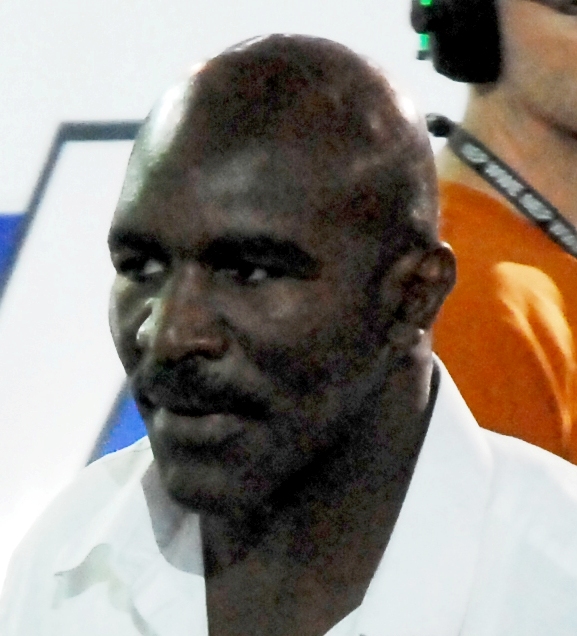
For Holyfield, the knockout was the start of the heavyweight career he had been chasing since leaving cruiserweight. He went on to defend the titles against George Foreman and Bert Cooper before losing them to Riddick Bowe, the undercard winner from that same Mirage card, in November 1992. The meeting with Tyson that the Douglas upset had derailed would wait years longer.
The fight itself lasted less than eight minutes of ring time. It is remembered less for its action than for its contrast: a lean, heavily coached challenger meeting a champion who had arrived out of shape for the biggest payday of his life, and a single counter that settled the matter.
Sources
- Buster Douglas vs. Evander Holyfield, Wikipedia, accessed October 2026
- Buster Douglas, Wikipedia, accessed October 2026
- Evander Holyfield, Wikipedia, accessed October 2026
- Mike Tyson vs. Buster Douglas, Wikipedia, accessed October 2026
- Associated Press fight report on Holyfield vs Douglas, The University Daily Kansan (University of Kansas digital archive), 26 October 1990
- Steve Hummer, "Holyfield won the world years ago", The Atlanta Journal-Constitution, 25 October 2015


