
Max Schmeling Was a Champion, a Propaganda Pawn, a Rescuer and a Friend to Joe Louis
From Klein Luckow to the heavyweight title, Kristallnacht, the Battle of Crete and a Coca-Cola fortune, Max Schmeling's 99 years ran through Germany's twentieth century. He ended them as a friend to the man who beat him in 1938.

Max Schmeling lived 99 years. In that time he went from a village in Brandenburg to the world heavyweight title, was turned into a propaganda symbol he never chose, hid two Jewish boys while Berlin burned, jumped into Crete as a paratrooper and ended up selling Coca-Cola in West Germany. He also became a friend to the man who had beaten him in two minutes.
From Klein Luckow to the German Ring
Schmeling was born on 28 September 1905 in Klein Luckow, a small place in the Prussian province of Brandenburg. His parents were Max and Amanda Schmeling. He had an older brother, Rudolf, and a younger sister, Edith. Nothing about the family pointed toward sport. The boy found boxing on his own and moved through it quickly.
In 1924 he won Germany's national amateur light heavyweight championship. Two years later, as a professional, he stopped Max Diekmann in the first round on 24 August 1926 to become German light heavyweight champion. In 1927 he took the European title at that weight from Fernand Delarge. By 1928 he had moved up to heavyweight, won the German championship there, and crossed the Atlantic to find bigger fights in the United States.
A Title Won on the Canvas: Sharkey, 1930
On 12 June 1930 Schmeling met Jack Sharkey at Yankee Stadium with the world heavyweight championship at stake. The fight ended in the fourth round, at 2:55, with Schmeling on the floor from a low punch. Sharkey was disqualified and Schmeling was declared champion. He was the first German, and the first European, to hold the world heavyweight title, a point the Associated Press made in its obituary decades later.
A title won on a foul carried an asterisk in the public mind, and Schmeling set out to remove it. On 3 July 1931, at Cleveland Municipal Stadium, he defended against Young Stribling and stopped him in the fifteenth and final round. The rematch with Sharkey came on 21 June 1932 at the Madison Square Garden Bowl in Queens. Sharkey was given a split decision that is still described as highly controversial, and Schmeling's reign was over.
Joe Louis, 1936 and 1938
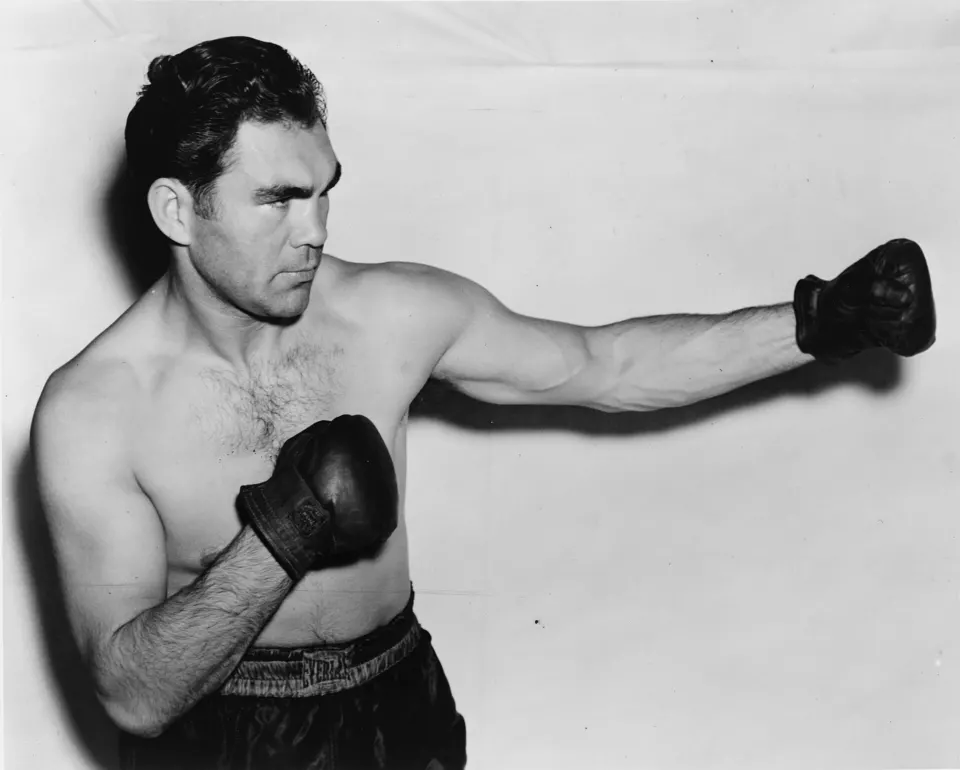
The two fights that define Schmeling's name in America are covered in detail elsewhere on Ringtalk, so the outline here is brief. On 19 June 1936 at Yankee Stadium, Schmeling knocked out the young Joe Louis in the twelfth round, a result regarded as one of the great upsets of the era. The Nazi government used the win as evidence of German strength, a role Schmeling had not asked for.
The rematch on 22 June 1938, again at Yankee Stadium, lasted two minutes and four seconds. Louis won by first-round stoppage before a crowd the International Raoul Wallenberg Foundation puts at more than 70,000. In 1975 Schmeling told an interviewer, as quoted by the Associated Press: "Looking back, I'm almost happy I lost that fight." His reasoning was that a win would have handed the regime an even bigger trophy.
Pressure From the Regime
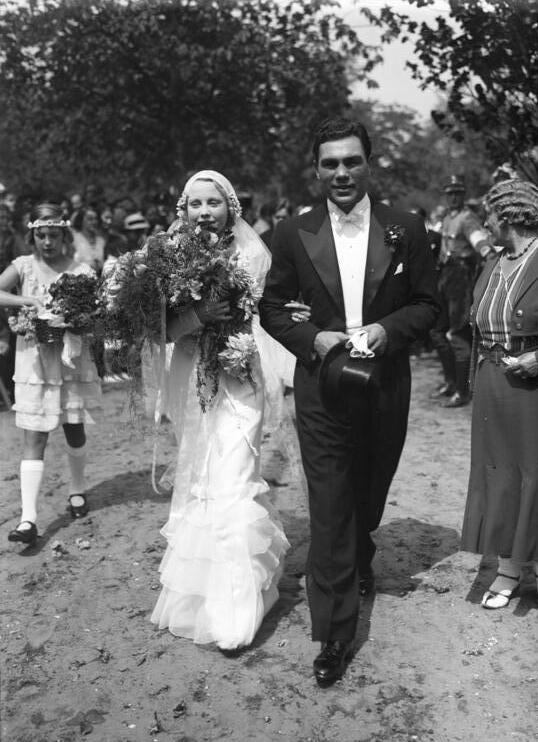
Schmeling's relationship with the Nazi state was uneasy. According to Wikipedia's account and the Jewish weekly J., he never joined the party. He also refused to drop his American manager, Joe Jacobs, who was Jewish, despite demands from the top of the government that he cut those ties. His marriage in 1933 to the Czech-born film actress Anny Ondra made him a celebrity couple in Berlin, and that fame gave him some cover, but it also made him a target for officials who wanted him as a poster figure.
Kristallnacht: Two Boys in the Excelsior Hotel
In November 1938, during the pogrom known as Kristallnacht, a Jewish friend of Schmeling named David Lewin sent his two teenage sons, Werner and Henri, to the boxer's rooms at the Excelsior Hotel in Berlin. Schmeling took them in. According to the International Raoul Wallenberg Foundation, he told the front desk that he was ill and that nobody was to come up. The boys stayed hidden until the violence eased, and Schmeling then got them out of the hotel and back to their family.
The brothers later escaped Germany and reached the United States, where Henri Lewin became a prominent hotelier based in San Francisco. For half a century the story stayed private. It became public in 1989, when Henri Lewin invited Schmeling to Las Vegas to thank him in front of guests. Lewin later described the act bluntly to J.: "In the Third Reich he committed an act of treason, breaking the law of the Third Reich to clean itself of every Jew." The Wallenberg foundation later honoured Schmeling for it.
Paratrooper on Crete
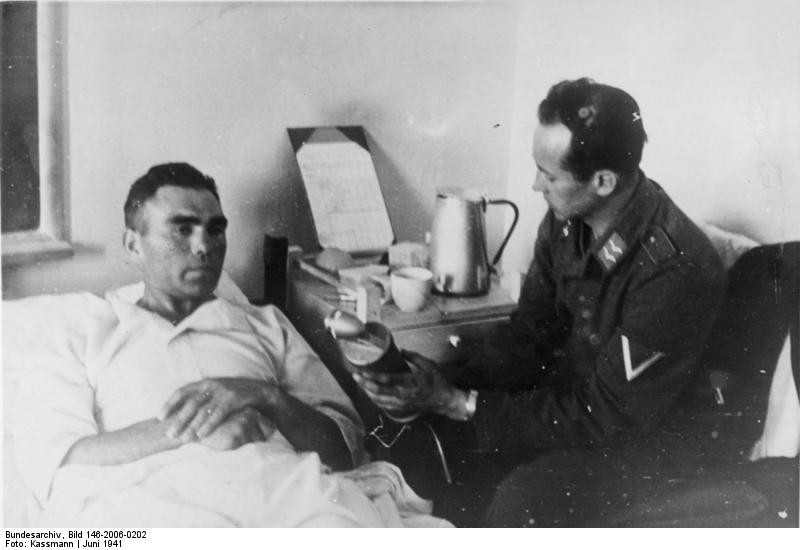
When war came, Schmeling was put into the Luftwaffe's paratroop arm, the Fallschirmjäger. The sources differ slightly on the start: Wikipedia gives his service as 1939 to 1941, while the Associated Press says he was drafted in 1940. Both agree on how it ended. He jumped into the Battle of Crete in May 1941 and, according to Wikipedia, was hit in the right knee by mortar shrapnel on the first day. He was later judged medically unfit and released from active service. A German federal archive photograph from June 1941 shows him recovering in a military hospital.
A Short Comeback and a Long Business Career
Postwar Germany offered little, and Schmeling went back into the ring. In 1947 he fought again, starting in Hamburg, and won three of five bouts before retiring for good in October 1948. The Associated Press gives his final professional record as 56 wins, 10 losses and 4 draws, with 39 knockouts.
His real second career was in business. He used his ring earnings to buy a Coca-Cola licence for Germany, and by the late 1950s, as the company returned to the West German market, he had become one of its public faces. Wikipedia notes that he owned a bottling plant, held an executive role, and helped introduce vending machines to the country. Schmeling grew wealthy in a way few fighters of his generation ever did.
Friendship With Joe Louis
The man who had beaten him so quickly in 1938 had a much harder life after boxing. Schmeling met Louis again in Chicago in 1954, according to J., and the two built an unlikely friendship. Schmeling quietly sent money to Louis, who was often short of it in his later years. When Louis died in 1981, Schmeling paid for the funeral, a fact reported by the Associated Press, J. and the Wallenberg foundation.
The Last Years
Anny Ondra died in 1987 after 54 years of marriage. Schmeling outlived her by nearly two decades. He died on 2 February 2005, aged 99, making him the longest-lived heavyweight champion in history. The Associated Press, citing his foundation in Hamburg, reported that he died at his home in Hollenstedt; Wikipedia gives the place as Wenzendorf in Lower Saxony. Either way, he died far from Klein Luckow, at the end of a life that had moved through almost every turn of Germany's twentieth century.
Sources
- Max Schmeling, Wikipedia, accessed October 2026
- Boxing Legend Max Schmeling Dies at 99, Associated Press via Fox News, February 2005
- Max Schmeling, who fought Louis and saved Jews, dies at 99, J. The Jewish News of Northern California, 11 February 2005
- Max Schmeling article by Baruch Tenembaum, International Raoul Wallenberg Foundation, undated


