
How Dick Tiger Went From Amaigbo and Liverpool to Two World Titles and Biafra
Richard Ihetu lost his first four fights in Liverpool, then won world titles at middleweight and light heavyweight before backing Biafra in Nigeria's civil war. He died of liver cancer in Aba in 1971, aged 42.

Richard Ihetu left a village in eastern Nigeria, lost his first four fights in a cold English port city, and still finished as world champion at both middleweight and light heavyweight. Then a civil war at home asked him for everything he had left, and at 42 he was dead. This is the life of Dick Tiger.
A Trader's Son From Amaigbo
He was born Richard Ihetu on August 14, 1929, in Amaigbo, a community in what is now the Nwangele area of Imo State in southeastern Nigeria. Nigeria was still a British colony, and the boy who would become Dick Tiger grew up Igbo, a fact that would shape the last years of his life far more than any punch.
At 17, in 1946, he went to the commercial town of Aba, where he earned his living in the market and first put on gloves. Accounts credit British military personnel stationed in Nigeria with teaching him the basics. He turned professional in his early twenties, around 1952, and took the Nigerian middleweight championship before deciding that a fighter with real ambitions had to go where the money and the rankings were: Britain.
Liverpool: Paint, Rain and Four Straight Losses
Sources place his arrival in Liverpool in 1955, although some accounts date his use of the city as a fighting base to 1957. Either way, the first impressions were harsh. Local historians record that the Nigerian newcomer found the weather and the food difficult, took a job at the Goodlass Wall paint factory, and in 1957 was living on Beaconsfield Street in the Liverpool 8 district, home to much of the city's African community.
The ring was no kinder at first. Under the management of Peter Banasko, a former boxer with connections to Nigerian boxing, Tiger lost his first four fights in England. The streak ended with a knockout of Dennis Rowley that reportedly took just 74 seconds. A bigger signal came in 1957 against the London prospect Terry Downes at Shoreditch Town Hall. The record books list that win as a sixth-round stoppage, while one Liverpool history describes it as a points victory; both agree it changed how British matchmakers viewed him.
After moving to the Liverpool promoter Tony Vairo, Tiger beat Pat McAteer in 1958 for the British Empire, or Commonwealth, middleweight title. He did not keep it long. In 1959, fighting in Edmonton, Canada, he lost the belt to local man Wilf Greaves on a 15-round decision that his biographers have called highly questionable.
A New Base in America
The same year, with the independent manager Jersey Jones guiding him, Tiger moved his career to the United States. There he built a reputation as a durable, heavy-handed pressure fighter who rarely took a backward step. He became a regular at Madison Square Garden in New York, sometimes described as one of the arena's house fighters, and worked his way into contention against the best middleweights of the era.
Three Nights With Gene Fullmer
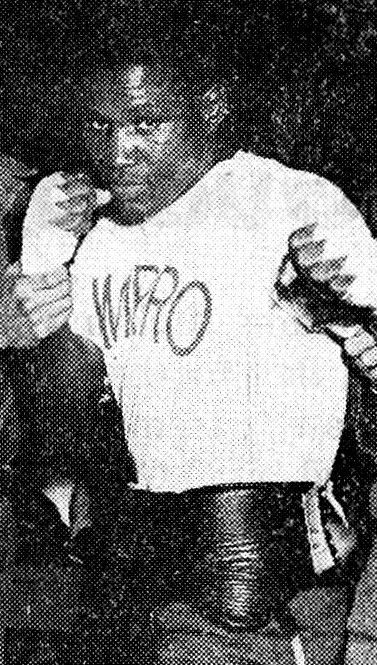
His breakthrough came against Gene Fullmer, the rugged Utah brawler who held the World Boxing Association middleweight title. On October 23, 1962, at Candlestick Park in San Francisco, Tiger won a unanimous 15-round decision and became the WBA middleweight champion. The Ring magazine named him its Fighter of the Year for 1962, and the Boxing Writers Association of America gave him the same honor.
A rematch on February 23, 1963, at the Las Vegas Convention Center ended in a split draw, leaving the question unsettled. The answer came on August 10, 1963, in a place that had never seen anything like it: Liberty Stadium in Ibadan, Nigeria. In front of his own country, Tiger forced Fullmer to retire after the seventh round. A world middleweight title fight on Nigerian soil was a landmark, and the champion's homecoming made him a national hero.
Giardello, Griffith and the Middleweight Crown
Tiger's next great rival was Joey Giardello of Philadelphia. The two men met four times, every bout going the full distance, and each won one 10-round non-title fight and one 15-round championship fight. The first title meeting, on December 7, 1963, at Convention Hall in Atlantic City, went to Giardello on a controversial 15-round decision and cost Tiger his belt.
He waited nearly two years for the chance to win it back. On October 21, 1965, at Madison Square Garden, Tiger won a unanimous 15-round decision over Giardello to become middleweight champion for a second time, evening their series at two wins apiece. The Ring again named him Fighter of the Year for 1965. Years later Giardello publicly thanked Tiger for having granted him that first title shot.
The second reign was brief. On April 25, 1966, at Madison Square Garden, Emile Griffith, the former welterweight champion moving up in weight, won a unanimous 15-round decision and took the WBA, WBC and Ring middleweight titles from him.
A Second Title at Light Heavyweight
Rather than chase Griffith, Tiger went up to 175 pounds. On December 16, 1966, back at Madison Square Garden, he took a unanimous decision from Puerto Rico's José Torres and became the undisputed light heavyweight champion, recognized by the WBA, the WBC and The Ring. The BWAA chose him as its Fighter of the Year for 1966. He beat Torres again in a rematch and also defended successfully against Roger Rouse.
He was in his late thirties by then, and the end came against a younger, taller and harder-hitting man. On May 24, 1968, at Madison Square Garden, Bob Foster knocked him out at 2:05 of the fourth round, taking the light heavyweight championship.
The Champion and Biafra
By the time Tiger lost to Foster, his country was at war. In May 1967 the eastern region of Nigeria, largely Igbo, declared itself the Republic of Biafra, and fighting with the federal government followed. Tiger, an Igbo from that region, gave the secession his public voice and his money, and sources agree the cause cost him dearly.
According to his Wikipedia biography, he formally joined the Biafran Army in December 1967 and was commissioned as a second lieutenant in its morale corps. Other accounts describe him as a public relations officer, and a Nigerian newspaper report says he served as a lieutenant who trained soldiers in hand-to-hand combat. On May 15, 1968, he sent back the British honor he had received in 1963 in protest at Britain's arms supplies to the Nigerian government. Most sources identify that honor as the MBE; at least one older reference calls it a CBE.
His boxing career limped on. His final bout was a rematch with Griffith at Madison Square Garden on July 15, 1970, a non-title fight over 10 rounds that Griffith won by unanimous decision. The war ended in January 1970, with Biafra defeated.
A Museum Guard and a Last Journey Home
Retired and with his fortune diminished, Tiger took work in New York as a security guard. Most sources say it was at the Metropolitan Museum of Art; one Liverpool history names a natural history museum instead. He announced his retirement from boxing in July 1971.
Around that time he began suffering severe back pain, and doctors diagnosed liver cancer. He returned to Nigeria, and on December 14, 1971, he died in Aba, the town where he had first learned to fight. He was 42. He was buried in Amaigbo, where he now lies beside his wife. A 2019 report in the Nigerian newspaper Daily Trust found the mausoleum neglected and overgrown with weeds.
A Legacy Measured in Firsts
Tiger was the first African to become undisputed champion at both middleweight and light heavyweight, and in 1991 he became the first African inducted into the International Boxing Hall of Fame. His final record varies by source: Wikipedia lists 82 fights with 60 wins, 19 losses and 3 draws, while other references give 81 bouts and slightly different win and loss totals. Whatever the exact numbers, he fought the elite middleweights of his era, and gave up much of what the ring had paid him for a country that existed for less than three years.
Sources
- Dick Tiger, Wikipedia, accessed October 2026
- Tiger, Dick, Liverpool Footprint (Liverpool local history), accessed October 2026
- Dick Tiger: Not a befitting tomb for a champion, Daily Trust, November 22, 2019
- Dick Tiger, Academic Kids Encyclopedia, accessed October 2026
- October 21 in Philadelphia boxing history, Philly Boxing History, accessed October 2026
- Emile Griffith, Wikipedia, accessed October 2026
- Bob Foster (boxer), Wikipedia, accessed October 2026
- Joey Giardello, Wikipedia, accessed October 2026


