
How Carl Froch the Nottingham Cobra Went From the Taylor Comeback to 80,000 at Wembley
From Colwick amateur to four-time super-middleweight world champion, Carl Froch survived Jermain Taylor, lost the Super Six final to Andre Ward, upset Lucian Bute and finished his career by knocking out George Groves before 80,000 at Wembley.

Carl Froch came out of Colwick in Nottingham and built a reputation for refusing to back away from anyone. 'The Cobra' won super-middleweight world titles four times, lost only twice in 35 professional fights, and closed his career with a single right hand in front of 80,000 people at Wembley Stadium.
Colwick, Nottingham and the Amateur Years
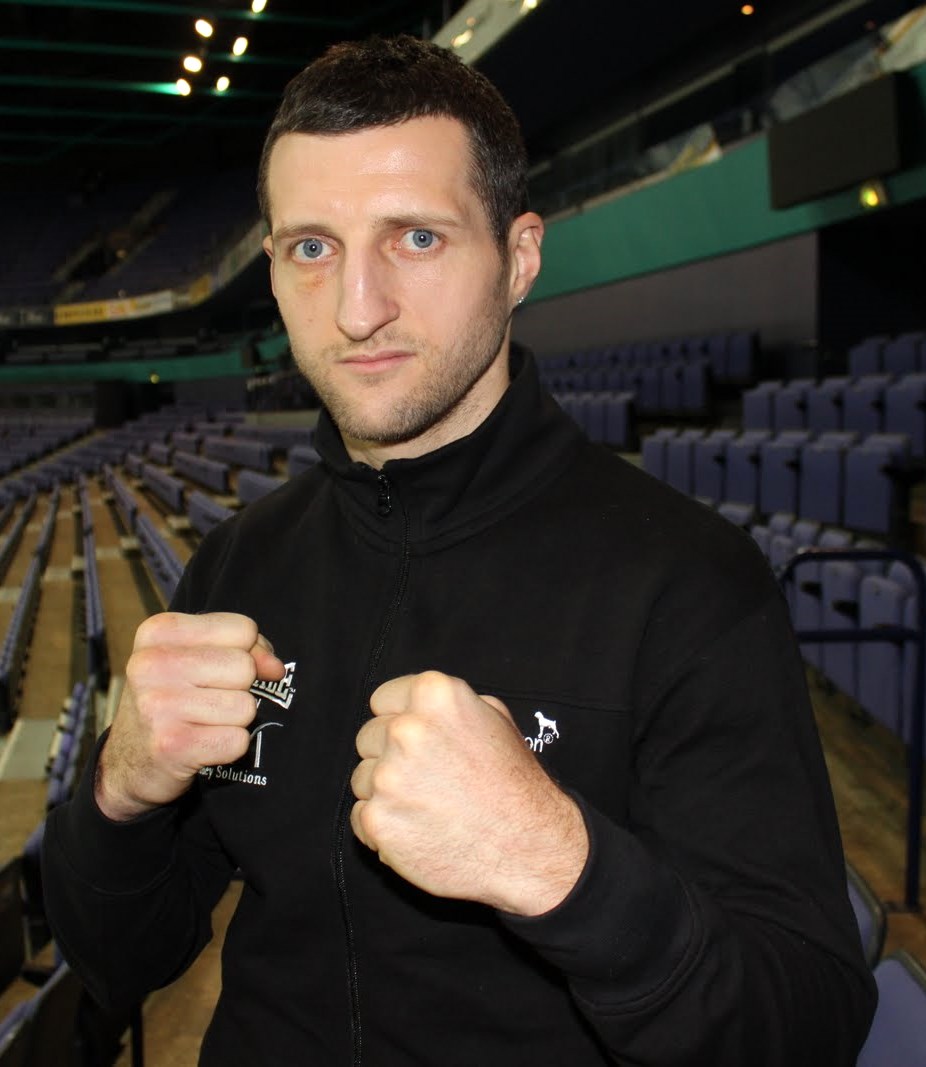
Froch was born on 2 July 1977 in Colwick, on the eastern edge of Nottingham. His paternal grandparents were Polish, and Wikipedia's account of his background notes some German ancestry on his grandfather's side as well; his mother's family was English. Nottingham stayed at the centre of his story. Many of his biggest nights were staged in his home city's arena, and he kept returning there as a champion.
He reached the top of the English amateur game as a middleweight, winning the ABA title in 1999 and again in 2001. That second year also brought his most significant amateur result: a bronze medal at the World Amateur Boxing Championships, held in Belfast in 2001. Among the fighters who beat him in the amateurs was the American Peter Manfredo Jr.
A Slow, Steady Climb Through the Domestic Ranks
Froch turned professional in March 2002 at York Hall in Bethnal Green, stopping the journeyman Michael Pinnock in the fourth round. From the start he worked with Rob McCracken, who remained his trainer for the whole of his professional career.
The domestic belts came in order. He won the English super-middleweight title against Alan Page in November 2003, then took the British and Commonwealth titles in 2004 in fights with Charles Adamu and Damon Hague. By 2006 he had won a Lonsdale Belt outright.
WBC Champion at Home Against Jean Pascal
That shot came on 6 December 2008 at the Trent FM Arena in Nottingham, against the Haitian-born Canadian Jean Pascal, for the vacant WBC super-middleweight title. Froch won a unanimous decision and became a world champion in his own city's arena.
Foxwoods, 2009: Fourteen Seconds From Defeat
His first defence took him across the Atlantic. On 25 April 2009, at the Foxwoods Resort in Mashantucket, Connecticut, Froch met Jermain Taylor, the former undisputed middleweight champion. In the third round Taylor put him down. It was the first knockdown Froch had suffered anywhere, amateur or professional. Looking back years later in Boxing News, he described it as closer to a loss of balance than a heavy blow, since it caught him while he was throwing a punch of his own.
Taylor stayed in front for most of the night. Going into the twelfth and final round, Froch was behind on two of the three judges' scorecards. Boxing News records that he had already hurt Taylor badly in the tenth and kept up the pressure through the eleventh. In the twelfth he trapped Taylor on the ropes and kept punching until the referee waved it off with 14 seconds left on the clock. The official result was a TKO at 2:46 of the final round. Froch kept his WBC belt.
The Super Six: Dirrell, Kessler, Abraham, Johnson
Later in 2009 Froch entered the Super Six World Boxing Classic, a round-robin tournament that brought six leading super-middleweights into one bracket. His group-stage opener on 17 October 2009 in Nottingham was a narrow one: he kept his WBC title against the American Andre Dirrell on a split decision.
The second stage brought his first professional loss. On 24 April 2010 he fought Mikkel Kessler in Herning, Denmark, and the Dane took the WBC belt on a unanimous decision, with scores of 116-112, 115-113 and 117-111. Froch got the title back on 27 November 2010 in Helsinki, Finland, where he dominated Arthur Abraham for a vacant WBC belt. Two judges had it 120-108 and the third 119-109.
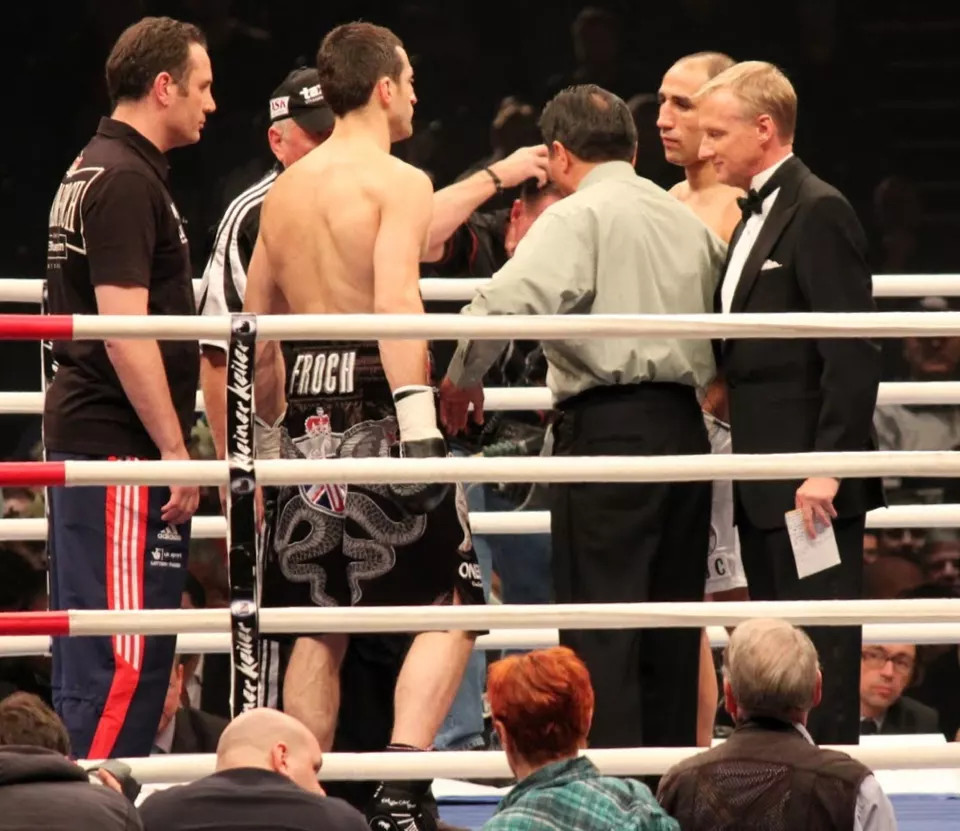
The semi-final took place at Boardwalk Hall in Atlantic City on 4 June 2011. There Froch beat the veteran Jamaican Glen Johnson on a majority decision, scored 117-111, 116-112 and 114-114.
Atlantic City, December 2011: The Final Against Andre Ward
The final against Andre Ward was originally set for 29 October 2011 in Atlantic City. ESPN reported that Ward was cut above his right eyebrow in sparring and needed seven stitches, so the fight was put back. Froch was furious about the delay. ESPN quoted his complaint that the postponement was "absurd and unprofessional."
The fight finally went ahead at Boardwalk Hall on 17 December 2011, with Froch's WBC title, Ward's WBA belt and the vacant Ring Magazine championship on the line. Ward won a unanimous decision, 115-113 on two cards and 118-110 on the third, and with it the tournament. It was only the second defeat of Froch's career, and the last.
Nottingham, 2012: Overpowering Lucian Bute
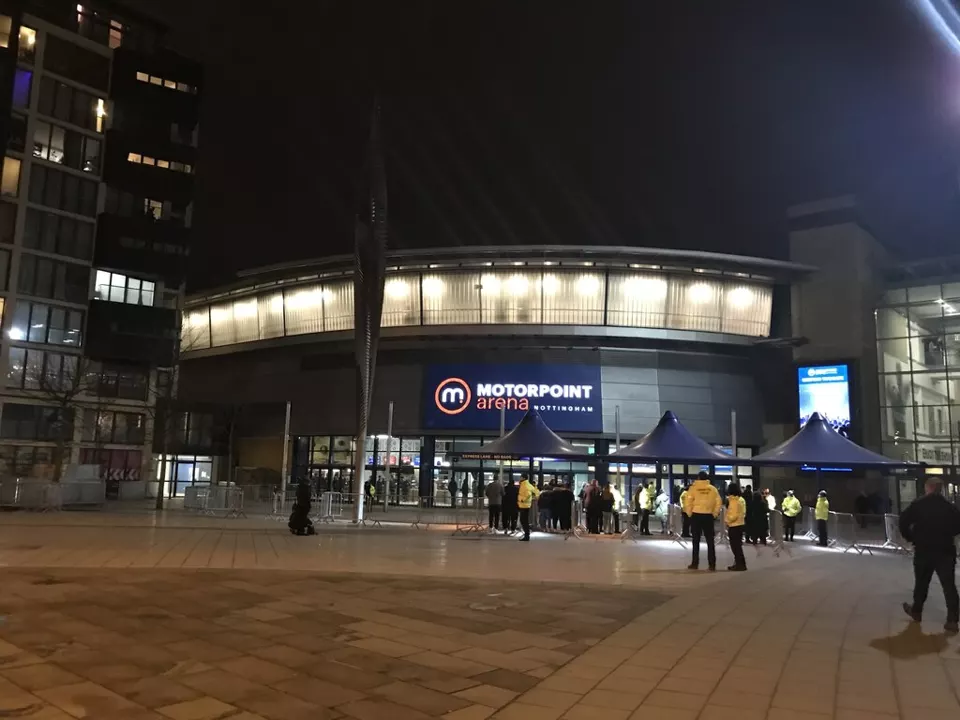
Few people gave Froch much chance in his next big assignment. Lucian Bute, the Romanian-born, Montreal-based IBF champion, arrived in Nottingham unbeaten at 30-0 with 24 knockouts, and Froch was a clear underdog with the bookmakers. They met on 26 May 2012 at the Capital FM Arena, and Froch controlled the fight from the start. In the fifth round a right hand hurt Bute, and Froch followed with more punches until Bute was holding the ropes. Referee Earl Brown started a count, and Bute's corner climbed into the ring to stop it. The win made Froch a three-time world champion, and BoxRec named him its Fighter of the Year for 2012.
He made a quick defence in November 2012, knocking out Yusaf Mack in the third round. On 25 May 2013 at the O2 Arena in London he got his rematch with Kessler and won it on points, adding the Dane's WBA belt to his IBF title.
Manchester, November 2013: The Stoppage That Started a Feud
The fight that came to define the end of his career was against a fellow Briton. On 23 November 2013 in Manchester, Froch defended his IBF and WBA titles against the younger George Groves. In the opening round Groves dropped him with an overhand right. It was only the second knockdown of Froch's career, the first having come against Taylor.
Groves was ahead on all three cards when the fight ended: 78-73, 76-75 and 76-75. Froch had been landing heavily, and in the ninth round referee Howard Foster stepped in and stopped it at 1:33 while Groves was still on his feet. Groves and his team protested that the stoppage was premature. The IBF had already lined Groves up as a mandatory challenger, and the controversy made a rematch close to unavoidable.
Wembley, 31 May 2014: Eighty Thousand and One Right Hand
The rematch went to Wembley Stadium on 31 May 2014. It was the first boxing show at the rebuilt stadium since it opened in 2007. Wikipedia reports that 60,000 tickets went in under an hour, and the final attendance of 80,000 was listed as a post-war record for a British boxing event.
The finish came in the eighth round. Froch, then 36, landed a straight right hand flush on Groves' chin late in the round, and Groves went down and did not beat the count. Froch improved to 33-2 and Groves fell to 19-2. Froch told Al Jazeera that it "must be the best punch I have ever thrown and landed in my life." Wikipedia's account of the bout says The Ring named it Knockout of the Year.
Retirement, Sky Sports and the Hall of Fame
Froch never boxed again. More than a year after Wembley, on 14 July 2015, he announced his retirement at the age of 38. In the same announcement Matchroom said that he was joining Sky Sports as a boxing analyst. In Matchroom's announcement he said his legacy spoke for itself and he had nothing left to prove.
His final record was 33 wins, 24 of them inside the distance, and two losses, both on points to Kessler and Ward, and he later beat Kessler in their rematch. CBS Sports put his record in championship fights at 10-2. The International Boxing Hall of Fame named him in its class of 2023, announced in December 2022, alongside Timothy Bradley Jr. and Rafael Márquez, and he was inducted at the Hall's home in Canastota, New York, in 2023.
Sources
- Carl Froch, Wikipedia, accessed October 2026
- Carl Froch vs. George Groves, Wikipedia, accessed October 2026
- Carl Froch vs. Lucian Bute, Wikipedia, accessed October 2026
- Super Six World Boxing Classic, Wikipedia, accessed October 2026
- In the nick of time: the unmatched drama of winning a fight with just seconds to go, Boxing News, undated
- Super Six final postponed; Andre Ward suffers cut, ESPN, October 2011
- Froch silences Groves with KO, Al Jazeera, 1 June 2014
- Carl Froch Retires From Boxing, Matchroom Boxing, 14 July 2015
- Timothy Bradley Jr., Carl Froch and Rafael Marquez headline 2023 International Boxing Hall of Fame class, CBS Sports, December 2022


